When "Stuffing the Context Window" Fails: "Lost in the Middle" in Long Contexts and the Tiered Memory Lifecycle of Enterprise Agents
Information recall degrades in the middle of long contexts, and dumping full histories into prompts inflates latency and token bills; enterprise agent memory should be distilled across tiers with time-decay weights, expiration cleanup, and human correction.


Why Dumping Full Histories into the Prompt Drops Critical Constraints
Consider a common engineering shortcut. While building a multi-week investment research assistant or a contract review workbench, a team notices that the underlying large language model accepts an expansive context window. Rather than designing retrieval indices or state machines, they concatenate weeks of meeting notes, prior chat transcripts, and entire contract appendices directly into every prompt. Once in use, operational failures surface. When a restrictive clause or a client preference updated the previous week sits buried in the middle of the long prompt, the model frequently overlooks it and reverts to outdated assumptions. Meanwhile, as session transcripts grow, API bills—which scale linearly with token volume—climb steadily with every turn, while the quadratic growth of self-attention computation with sequence length drives up response latency.
This failure mode highlights a core architectural distinction: a wide context window is not a managed memory system. Recall of information in the middle of long contexts degrades, and stuffing full history into prompts inflates both latency and cost; enterprise memory should be distilled across tiers with recency weights, expiration cleanup, and human correction.
From "Lost in the Middle" to Virtual Context Management: The Underlying Mechanisms
Why does expanding the context window fail to solve enterprise knowledge and state retention? Research across natural language processing and systems architecture explains the bottleneck through positional sensitivity, non-parametric retrieval, and hierarchical memory management.
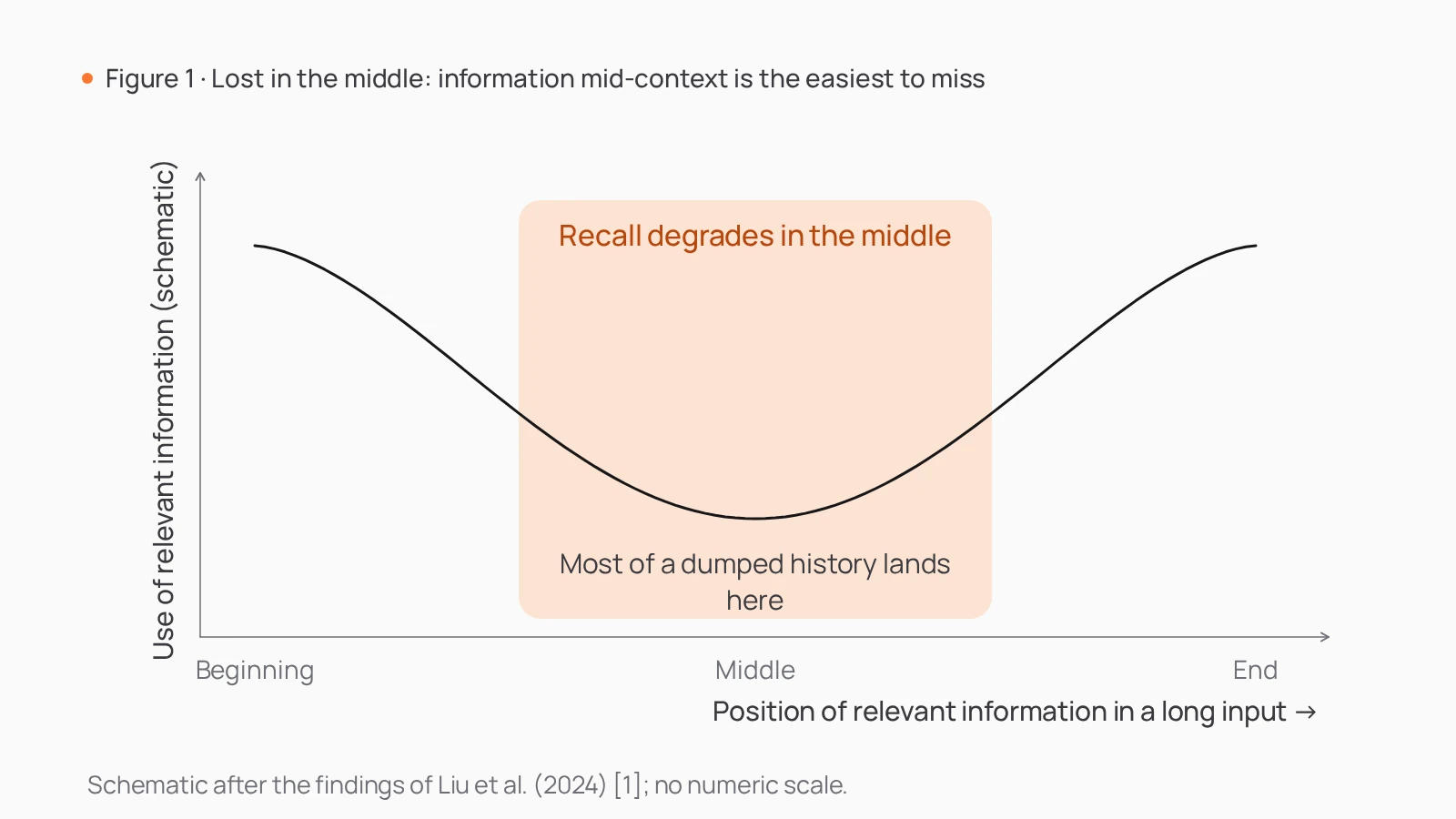
First, language models do not attend evenly across long inputs. Liu et al. (2024) analyzed language model performance on two tasks requiring the identification of relevant information within input contexts: multi-document question answering and key-value retrieval[1]. They found that performance can degrade significantly when changing the position of relevant information, indicating that current language models do not robustly make use of information in long input contexts[1]. In particular, performance is often highest when relevant information occurs at the beginning or end of the input context, and degrades significantly when models must access relevant information in the middle of long contexts—even for explicitly long-context models[1]. Appending raw logs into a single prompt pushes critical intermediate facts straight into this vulnerable middle zone.
Third, across extended interactions and large documents, the context window acts as a scarce fast-memory cache. Packer et al. (2023) observed that limited context windows hinder the utility of large language models in extended conversations and document analysis[3]. Inspired by hierarchical memory systems in traditional operating systems—which provide the appearance of large memory resources through data movement between fast and slow memory—they proposed virtual context management and introduced MemGPT, managing different memory tiers to provide extended context within the model’s limited window and using interrupts to manage control flow between itself and the user[3]. Evaluations in two domains—document analysis (analyzing large documents that far exceed the underlying model’s context window) and multi-session chat (creating conversational agents that remember, reflect, and evolve dynamically through long-term interactions)—show how tiered paging overcomes fixed window limits[3].
Engineering a Governed Memory Lifecycle: Tiered Distillation, Expiration, and Human Gates
Translating these findings into enterprise engineering requires replacing append-only prompt logs with a governed memory lifecycle: separating active session buffers, structured workspace or personal memory, and permissioned document retrieval, while embedding human review and retirement rules into the workflow.
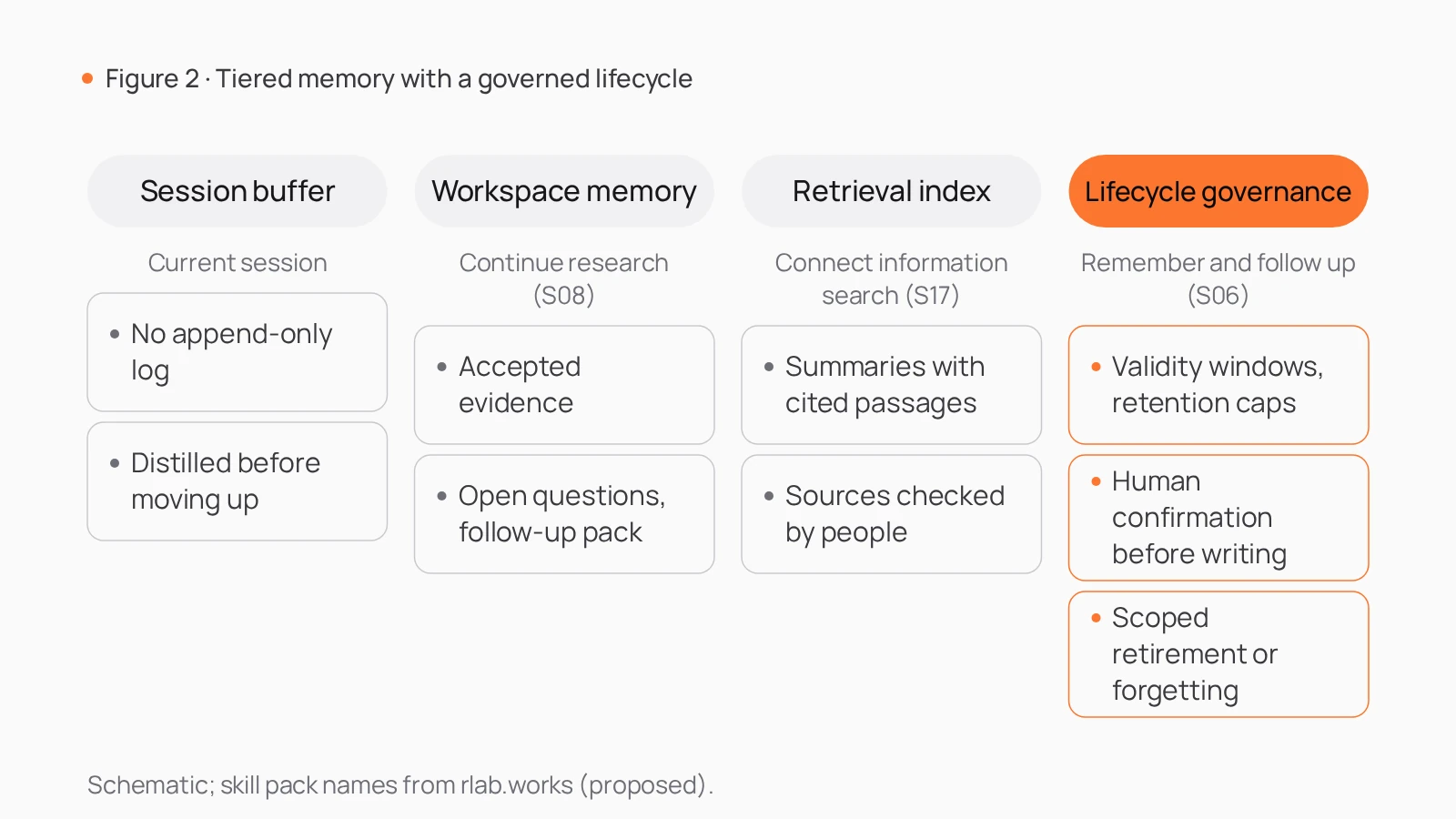
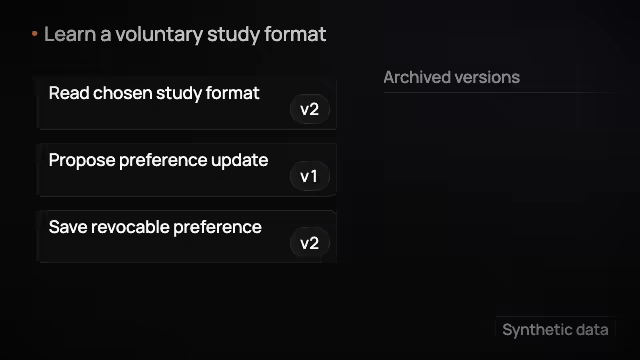
First, for user preferences and ongoing follow-ups, Remember and follow up (S06) turns memory persistence into a consent-driven workflow. Taking User consent, preferences and conversation records as initial input, it collects opt-in preferences, prepares deduplicated and redacted memory candidates, and pauses at a human review gate (Let the user confirm, where rejected output returns for revision and does not advance) to produce accepted memories that the user can edit or delete, before continuing the conversation or following up as requested. Its underlying personal memory retrieval and lifecycle component (working code from static source inspection) extracts memory candidates from conversations and check-ins, deduplicates and ranks them, applies validity windows and retention caps, and supports manual creation, editing, and deletion. In consumer apps, S06 is tagged as a source-supported industry (meaning only that source data has an explicit industry association, not customer deployments or outcomes), with the boundary that crisis prompts are not professional support and help drafts remain the user’s decision to send. In education, it is a transferable use—remembering practice preferences with an adult learner’s consent for future exercises and toggleable reminders—provided teams replace the original companion theme and fixed materials, avoid judging learning ability or psychological state, and never auto-send help drafts. It has no tag for finance or legal services, serving only as a general pattern.
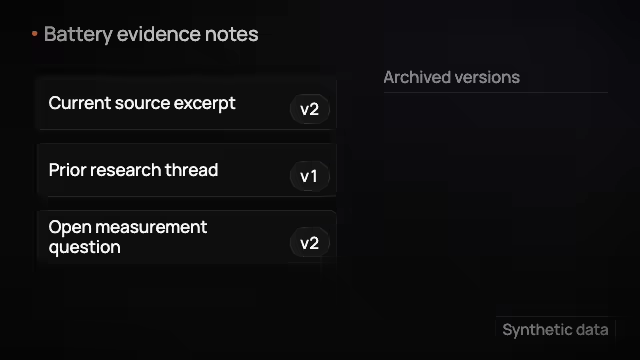
Second, for multi-week analytical workflows, Continue research (S08) avoids re-stuffing raw files into every session. Starting from Research question, existing material and available time, it runs through Load research context → Plan follow-up research → Approve and run (human review) → Review the changes (human review), carrying forward only accepted evidence, open questions, and a continuation bundle. The persistent research workspace and memory component (working code) saves universes, sessions, observations, decisions, and reusable memories, while Versioned agent memory and knowledge lifecycle (working code) ingests, evaluates, versions, retrieves, and retires or forgets scoped agent memories and knowledge, updating indices and audit history. S08 is a transferable use in finance—letting multi-week research resume with prior evidence—though research execution, general search, and enrichment queues still need wiring, and the pack is not labeled a native financial workflow. It carries no tag for consumer, education, or legal sectors.
Third, for external corpora, Connect information search (S17) under AI Gateway takes Question, authorized sources and search scope, collects permitted material, builds relevance-ranked retrieval candidates, prepares a summary draft with passage citations, and pauses at a human review gate (Check the sources) to produce a human-confirmed summary and evidence bundle. In legal services, S17 is a transferable use—connecting an authorized contract library to clause retrieval while preserving source locations for legal staff to check item by item—provided document permissions and clause positions are wired in, and recognizing that summary outputs cannot serve as legal advice on their own. It has no tag for consumer, education, or finance.
Every skill pack above is a proposed composition demonstrated with synthetic data and not yet connected to live services; component maturity comes from static code inspection rather than production deployment.
Pre-Pilot Checks for Engineering and Executive Leaders
Before funding a long-context or multi-session agent pilot, leaders can apply concrete checks to prevent context-stuffing failures:
- Verify tiered storage and validity windows: Reject designs that concatenate raw transcripts into every prompt. Confirm that the architecture separates session buffers, distilled workspace state, and retrieved passages, enforcing retention caps and validity windows.
- Inspect human correction gates on memory writes and citations: Ensure candidate memories require user or reviewer confirmation before entering persistent storage, and retrieved summaries pause for source verification before informing decisions.
- Audit scoped retirement and forgetting mechanisms: Check that when policies change, contracts expire, or consent is withdrawn, the system can retire or forget scoped memories while updating indices and audit logs.
Found it useful? Pass it on.
References
- [1]
Liu, N. F., Lin, K., Hewitt, J., Paranjape, A., Bevilacqua, M., Petroni, F., & Liang, P. (2024). Lost in the Middle: How Language Models Use Long Contexts. Transactions of the Association for Computational Linguistics (TACL), 12, 157–173. doi.org/10.1162/tacl_a_00638
- [2]
Lewis, P., Perez, E., Piktus, A., Petroni, F., Karpukhin, V., Goyal, N., Küttler, H., Lewis, M., Yih, W.-t., Rocktäschel, T., Riedel, S., & Kiela, D. (2020). Retrieval-Augmented Generation for Knowledge-Intensive NLP Tasks. Advances in Neural Information Processing Systems (NeurIPS), 33, 9459–9474. arxiv.org ↗
- [3]
Packer, C., Wooders, S., Lin, K., Fang, V., Patil, S. G., Stoica, I., & Gonzalez, J. E. (2023). MemGPT: Towards LLMs as Operating Systems. arXiv preprint arXiv:2310.08560. arxiv.org ↗
Related capabilities
Platform modules
Skills packs
S06 · Agent OS
Remember and follow up
Asking the same questions every time feels careless to users; remembering too much feels intrusive.
Keep preferences with consent, review memories and continue conversations at an agreed pace.
- Collect opt-in preferences
- Prepare memory candidates
- Let the user confirmHuman review
- Continue or route for support
- Follow up as requested
5 steps1 human reviews10 components
S08 · Agent OS
Continue research
When research changes hands or pauses for weeks, nobody can find what was checked or why a conclusion was reached.
Save research scope and evidence, investigate in bounded batches and confirm follow-up work.
- Load research context
- Plan follow-up research
- Approve and runHuman review
- Review the changesHuman review
4 steps2 human reviews6 components
S17 · AI Gateway
Connect information search
AI answers sound convincing, but without sources nobody dares to use them.
Connect information sources, retrieve relevant passages and check summary sources and access scope.
- Collect permitted material
- Build retrieval candidates
- Prepare the summary
- Check the sourcesHuman review
4 steps1 human reviews5 components