Industrializing Multimodal Perception: Why Audio, Video, and Visual Understanding Must First Pass Through Timeline Alignment and Layout Normalization
An industrial multimodal pipeline must align timelines and normalize layouts first, retrieve candidates through specialized indexes, and link every conclusion back to its source frame or screenshot region on the review interface.

Why Multimodal Demos Stall at the Operational Review Gate
Imagine a travel consultant feeding hotel rate screenshots from different portals into a vision-language model to compare options. The model outputs a fluent recommendation, yet equates a non-refundable rate that includes breakfast with a refundable room-only rate, leaving no way to jump from the summary table back to the policy line on the source screenshot. Or consider an administrative team passing a long recorded interview directly to a speech API to generate notes: because chunk boundaries drift and distributed audio copies carry ad-insertion offsets, reviewers cannot click a sentence in the draft to hear the exact moment when a name or appointment date was spoken.
In both cases, rework happens because the workflow skipped upstream normalization and source anchoring. An industrial multimodal pipeline should align timelines and normalize layouts first, retrieve candidates through specialized indexes, and ensure on the review interface that every conclusion links back to its source frame or screenshot region.
Zero-Shot Multimodal Representations and High-Dimensional Indexing
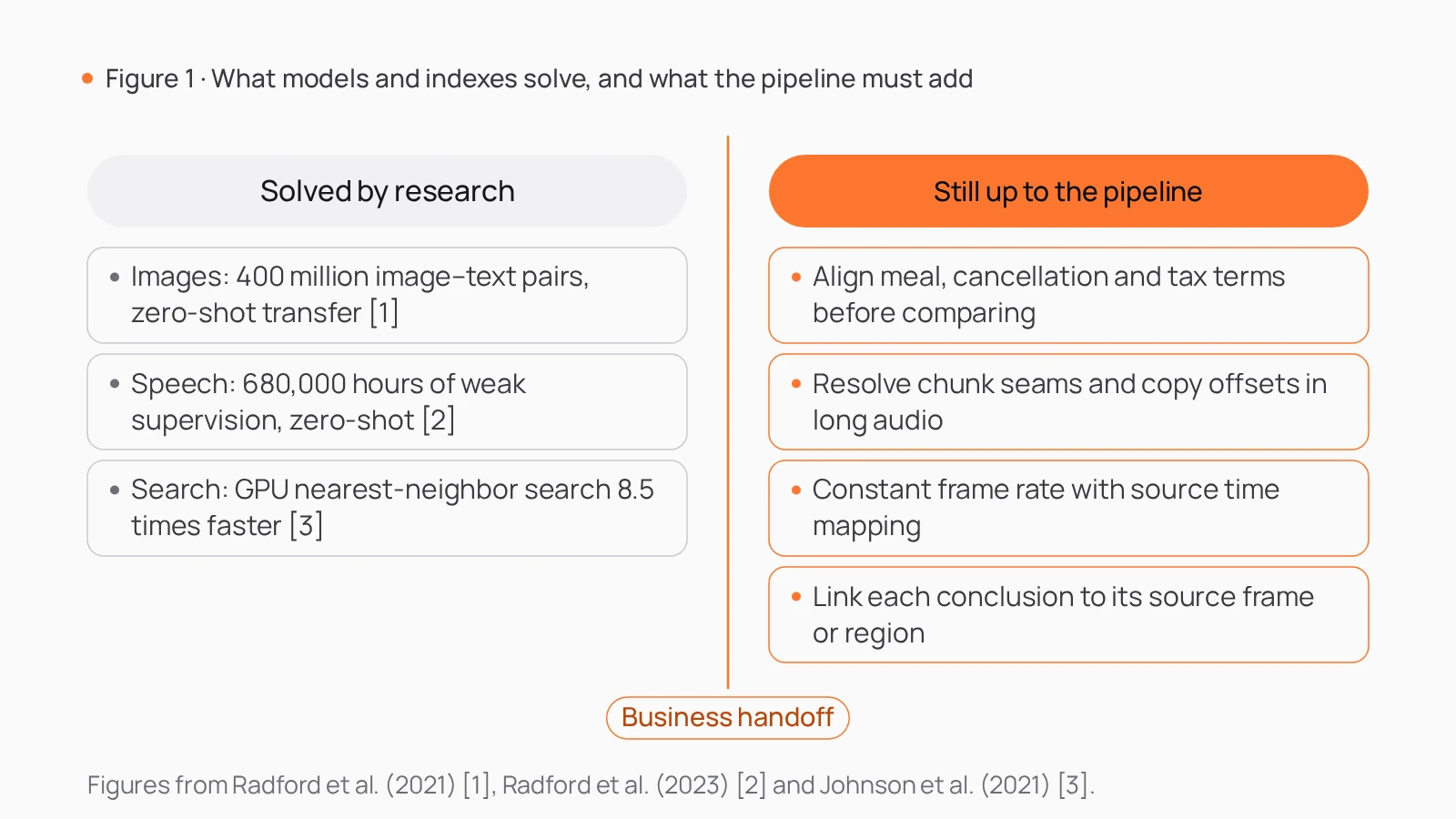
Empirical advances in vision-language pre-training, weakly supervised speech recognition, and GPU similarity search provide the building blocks for enterprise media pipelines, while clarifying what foundation models and indexes do not solve on their own.
In computer vision, Radford et al. (2021) noted that state-of-the-art systems are conventionally trained to predict a fixed set of predetermined object categories, limiting generality and usability because additional labeled data is needed to specify any other visual concept[1]. Learning directly from raw text about images leverages a broader supervision source: predicting which caption goes with which image efficiently and scalably learns representations from scratch on 400 million (image, text) pairs collected from the internet[1]. After pre-training, natural language references learned visual concepts or describes new ones, enabling zero-shot transfer to downstream tasks[1]. Benchmarked across over 30 existing vision datasets—spanning optical character recognition (OCR), video action recognition, geo-localization, and fine-grained object classification—the model transfers non-trivially and is often competitive with fully supervised baselines without dataset-specific training; for instance, it matches the zero-shot accuracy of the original standard supervised baseline on a classic benchmark without using any of the 1.28 million training examples that baseline required[1].
A parallel mechanism applies to speech. Radford et al. (2023) studied speech systems trained simply to predict transcripts of internet audio[2]. Scaled to 680,000 hours of multilingual and multitask weak supervision, the resulting models generalize well to standard benchmarks, competing with prior fully supervised results in a zero-shot setting without fine-tuning and approaching human accuracy and robustness[2].
Once media assets are encoded into high-dimensional features, retrieving candidates across large catalogs becomes an algorithmic bottleneck. Johnson, Douze, and Jégou (2021) noted that databases handling complex media rely on specific indexing structures for similarity search, and while graphics processing units (GPUs) excel at data-parallel distance computations, prior approaches were bottlenecked by algorithms exposing less parallelism—such as top-candidate selection—or making poor use of the memory hierarchy[3]. Introducing a novel candidate-selection design across brute-force, approximate, and product-quantization compressed-domain search, their implementation operates at up to 55 percent of theoretical peak performance, enabling nearest-neighbor search 8.5 times faster than prior GPU state of the art[3]. On 4 GPUs, their method builds a high-accuracy nearest-neighbor graph on 95 million images from a public dataset in 35 minutes, and a graph connecting 1 billion vectors in less than 12 hours[3].
Together, these studies define a clear division of labor. Large-scale weak supervision and GPU similarity indexes solve cross-modal representation and high-throughput recall, but they do not reconcile chunk seams in long recordings, variable frame rates in footage, or inconsistent commercial terms across screenshots. Feeding unaligned media directly into models leaves reviewers unable to verify outputs against source media.
Engineering the Pipeline: Alignment, Normalization, and Traceable Review
Within the Intelligence and AI Gateway modules on rlab.works, multimodal workflows enforce upstream normalization, indexed retrieval, and human gates:
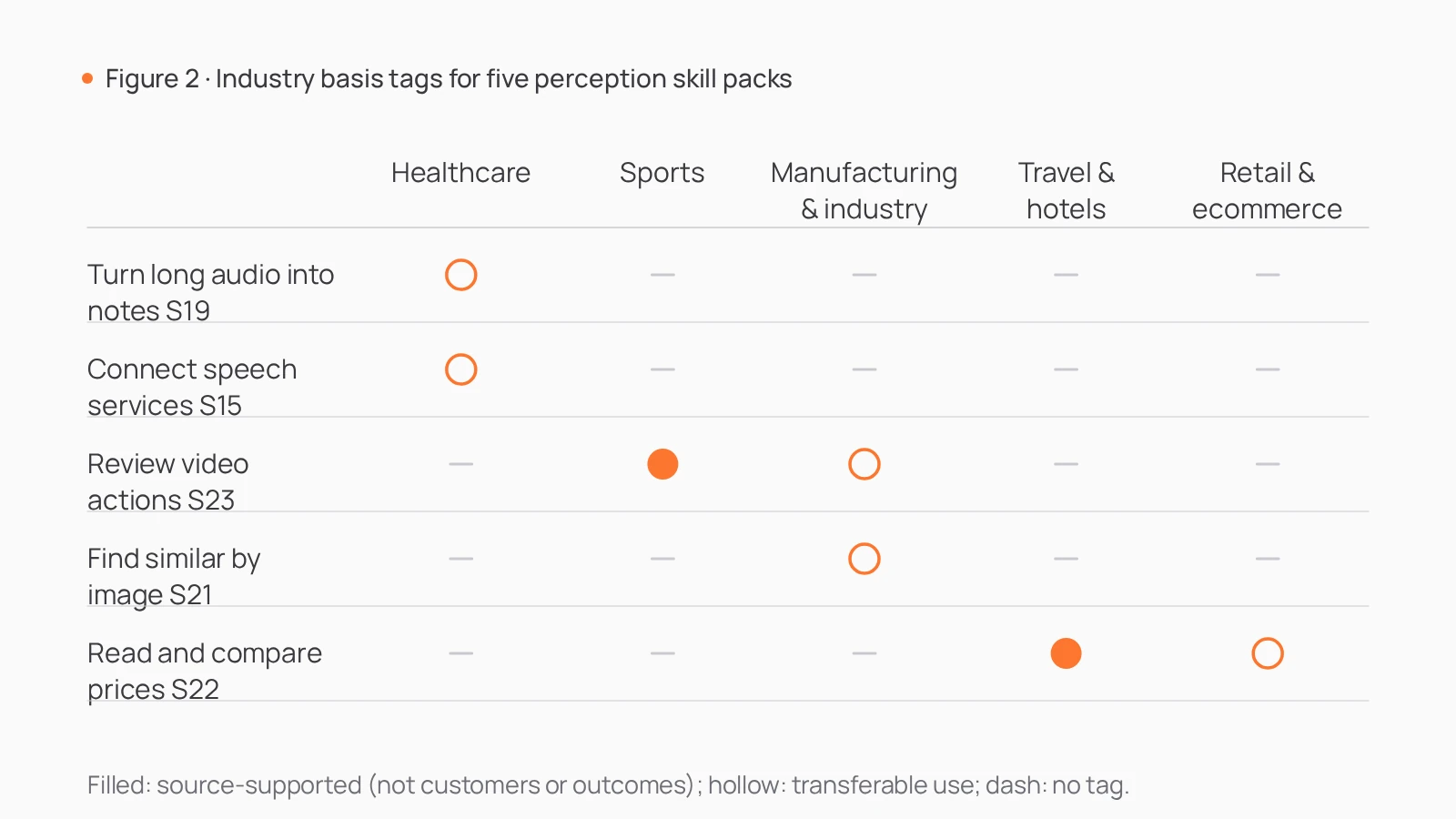
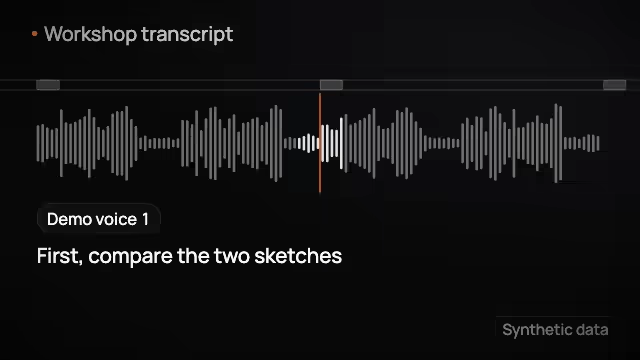
- Audio timeline alignment and verified speech sessions: Turn long audio into notes (S19) takes Authorized recording, media metadata and note requirements, prepares recording sources with retention rules, and uses Long-audio transcription, overlap alignment and speaker stitching to split long audio into bounded tasks, resolve chunk seams, and output position-linked transcripts with copy offsets. Human gates at Check text and attribution and Review and export return rejected outputs for revision so they do not advance, producing confirmed notes with audio locators. Connect speech services (S15) takes consented audio, language, and output mode, transcribes the request, and pauses at a human gate (Check reply content) before generating a spoken reply and checking session handoff. In healthcare, both are tagged for transferable use: S19 turns consented appointment interviews into timestamped notes for staff to check names and dates—strictly as service records, never for diagnosis or chart adjudication, under bounded retention and access—while S15 connects administrative Q&A only, requiring staff to verify important dates before reading them to visitors, with transcription, review UI, and live sessions orchestrated separately. Neither has an industry tag for sports, travel, or manufacturing.
- Frame-accurate video normalization and trajectory replay: Review video actions (S23) takes Authorized footage, venue information and review goal and opens with a human gate (Confirm footage sources). Next, Media inspection and frame-accurate normalization normalizes footage to a constant frame rate and resolution while preserving source timing and identity mappings. After proposing timestamped motion candidates, a human gate (Review against requirements) lets a reviewer correct trajectories, annotations, and events before summarizing confirmed events and building annotated replays and delivery packs. For sports, S23 is a source-supported industry workflow where analysts review ball-track candidates in match footage to generate conditional metrics and replays, bounded to specified courts and calibration conditions. For manufacturing and industry, S23 is tagged for transferable use—flagging suspicious workstation motions for a shift leader to check against standard operating procedures—though workstation calibration, motion candidates, and shift reports must be rebuilt, and existing components do not automatically recognize procedures or adjudicate violations.
- Catalog vector indexing and screenshot term normalization: Find similar by image (S21) places a human gate upfront (Validate source records) before Product catalog and multimodal indexing batch-generates model-tagged image vectors alongside structured catalog attributes. Once tiered candidates are retrieved, a human gate (Check specifications and select) verifies specifications and availability. In manufacturing and industry, S21 is a transferable use pattern: technicians photograph an old part to find visual candidates from a spare-parts catalog and check model numbers, dimensions, and substitution rules, provided material fields and image domains are adapted and visual similarity is never treated as proof of mechanical compatibility or safety. Similarly, Read and compare prices (S22) locates source offers, extracts price and condition candidates with provenance, and aligns room types, meal plans, and cancellation terms before a human gate (Compare and review) inspects differences. S22 is a source-supported industry pattern for travel and hotels—where screenshots do not represent live inventory and quotes must be re-verified at booking—and a transferable use pattern for retail once hotel collectors, field extractors, and ranking rules are replaced.
Architectural candor requires stating current limits. Every skill pack on rlab.works is a proposed composition demonstrated with synthetic data and not yet connected to live services. The components above are working code based on static source inspection rather than production deployment. A source-supported industry tag means only that source data has an explicit industry association; it implies nothing about customer deployments, outcomes, or returns.
Pre-Pilot Checks for Engineering and Operations Leaders
Before funding a multimodal perception pilot, leaders can apply these checks:
- Verify upstream timeline and layout normalization: Does the pipeline resolve audio chunk seams and copy offsets, normalize variable frame rates against source timecodes, and align commercial comparison terms before downstream reasoning?
- Demand deterministic jump-back provenance: Can a reviewer click any extracted quote field, note claim, part candidate, or motion event and jump directly to the source screenshot region, audio timestamp, or normalized video frame?
- Enforce blocking human gates and domain boundaries: Are review steps wired to return unaccepted outputs for revision, and do rules bar administrative audio notes from clinical diagnosis, visual part retrieval from safety certification, and screenshots from acting as live inventory guarantees?
Found it useful? Pass it on.
References
- [1]
Radford, A., Kim, J. W., Hallacy, C., Ramesh, A., Goh, G., Agarwal, S., Sastry, G., Askell, A., Mishkin, P., Clark, J., Krueger, G., & Sutskever, I. (2021). Learning Transferable Visual Models From Natural Language Supervision. Proceedings of the 38th International Conference on Machine Learning (ICML), PMLR 139, 8748–8763. arxiv.org ↗
- [2]
Radford, A., Kim, J. W., Xu, T., Brockman, G., McLeavey, C., & Sutskever, I. (2023). Robust Speech Recognition via Large-Scale Weak Supervision. Proceedings of the 40th International Conference on Machine Learning (ICML), PMLR 202, 28492–28518. arxiv.org ↗
- [3]
Johnson, J., Douze, M., & Jégou, H. (2021). Billion-Scale Similarity Search with GPUs. IEEE Transactions on Big Data, 7(3), 535–547. doi.org/10.1109/TBDATA.2019.2921572
Related capabilities
Platform modules
Skills packs
S19 · Intelligence
Turn long audio into notes
Hours of meetings and interviews, and writing the notes means listening to it all again.
Organize long recordings and timestamps, review transcripts and produce traceable notes.
- Prepare recording sources
- Transcribe and align
- Check text and attributionHuman review
- Draft the notes
- Review and exportHuman review
5 steps2 human reviews6 components
S21 · Intelligence
Find similar by image
A customer sends a photo and asks if you have it; matching it against the catalog by hand is slow and misses things.
Import a catalog, retrieve candidates by image or text and review specifications and availability.
- Validate source recordsHuman review
- Build the image index
- Find similar candidates
- Check specifications and selectHuman review
4 steps2 human reviews3 components
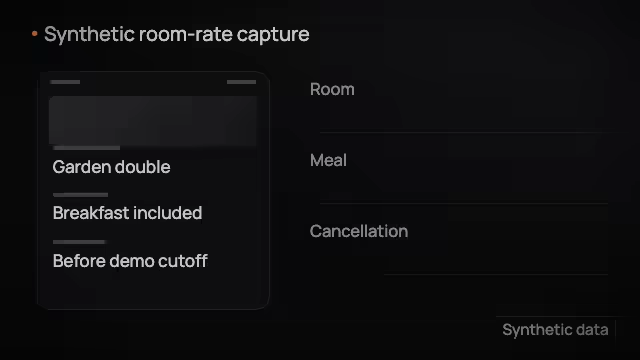
S22 · Intelligence
Read and compare prices
Quote screenshots differ in format, tax and inclusions, so manual comparisons often compare unlike with unlike.
Read prices from screenshots and links, align comparison terms and review differences and tradeoffs.
- Locate source offers
- Read key fields
- Align comparison terms
- Compare and reviewHuman review
4 steps1 human reviews7 components
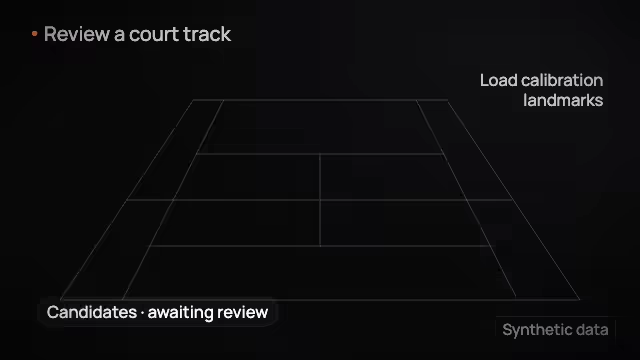
S23 · Intelligence
Review video actions
Finding key moments frame by frame is slow and tiring, and the conclusions are hard to check later.
Preserve footage sources, propose motion candidates and create evidence-linked replays after human correction.
- Confirm footage sourcesHuman review
- Normalize timing and frames
- Propose motion candidates
- Review against requirementsHuman review
- Summarize confirmed events
- Build annotated replays
- Hand over the review pack
7 steps2 human reviews8 components
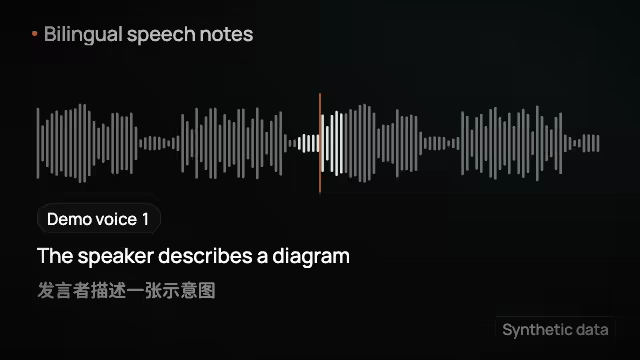
S15 · AI Gateway
Connect speech services
Adding voice to a system means wiring transcription, understanding and speech synthesis separately.
Turn speech into reviewable text, respond with a selected voice and inspect the session.
- Transcribe and interpret
- Check reply contentHuman review
- Generate spoken reply
- Check session handoff
4 steps1 human reviews4 components