When Probabilistic Agents Meet Deterministic Transaction Ledgers: Sandbox Rehearsal and Idempotent Handoffs in Quoting, Booking, Fulfillment, and Refunds
Probabilistic agents should only gather constraints, assemble drafts, and rehearse in sandboxes; inventory locks, payment capture, and refunds belong behind deterministic rule validation and human-signed triggers.


Ledger Imbalance When Probabilistic Reasoning Connects Directly to Funds and Inventory
Consider a plausible deployment scenario: an enterprise connects a language model agent to its procurement quoting, room booking, or customer support desk, expecting it to interpret natural-language requests and directly invoke APIs that lock inventory, capture payments, or issue refunds. In a demonstration, the dialogue feels smooth. Under real commercial traffic, however, structural failure modes surface. Across multi-turn clarifications, a model may misread promotional eligibility or cancellation rules; during timeouts and retries, an unguarded tool call may submit duplicate payment requests; or when a supplier callback is delayed, the assistant may prematurely assure a customer that a reservation is confirmed.
These failures stem from collapsing fundamentally different computational regimes—probabilistic natural-language inference and deterministic ledger mutation—into a single execution layer. Commercial ledgers require every fund transfer, inventory reservation, and entitlement change to be verifiable, traceable, and idempotent. A sound architectural division of labor therefore assigns distinct roles: probabilistic agents gather constraints, assemble drafts, and run sandbox rehearsals, while locking inventory, collecting payments, and issuing refunds are governed by deterministic rule validation and triggered only after a human signature.
Transaction Boundaries, Saga Compensation, and Payment Data Isolation
Why cannot a probabilistic agent act as a direct executor over a transaction ledger? Database transaction theory, distributed long-lived transaction orchestration, and payment security standards each explain a critical boundary.
First is atomicity and durability. Presenting the virtues and limitations of the transaction concept, Gray (1981) defines a transaction as a unit of work with consistency, atomicity, and durability: it either commits all its effects or none, and committed effects survive failures[1]. Systems implement these properties via logging and locking, yet Gray (1981) highlights the concept’s limitations for long-lived and nested transactions[1]. In agent-assisted commerce—spanning inquiry, quote comparison, human approval, and asynchronous supplier callbacks—holding database locks across external resources during multi-turn interaction is impractical.
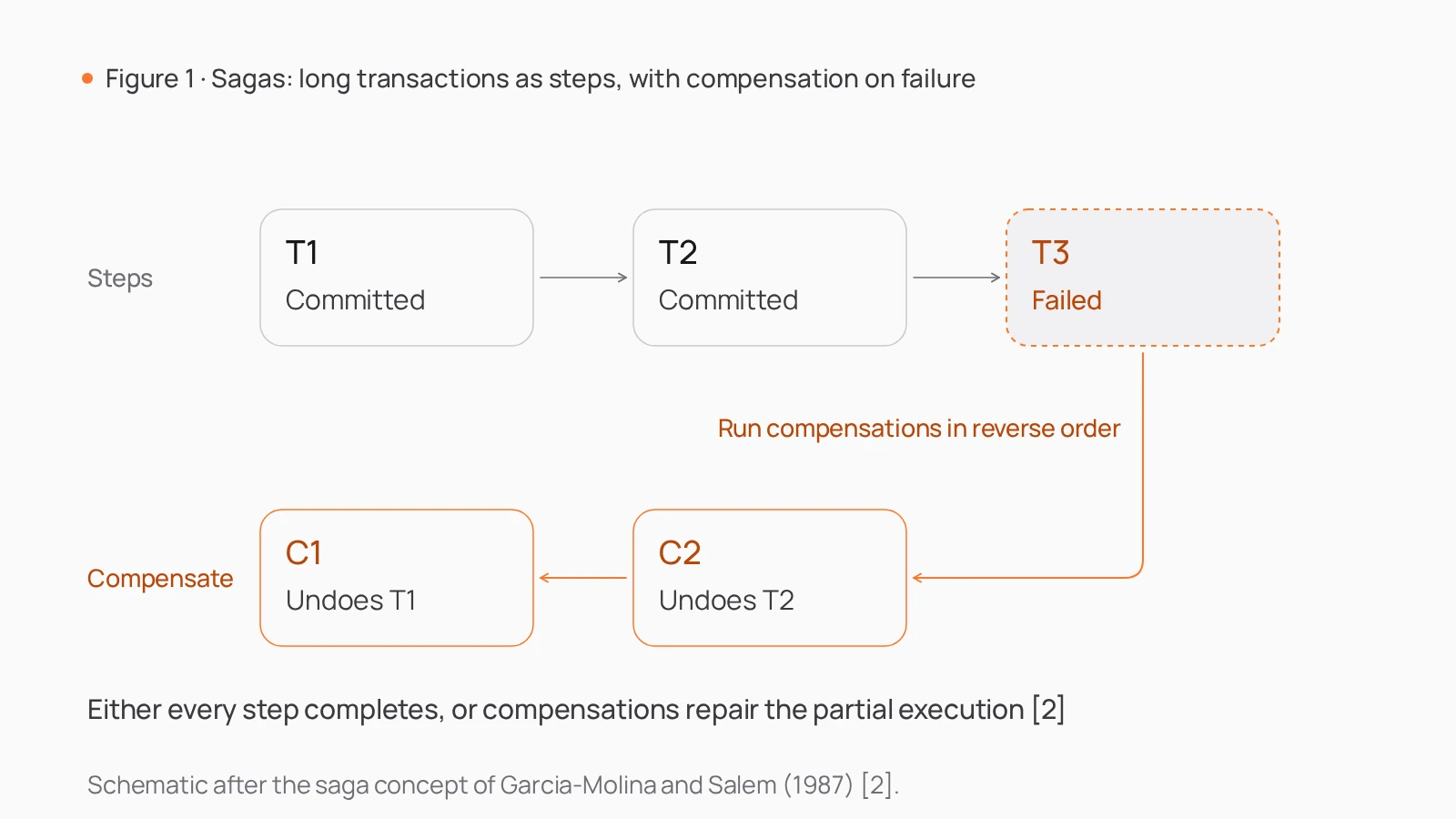
Because long-lived transactions (LLTs) hold database resources for extended periods and significantly delay shorter, more common transactions, Garcia-Molina and Salem (1987) proposed the saga[2]. An LLT is a saga if written as a sequence of transactions interleaved with other transactions; the database management system guarantees that either all transactions in a saga complete successfully or compensating transactions run to amend partial execution[2]. Noting that sagas are relatively simple in concept and implementation and can improve performance significantly, the authors analyze running sagas on existing systems that do not directly support them and discuss database and LLT design techniques for breaking LLTs into sagas[2]. For agent engineering, this means models must never mutate production ledgers incrementally during dialogue. Instead, workflows must separate early discovery into side-effect-free drafts or sandbox rehearsals, while pairing committed external states with reconciliation and compensating actions.
Sandbox Rehearsal and Signed Handoffs: Mapping to the Commerce Module
Translating these principles into software architecture places a sandbox rehearsal layer, field-level redaction, and signed human review gates between the agent and the ledger. Within the Commerce module on rlab.works, this separation is structured across skill packs and atomic components:
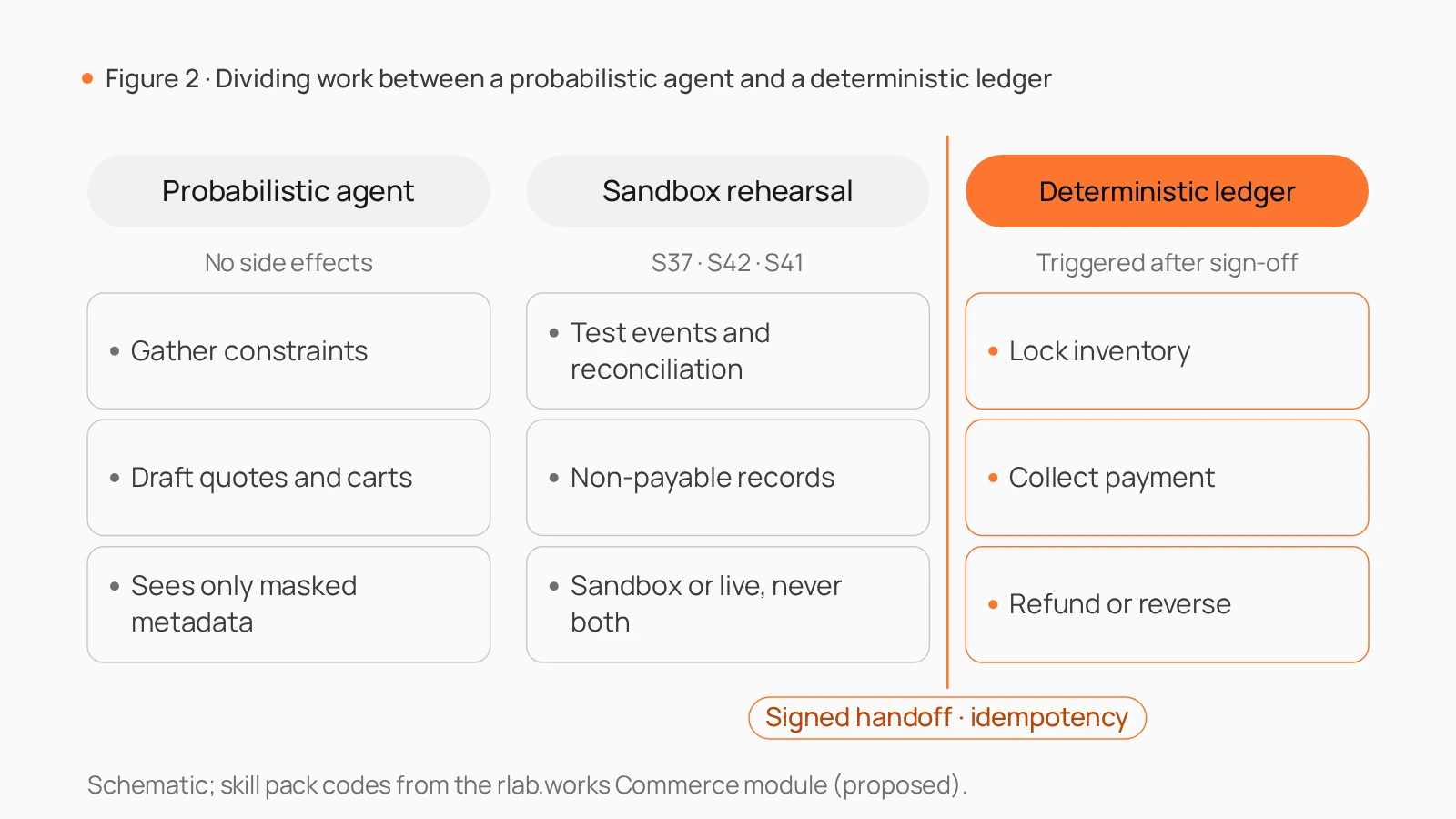
Every skill pack on rlab.works is a proposed composition demonstrated with synthetic data and not yet connected to live services; component maturity ratings derive from static source inspection rather than production deployment.
Pre-Pilot Checks for Engineering and Risk Leaders
Before funding an agent pilot that touches quoting, reservations, or refunds, leaders can apply the following checks:
- Verify isolation between rehearsal drafts and ledger writes: Confirm that conversational exploration operates only on sandbox sessions, expiring intents, or non-payable simulation records, ensuring rehearsal events never leak into production receivables or activate live entitlements.
- Require signed, idempotent human gates before fund or inventory mutation: Check that transitions to checkout, cancellation reversal, and refund execution are gated by human review nodes with blocking authority, expiring context signatures, and idempotency validation.
- Audit payment field redaction and least-privilege access: Ensure that raw card data and credentials never enter model prompts, workflows consume only redacted metadata and status receipts, and every approval, callback check, and compensating action leaves an audit trail.
Found it useful? Pass it on.
References
- [1]
Gray, J. (1981). The Transaction Concept: Virtues and Limitations. Proceedings of the 7th International Conference on Very Large Data Bases (VLDB 1981), 144–154. jimgray.azurewebsites.net ↗
- [2]
Garcia-Molina, H., & Salem, K. (1987). Sagas. Proceedings of the 1987 ACM SIGMOD International Conference on Management of Data, 249–259. doi.org/10.1145/38713.38742
- [3]
PCI Security Standards Council. (2022). Payment Card Industry Data Security Standard (PCI DSS) v4.0. PCI SSC. pcisecuritystandards.org ↗
Related capabilities
Platform modules
Skills packs
S33 · Commerce
Quote and confirm
For each quote, sales checks prices, asks several suppliers and totals it by hand, and the back-and-forth is slow.
Prepare quotes and line items from requirements, then hand them to the customer for confirmation.
- Check eligibility and prices
- Assemble supplier quotes
- Prepare confirmation details
- Hand over for confirmationHuman review
4 steps1 human reviews4 components
S34 · Commerce
Confirm and cancel reservations
Bookings depend on price-lock windows and cancellations on supplier receipts, and local success often does not match the supplier's state.
Check available resources and short-lived quotes, then follow supplier states and cancellation requests after confirmation.
- Intake and check availability
- Create a short-lived confirmation
- Confirm or cancel with a personHuman review
- Reconcile resource-provider state
- Sync and notify
5 steps1 human reviews9 components
S37 · Commerce
Open subscriptions and updates
Paid subscriptions without access, and messages that keep coming after unsubscribing, frustrate users.
Rehearse subscription events, confirm activation and preferences, then send updates within consent scope.
- Rehearse the lifecycle
- Confirm plan and paymentHuman review
- Check entitlements and quotas
- Confirm preferences and notify
4 steps1 human reviews4 components
S41 · Commerce
Reconcile payments and refunds
Many payment channels and currencies mean manual spreadsheet reconciliation, and wrong refunds are hard to recover.
Calculate charges, verify payment events and have reviewers resolve discrepancies and refunds.
- Check amounts and sensitive fields
- Rehearse or verify payment
- Match receivables and receipts
- Approve refunds or correctionsHuman review
- Reconcile execution state
5 steps1 human reviews6 components

S42 · Commerce
Rehearse offer matching
You want to match supply and demand, but going live directly risks unclear qualifications and failed transactions.
Review service listings and subscription criteria, explain matches and rehearse handoff before summarizing feedback.
- Review service listingsHuman review
- Match demand and explain
- Confirm and rehearse handoffHuman review
- Summarize feedback and adjust
4 steps2 human reviews5 components