Treat Agents as Principals: Runtime Scope Credentials and Non-Human Identity Governance
Granting tool-using agents shared API keys and standing privileges recreates non-human identity failure modes at agent scale. Production engineering treats each agent as an attested principal with a named owner, just-in-time scope, and revocable audit linkage working alongside sandboxes and human gates.


Shared API Keys and Standing Privileges: How Tool-Using Agents Amplify Identity Risk
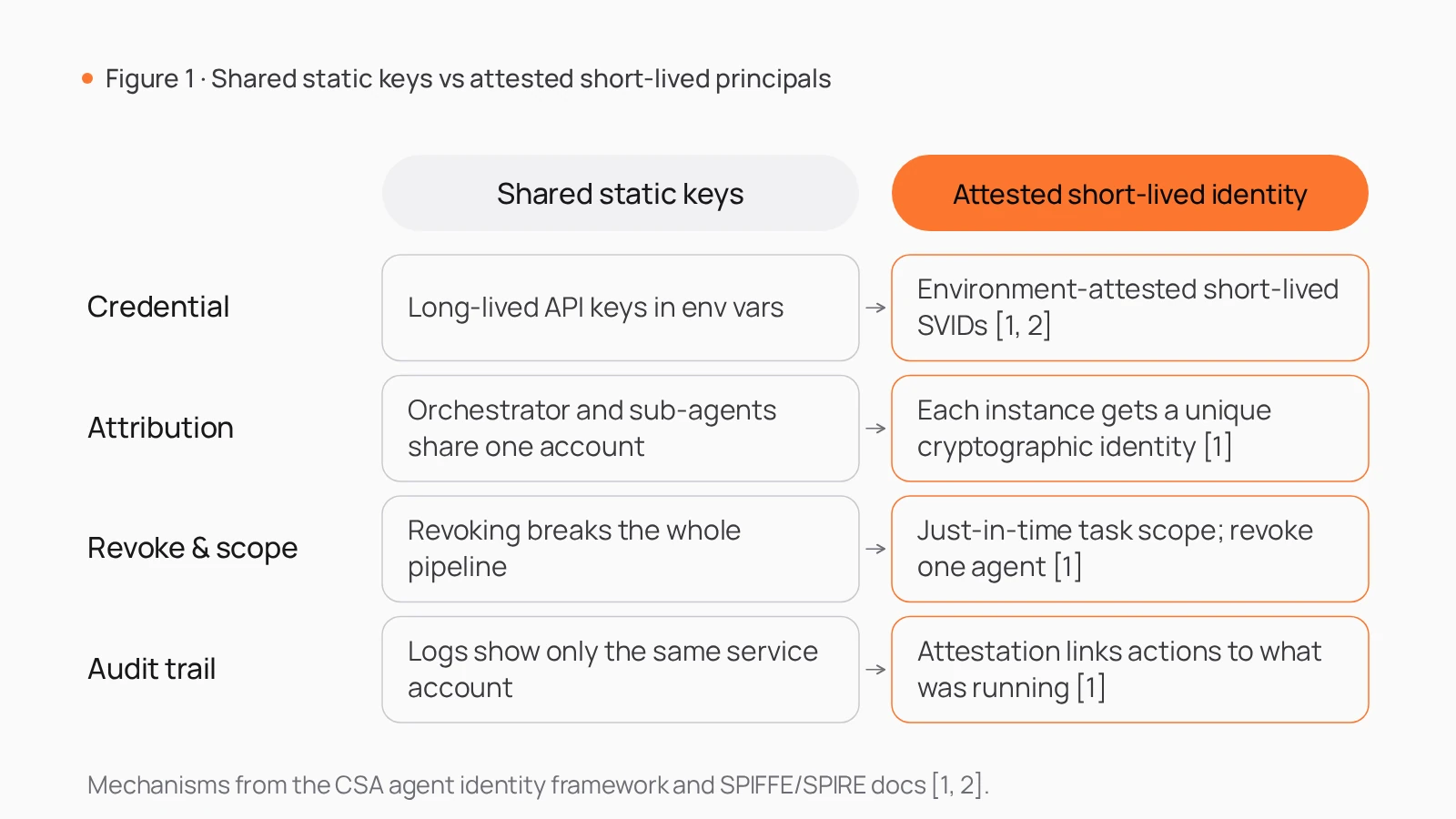
When engineering teams wire tool-using agents into internal databases, document repositories, or SaaS APIs, a familiar shortcut often appears: developers inject a shared static API key or long-lived service account token into the runtime environment so orchestrators, persistent assistants, and spawned sub-agents can call external tools without friction. The operational cost surfaces as soon as an agent performs an unexpected write, queries restricted records, or modifies a configuration. Reviewing the logs, security and audit teams find every action attributed to the same generic service credential. They cannot tell which agent instance initiated the request, what code signature or container image was running at the time, or how to revoke access for the offending workflow without breaking unrelated automations sharing that key.
By mid-October 2026, rapid industry productization around runtime agent authorization and identity-policy layers underscored how pervasive this architectural gap has become. Enterprises that grant tool-using agents shared API keys and standing privileges recreate non-human identity (NHI) failure modes at agent scale [1]. Production readiness requires treating each agent as a distinct security principal: equipped with an attested short-lived identity, a named human owner, least-privilege and just-in-time (JIT) task scope, and revocable audit linkage. Rather than replacing execution sandboxes or human review gates, runtime identity governance works alongside them as a foundational control layer.
From Workload Attestation to Dynamic Task Scope: The Mechanics of Agent Identity
Bringing autonomous or semi-autonomous workflows under disciplined identity governance requires solving two distinct engineering problems: establishing verifiable workload identity without static secrets, and constraining authorization to the active task context.
The Cloud Security Alliance (CSA) 2026 guidance on Non-Human Identity Governance for Agentic AI and the Agent Identity Governance Framework (AIGF) details how cryptographic workload identity standards—specifically the Cloud Native Computing Foundation (CNCF) SPIFFE and SPIRE frameworks—address the static secret problem [1, 2]. Instead of distributing long-lived API keys, SPIFFE and SPIRE issue short-lived, cryptographically signed credentials known as SPIFFE Verifiable Identity Documents (SVIDs) derived from attestation of the execution environment [1, 2]. Under the hood, the SPIRE Agent relies on modular plugins including NodeAttestor, WorkloadAttestor, KeyManager, and SVIDStore to evaluate selectors gathered from workload introspection alongside node attestation [2]. Each agent receives a unique cryptographic identity tied to its deployment context—such as its container, host node, and code signature—which automatically renews before expiration while security policies attach directly to the SPIFFE ID [1]. Crucially, environment attestation creates a verifiable audit trail connecting downstream actions to a cryptographic claim about what was running [1].
Yet workload attestation alone does not complete the authorization model. The CSA (2026) framework highlights three operational realities that separate agentic workloads from traditional microservices [1]:
- Zero standing privilege and just-in-time scope: Agents should not hold broad, continuous credentials. Instead, they should request time-limited, scope-limited access for a task, making attribute-based or policy-based access control (ABAC/PBAC) better suited than static role-based access control (RBAC) for task context [1].
- Delegated tokens for ephemeral sub-agents: While SPIFFE suits orchestrators and persistent agents, very high-velocity ephemeral sub-agents may need delegated tokens derived from an orchestrator SVID to keep audit parentage without per-sub-agent attestation latency [1].
- Closing the agent registry gap: A workload SVID proves process identity, not by itself an approved behavioral envelope or tool authorization [1].
At the organizational governance level, the National Institute of Standards and Technology released its Artificial Intelligence Risk Management Framework (AI RMF 1.0) in January 2023, structuring AI risk management around four functions: Govern, Map, Measure, and Manage [3]. While NIST AI RMF 1.0 does not mandate SPIFFE, teams can map agent-identity controls onto Govern, Map, and Manage outcomes—covering inventory, ownership, least privilege, monitoring, and residual risk acceptance [3].
Engineering Implementation: Wiring Principals, Policy Gateways, and Human Gates
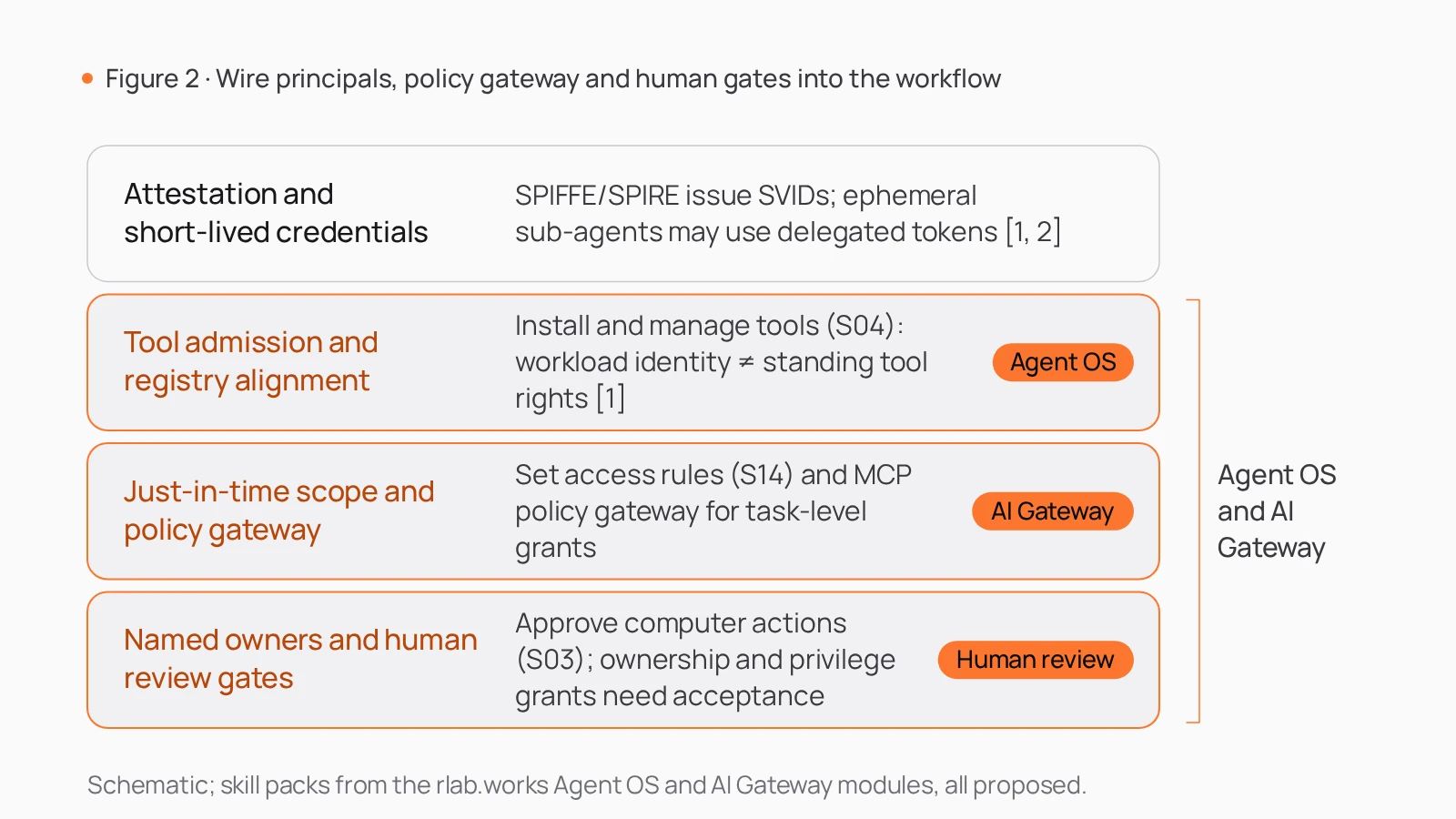
Translating non-human identity governance into software architecture means binding cryptographic identity, tool-level policy enforcement, and human confirmation into the runtime state machine. Within the rlab.works capability architecture, this coordination spans Agent OS and AI Gateway through three skill packs and their underlying components.
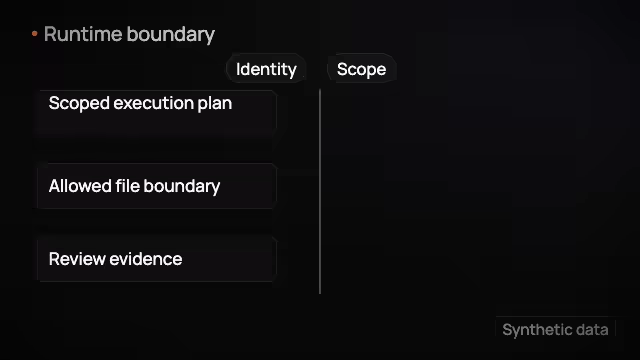
First, high-impact host or workspace operations require explicit identity boundaries paired with human review. In the Agent OS module, the skill pack Approve computer actions (S03) governs workflows where an agent inspects local files, executes shell commands, or interacts with desktop interfaces. Rather than executing under an ambient administrator profile, the runtime relies on Scoped agent identity and Governed agent execution to bind the session to a narrow credential scope and pause execution at mandatory human checkpoints. For legal operations, this pattern represents a transferable adaptation: when a legal support workflow uses an agent to organize discovery folders or cross-check local contract schedules, the agent operates within a time-bounded read scope, and any proposed file modification or external transmission pauses at a human gate. Rejected outputs do not advance.
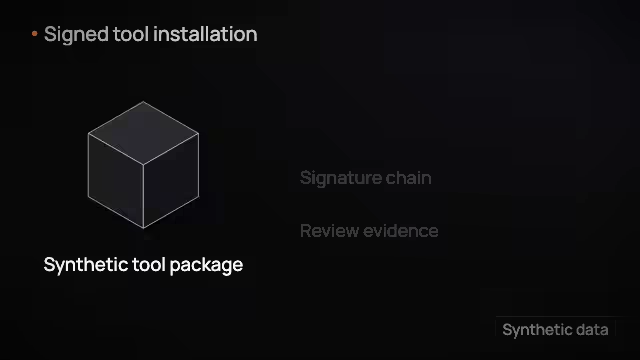
Second, bridging the agent registry gap requires governing how tools and credentials enter the runtime. The skill pack Install and manage tools (S04) structures plugin onboarding, signature verification, and connector credential lifecycles as an enterprise transferable pattern. By decoupling workload identity from standing third-party OAuth tokens, the architecture ensures that an attested process only invokes tools that have been explicitly registered and scoped for the active workflow.
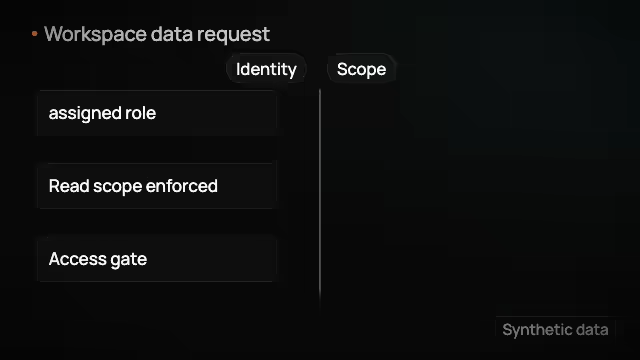
Third, organizations must enforce consistent policy across workspaces and model endpoints. Combining Agent OS with AI Gateway, the skill pack Set access rules (S14) pairs workspace access governance with an MCP policy gateway to evaluate tool and model requests against contextual policies. Although mapped to public-sector workflows in source data, this pattern serves as a transferable adaptation for enterprise and legal environments that require strict tenant and matter isolation. Crucially, ownership assignment and privilege grants require human acceptance at governance gates; rejected outputs do not advance.
Pre-Production Checklist for Agent Identity Governance
Before promoting tool-using agents from internal prototypes to production workflows, architecture and security leads can apply three verification checks:
- Replace static shared keys with attested and delegated credentials: Verify that persistent agents and orchestrators authenticate via short-lived, environment-attested credentials rather than shared API keys, and that high-velocity ephemeral sub-agents use narrow delegated tokens that preserve parent-child audit linkage.
- Separate process identity from just-in-time tool authorization: Confirm that holding a valid workload identity does not grant standing access to every registered connector. Route tool invocations through an MCP policy gateway using dynamic ABAC/PBAC rules that expire immediately when the task concludes.
- Enforce human gates on ownership and privilege grants: Ensure every agent principal in the inventory maps to a named human owner, and verify that privilege grants, tool installations, and sensitive computer actions pause for human acceptance—where rejected outputs cannot advance.
Found it useful? Pass it on.
References
- [1]
Cloud Security Alliance. (2026). Non-Human Identity Governance for Agentic AI / Agent Identity Governance Framework. labs.cloudsecurityalliance.org ↗
- [2]
SPIFFE. SPIFFE and SPIRE documentation: SVIDs, attestation, and short-lived credentials. spiffe.io ↗
- [3]
National Institute of Standards and Technology. (2023). Artificial Intelligence Risk Management Framework (AI RMF 1.0). nist.gov ↗
Related capabilities
Platform modules
Skills packs
S03 · Agent OS
Approve computer actions
Back-office entry, forms and file edits are repetitive computer work you would hand to AI, if you trusted it not to click and change the wrong things.
Check identity and action scope, run approved actions and retain page and file changes.
- Check readiness
- Approve the action listHuman review
- Act and retain evidence
- Check the changesHuman review
4 steps2 human reviews8 components
S04 · Agent OS
Install and manage tools
Adding plugins and account connections to AI is easy, but unknown plugins and broad permissions are a risk.
Check tool provenance and licenses, approve account scopes, install and inspect calls.
- Check packages and licenses
- Approve account scopesHuman review
- Install and register
- Check calls and rollbackHuman review
4 steps2 human reviews7 components
S14 · AI Gateway
Set access rules
Everyone uses AI, nobody controls who can call which model or tool, and incidents cannot be traced.
Define team access, review rule changes and test allowed and denied requests.
- Define access scope
- Validate and review changesHuman review
- Apply access rules
- Review request evidenceHuman review
4 steps2 human reviews6 components