When LLM-as-a-Judge Becomes a Release Gate: Reliability Without Validity and Scaffold Effects
When organizations use LLM-as-a-Judge scores or agent leaderboards as release and promotion gates, measurement error becomes operational risk. Raw exact-match agreement overstates chance-corrected discrimination, high test–retest consistency can mask severe position bias, and agent scores entangle base models with their scaffolds.


When a Single Evaluation Score Becomes an Operational Hazard
Across enterprise software and financial services, engineering teams increasingly wire automated LLM-as-a-Judge pipelines or public agent leaderboard rankings directly into continuous integration and release gates. The rule often looks straightforward: if a candidate model achieves a higher win rate or raw agreement score than the incumbent on an internal test suite, the gateway promotes the new model into production traffic. Yet teams regularly discover that a release cleared by an automated judge still triggers regressions in compliance-sensitive Q&A, brittle tool-calling sequences, or degraded customer workflows after cutover.
The root cause is treating an unvalidated measurement proxy as an operational release authority. When organizations use LLM-as-a-Judge scores or agent leaderboards as promotion gates, psychometric measurement error turns directly into operational risk. Raw exact-match agreement substantially overstates chance-corrected discrimination; high test–retest repeatability can conceal severe position bias; and agent benchmark scores entangle underlying model capabilities with external orchestration scaffolds. Production release gates require multi-protocol validation and human review for high-impact decisions—never a single raw agreement number.
Dissecting the Measurement Illusion: Kappa Deflation, the Consistency–Bias Paradox, and Scaffold Variance
Ever since Zheng et al. (2023) established the foundational pairwise LLM-as-a-Judge paradigm with MT-Bench and Chatbot Arena—while also documenting early concerns such as position bias—automated model grading has become the default scalability mechanism for AI evaluation[3]. However, as organizations promote these evaluators from exploratory research aides to automated production gates, two recent large-scale studies expose how single-metric gates fail.
Norman, Rivera, and Hughes (2026) conducted a systematic evaluation of 21 judge models across nine providers on MT-Bench, JudgeBench, and RewardBench[1]. Running 118 evaluation runs at temperature 0 across three distinct protocols—agreement, consistency, and bias audit—the authors analyzed approximately 541,000 judgments and uncovered four critical failure modes[1]:
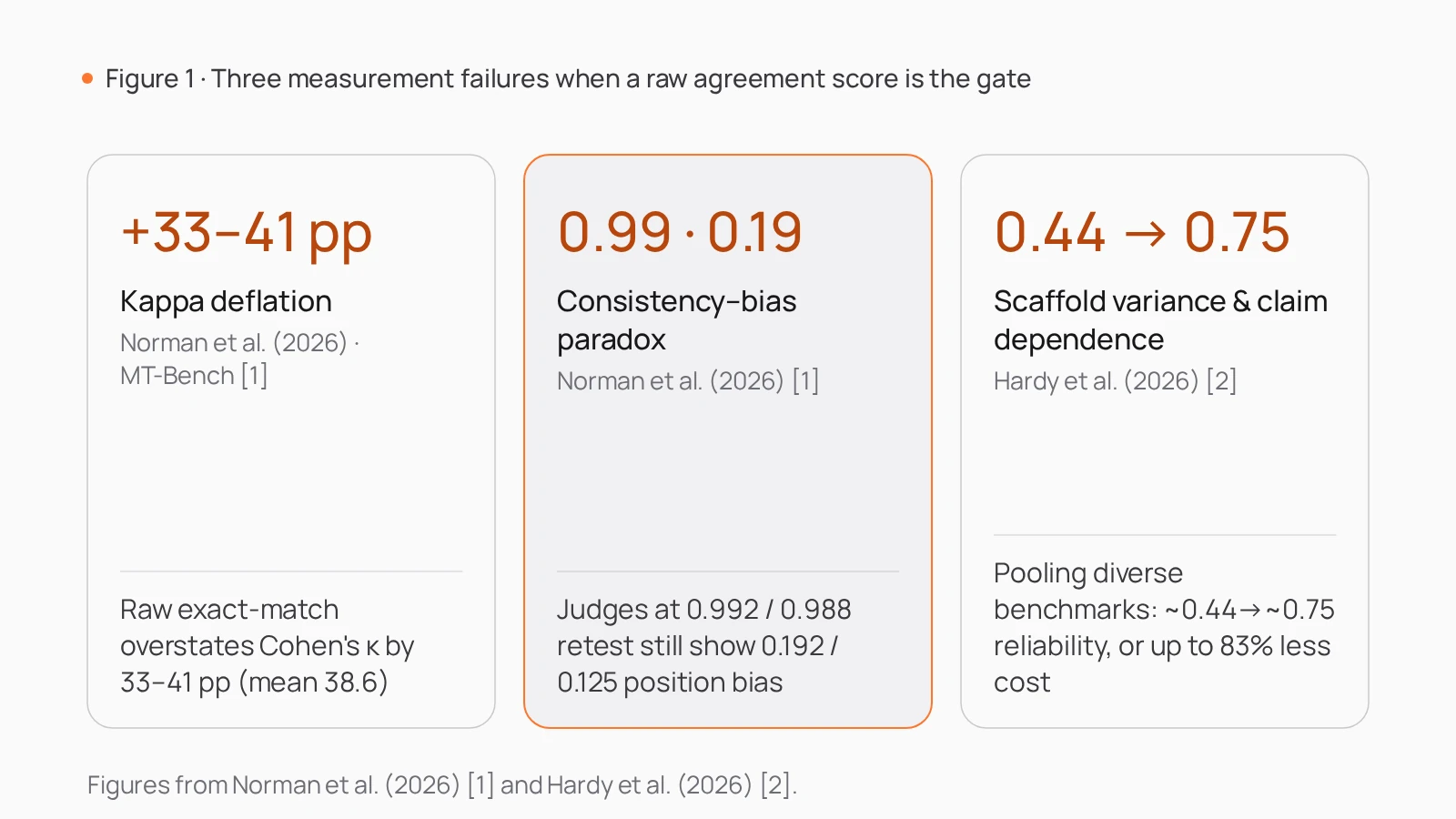
First, kappa deflation shows that raw percentage agreement is a misleading gate metric. On MT-Bench, raw exact-match agreement overstates chance-corrected Cohen’s $\kappa$ by 33 to 41 percentage points (specifically 33.8 to 41.3 percentage points across the cohort, with a mean gap of 38.6 percentage points)[1]. A gate calibrated on raw agreement systematically exaggerates how well a judge distinguishes quality beyond chance.
Second, judge rankings shift dramatically across evaluation regimes. Across benchmarks, judge rankings shift by up to 14 positions[1]. Furthermore, discriminative spread depends heavily on the task domain: the Cohen’s $\kappa$ spread across judges on correctness-focused JudgeBench reaches 60.4 percentage points, compared with just 13.5 percentage points on preference-focused MT-Bench—roughly a 4.5-fold difference[1]. An evaluator that looks interchangeable on open-ended conversational preference may fail sharply on factual or logical correctness.
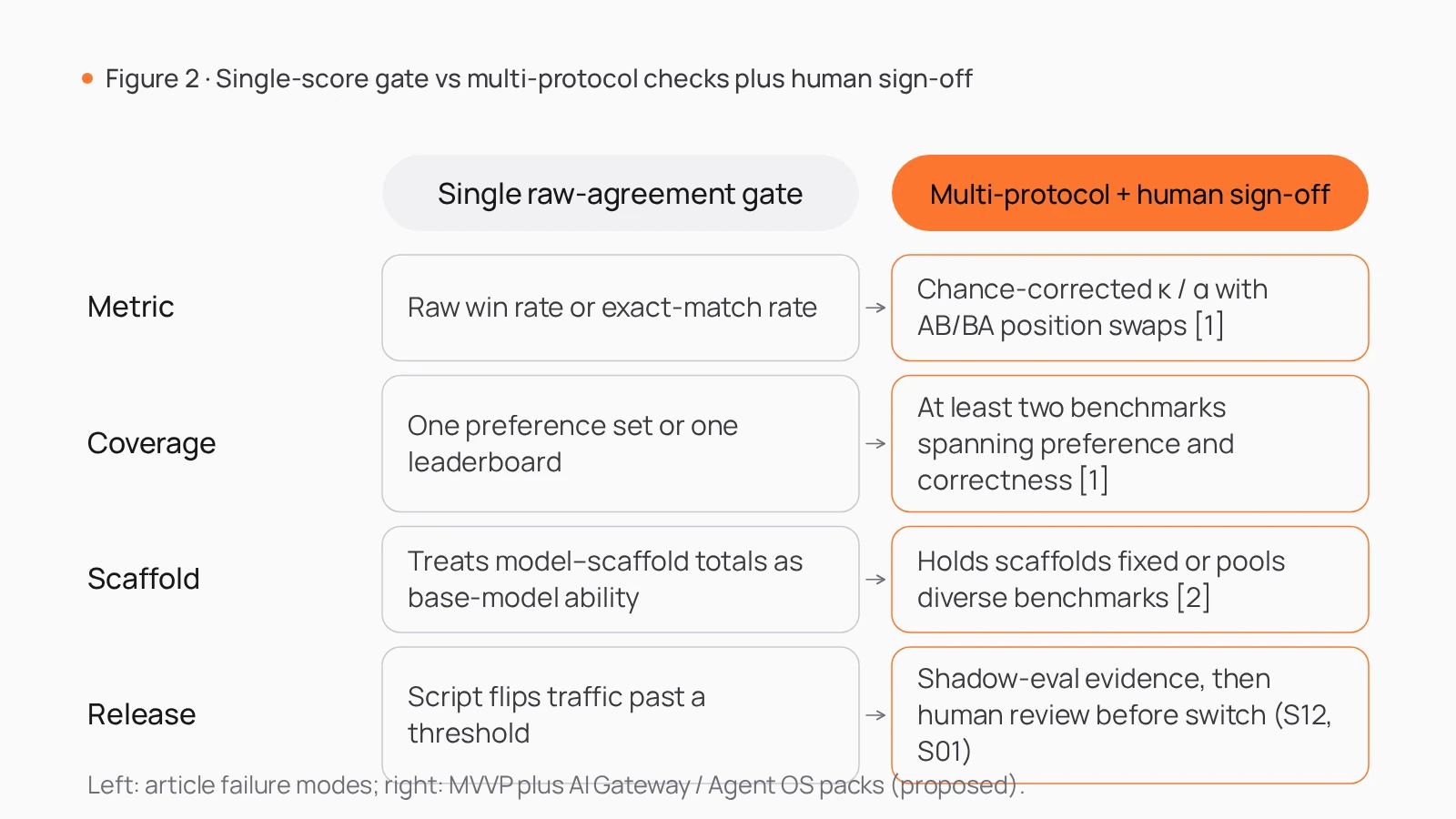
Third, the authors identify a consistency–bias paradox: high repeatability does not imply validity. Several production-deployed judges in the study achieved test–retest reliability above 0.95 at temperature 0 while simultaneously exhibiting severe position bias above 0.10—including two production-deployed judges in the study with test–retest reliability of 0.992 and 0.988 paired with position bias of 0.192 and 0.125, respectively[1]. These judges are not objective; they are deterministically biased toward a specific presentation slot. By contrast, verbosity bias remained below 0.011 across the entire cohort under their single pairwise rubric, demonstrating that under controlled rubrics, position bias is the far more deceptive threat[1]. To counter these vulnerabilities, Norman et al. (2026) propose a five-part Minimum Viable Validation Protocol (MVVP): (1) apply chance correction via $\kappa$ or $\alpha$, (2) enforce bidirectional position swapping (AB and BA), (3) run at least 3 test–retest trials at temperature 0 without caching, (4) evaluate across at least 2 benchmarks spanning preference and correctness, and (5) whenever test–retest exceeds 0.95, explicitly verify that position bias remains below 0.10[1].
When evaluation shifts from single-turn responses to multi-step tool-using agents, a second structural confound emerges. Hardy et al. (2026) apply generalizability theory and Bayesian variance decomposition to the Holistic Agent Leaderboard and the Harbor Index (spanning 22 benchmarks in their abstract)[2]. They show that while generalizability coefficients ($E\rho^2$) for fixed model–scaffold systems are very high (0.935 to 0.994), reliability drops to a wide range of 0.148 to 0.841 when the goal is ranking the underlying models themselves[2]. Crucially, when measurement uncertainty is scaffold-limited, adding infinitely many similarly constructed tasks improves underlying model-ranking reliability by at most 0.097[2]. Instead, pooling diverse benchmarks raises projected reliability from roughly 0.44 to roughly 0.75 at the same total task budget, or reduces projected evaluation cost by up to 83% for their illustrative signal-to-noise target[2]. Reliability is therefore strictly claim-dependent: scaffold variance is valid signal when selecting a complete deployable system, but measurement error when comparing base models[2].
Engineering the Release Gate: Shadow Evaluation, Multi-Protocol Checks, and Human Authority
Translating these findings into enterprise architecture requires separating automated measurement generation from release authorization across the AI Gateway and Agent OS modules.
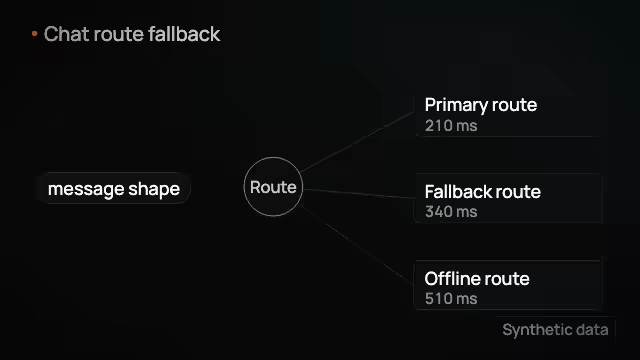
Within the AI Gateway, the skill packs Compare and switch models (S12) and Connect and check services (S18) serve as transferable workflow patterns for enterprise engineering. Rather than gating traffic on a single leaderboard score, teams can wire two atomic capabilities into their pre-release pipeline:
- Shadow evaluation and multi-protocol benchmarking: Before shifting live traffic, shadow routing mirrors production requests to candidate models in parallel with offline benchmark suites. Here the pipeline enforces the MVVP rules—running uncached temperature-0 repeats, executing AB/BA position swaps, and computing chance-corrected $\kappa$ alongside position-bias diagnostics.
- Task-level routing and scaffold-aware evaluation: Because preference agreement does not transfer to correctness and scaffolds confound model comparisons, routing evaluation partitions workloads by task regime (conversational preference vs. verifiable compliance correctness) and holds agent scaffolds explicit across pooled benchmarks. Prior to cutover, Connect and check services (S18) verifies endpoint contracts, latency ceilings, and fallback readiness.
For high-impact model promotions or emergency rollbacks in enterprise and financial workflows, automated judge metrics must serve as structured evidence rather than sole decision authority. In the Agent OS module, the skill pack Plan and deliver work (S01)—cataloged as a transferable pattern in manufacturing and adaptable as a general governance workflow in enterprise settings—anchors release sign-off through Auditable workflows, human confirmation and decision review. Instead of allowing an automated script to flip production routing weights, the state machine packages the chance-corrected agreement metrics, AB/BA bias audit, and cross-benchmark variance breakdown, then pauses at a mandatory human gate. If position bias exceeds threshold or correctness benchmarks diverge, the reviewer rejects the promotion and holds the candidate configuration out of production.
Three Verification Checks Before Trusting an Automated Gate
Engineering leaders and risk officers can apply three concrete checks before allowing an LLM judge or agent benchmark to gate production releases:
- Demand chance correction and regime coverage: Reject raw percentage agreement. Require Cohen’s $\kappa$ or Krippendorff’s $\alpha$ across at least two benchmarks that separately test open-ended preference and factual or logical correctness.
- Audit high-consistency judges for position bias: Never equate determinism with fairness. When a judge achieves $>0.95$ test–retest consistency across $\ge 3$ uncached temperature-0 runs, verify via AB/BA swapping that position bias is strictly $<0.10$.
- Match the benchmark design to the operational claim—and keep a human gate: Decide whether you are procuring a fixed model–scaffold system or swapping an underlying model; if the latter, pool diverse benchmarks rather than merely adding homogeneous tasks, and require human acceptance before promoting or rolling back high-impact production routes.
Found it useful? Pass it on.
References
- [1]
Norman, J. D., Rivera, M. U., & Hughes, D. A. (2026). Reliability without Validity: A Systematic, Large-Scale Evaluation of LLM-as-a-Judge Models Across Agreement, Consistency, and Bias. arXiv:2606.19544. arxiv.org ↗
- [2]
Hardy, M., Azam, R., Reuel, A., Kochenderfer, M., & Koyejo, S. (2026). Agent Evaluation Reliability: More Tasks Won’t (Always) Fix An Agent Leaderboard. arXiv:2610.00651. arxiv.org ↗
- [3]
Zheng, L., Chiang, W.-L., Sheng, Y., Zhuang, S., Wu, Z., Zhuang, Y., Lin, Z., Li, Z., Li, D., Xing, E. P., Zhang, H., Gonzalez, J. E., & Stoica, I. (2023). Judging LLM-as-a-Judge with MT-Bench and Chatbot Arena. Advances in Neural Information Processing Systems (NeurIPS). arXiv:2306.05685. arxiv.org ↗
Related capabilities
Platform modules
Skills packs
S12 · AI Gateway
Compare and switch models
New models keep arriving: switching may make results worse, not switching may leave you behind.
Compare available services on shared samples, then review differences and adjust primary and fallback choices.
- Check candidate services
- Compare sample results
- Review switch proposalsHuman review
- Configure primary and fallback
- Recheck samplesHuman review
5 steps2 human reviews7 components
S18 · AI Gateway
Connect and check services
Connecting a new service changes live configuration, and when it fails there is no clear way back.
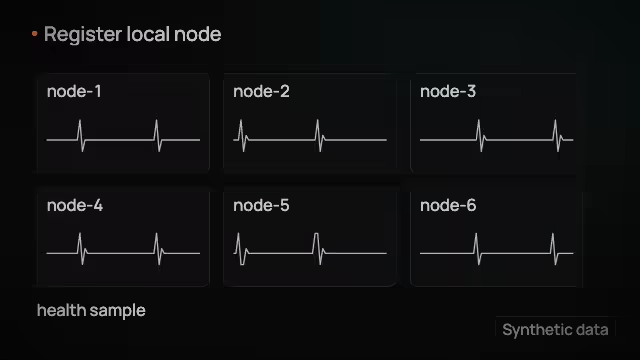
Register service nodes, check configuration and test requests before accepting integration.
- Register connections
- Prepare request paths
- Send bounded trial requests
- Accept or roll back integrationHuman review
4 steps1 human reviews5 components

S01 · Agent OS
Plan and deliver work
Hand AI a big job and it often stops halfway or drifts, and nobody can tell how far it got.
Break a goal into dependent tasks, confirm execution and deliver reviewable results.
- Plan the steps
- Approve the scopeHuman review
- Run and collect
- Review and hand overHuman review
4 steps2 human reviews7 components