The Engineering Economics of the AI Gateway: Multi-Protocol Routing, Tail-Latency Mitigation, and Semantic Policy Canary Rollouts
A unified AI gateway normalizes heterogeneous protocols, routes requests to task-appropriate models, and centralizes prompt canary rollouts, quota circuit-breaking, and batching to control both tail latency and inference cost.


The Hidden Engineering Tax of Direct Model API Calls
Consider a scenario inside an organization where multiple engineering teams independently build knowledge retrieval tools, document batch processors, and ticket-routing assistants. Initially, each team hardcodes external or self-hosted large language model endpoints directly into application code, authenticating with locally stored keys. Once these applications enter sustained operation, structural friction emerges. When an upstream endpoint experiences an intermittent latency spike, direct client calls lack unified timeout and failover logic, stalling downstream workflows. When a prompt template requires updating or an endpoint schema changes, engineers must modify application code across multiple repositories and redeploy. At billing reconciliation time, scattered usage logs cannot be cleanly tied back to departmental budget reservations.
This fragility stems from treating model inference as isolated application-level calls rather than centrally governed infrastructure. A unified AI gateway normalizes heterogeneous protocols, routes requests to task-appropriate models, and centralizes prompt canary rollouts, quota circuit-breaking, and batching to control both tail latency and inference cost.
Tail-Latency Tolerance, Model Cascades, and Paged Memory: Systems Mechanics
Why must the model access layer centralize latency mitigation, routing policies, and batch scheduling? Research in distributed systems and model serving explains the underlying mechanics.
First is tail latency in distributed services. Dean and Barroso (2013) argue that in large-scale services, when a request fans out to many servers, rare latency hiccups in individual components dominate overall response time (“tail latency”)[1]. Rather than attempting to eliminate all component-level variability, systems should be “tail-tolerant”—using techniques such as hedged requests (sending a second copy of a slow request), tied requests, micro-partitioning, selective replication, and putting slow machines on probation[1]. In model infrastructure, when a workflow chains multiple inference calls, a single slow response degrades the entire pipeline; the gateway layer must therefore track endpoint health, place degraded nodes on probation, and execute deterministic fallback.
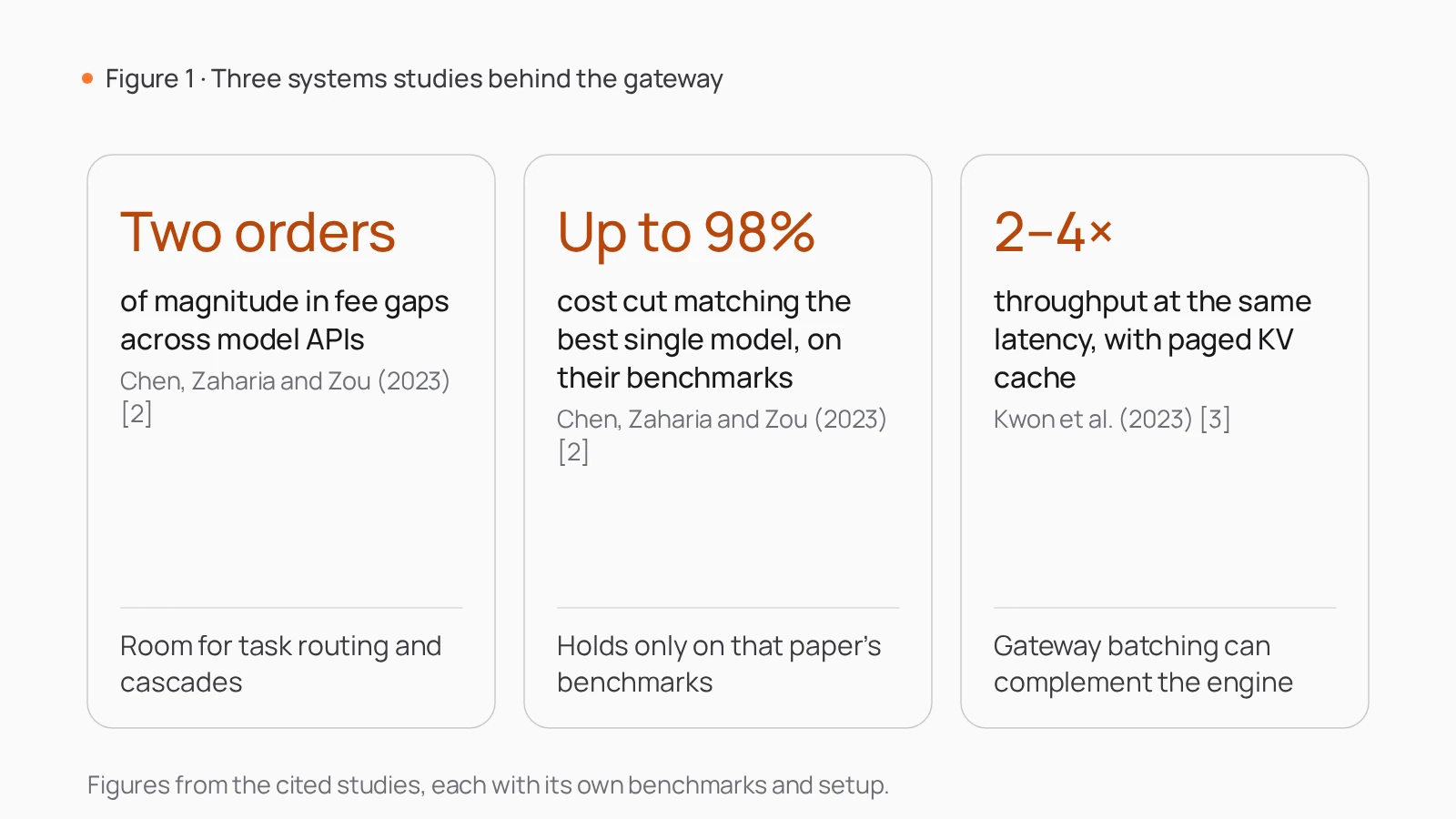
Second is cascade routing under heterogeneous pricing. Reviewing popular large language model APIs, Chen, Zaharia, and Zou (2023) find heterogeneous pricing structures with fees differing by two orders of magnitude[2], making inference over large query and text collections expensive. They outline three types of strategies[2] to reduce inference cost: prompt adaptation, LLM approximation, and LLM cascade[2]. Their cascade framework learns which model combinations to invoke across queries; on their experimental benchmarks, it matches the best individual model’s performance with up to 98% cost reduction or improves accuracy over that baseline by 4% at the same cost[2]. Strictly bounded, these cost and accuracy figures hold only on the specific benchmarks evaluated in that study and cannot be generalized as guaranteed savings across enterprise workloads.
Third is memory management and batching throughput in serving engines. Kwon et al. (2023) note that high-throughput model serving requires batching sufficiently many requests at a time, but existing systems struggle because each request’s key-value cache (KV cache) memory is huge and grows and shrinks dynamically; inefficient management wastes memory through fragmentation and redundant duplication, limiting batch size[3]. Inspired by operating-system virtual memory and paging, the authors propose PagedAttention and build a serving system achieving near-zero waste[3] in KV cache memory and flexible KV cache sharing within and across requests[3]. Evaluations show this system improves popular models’ throughput by 2–4× at the same latency level compared to prior state-of-the-art systems, with stronger gains on longer sequences, larger models, and complex decoding algorithms[3]. Architecturally, an upstream gateway that normalizes requests, preserves cache affinity, and funnels asynchronous jobs into batch adapters helps underlying serving engines realize higher throughput.
Engineering Governance in Practice: Onboarding, Switching, and Quota Contracts
Translating these mechanics into production architecture means decoupling protocol translation, failover switching, budget reconciliation, and access rules from business code into gateway workflows with explicit input contracts and human review gates. Within the AI Gateway module on rlab.works, four skill packs and atomic components structure this lifecycle.
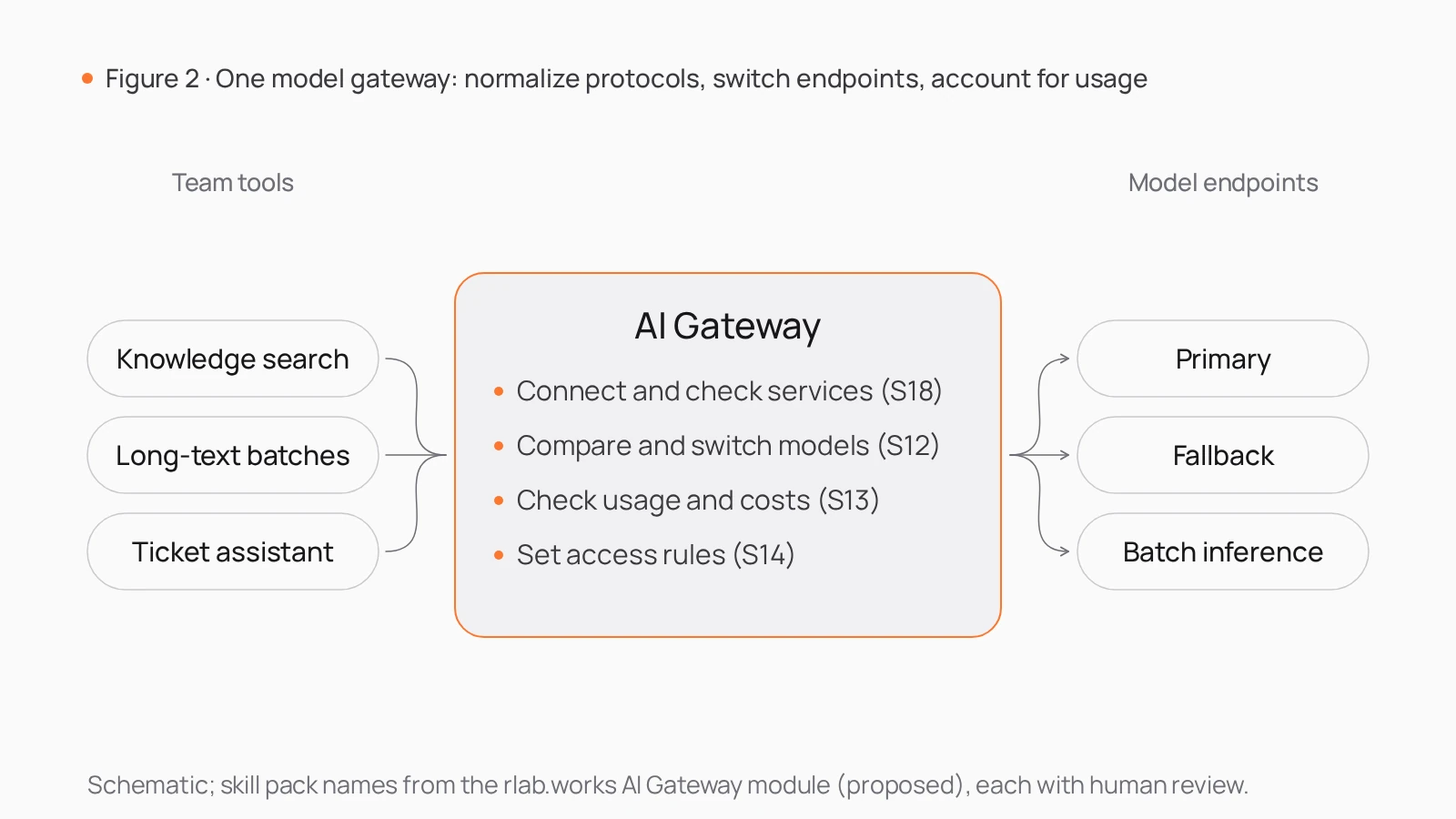
These workflows rely on working-code components (verified via static source inspection). Multi-protocol model routing, fallback and compatibility normalizes heterogeneous chat and response payloads, scores compatible endpoints via rules, and handles fallback, health status, and cache affinity (though capability metadata alone does not prove live model support). Alongside it, Versioned gateway policy rollout validates policy drafts, diffs versions, executes rollouts, archival, and rollbacks, and serves active policy bundles through a cache validator.
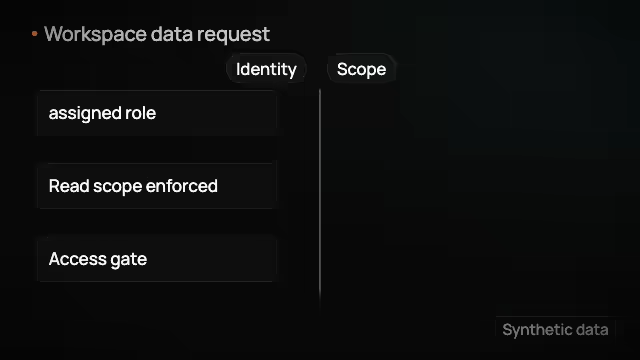
For cost accounting and access control, Check usage and costs (S13) takes Batch jobs, pricing rules and available budget, verifies funds to reserve budget, submits jobs—supported by Provider batch inference, which manages batch API requests via adapters and persists batch metadata—collects provider usage receipts, accounts for request costs in a traceable ledger, and routes discrepancies to a human review gate. Meanwhile, Set access rules (S14) takes Team roles, service catalog and access requirements, drafts access scope, pauses for human review of rule diffs, tests allowed and denied requests, and requires human review of request evidence to produce a revertible access version.
Honest engineering requires stating industry adaptation and maturity boundaries. None of these four skill packs carries a source-supported industry tag in the industries covered here; they serve strictly as transferable use or general patterns. S12 and S18 are tagged for transferable use only in business and general services (requiring real domain samples to verify compatibility, relying on existing records without promising automatic optimal-model discovery, and checking heartbeats, application responses, and deployment outcomes separately without assuming SDK streaming or auto-retries); neither carries a tag for finance or government and public services. S13 is tagged for transferable use in finance (solely for research-tool operational expense reconciliation, requiring a designated billing owner and unified units, excluding financial transaction settlement) and in government and public services (tracking batch tasks against departmental budgets for monthly reconciliation, mapping top-up and settlement to fiscal workflows without claiming regulatory compliance), with no tag in business and general services. S14 is tagged for transferable use only in government and public services (requiring integration with organizational identity and actual document permissions rather than prompt-based restrictions), with no tag in business or finance. Finally, every skill pack on the site is a proposed composition demonstrated with synthetic data and not yet connected to live services, and component maturity reflects static code inspection rather than production deployment.
Pre-Deployment Checks for Engineering and Technology Leaders
Before funding an AI gateway initiative, technology leaders can apply several concrete verification checks:
- Verify that health probing and fallback contracts operate independently of application code: When an upstream node exhibits tail-latency spikes, can the gateway isolate the slow endpoint, route to a fallback, and preserve cache affinity via configuration without application redeployment?
- Check that model switching and policy updates enforce sample-based diffing and human gates: Does changing routing weights or prompt policies require evaluating candidates on shared samples, inspecting quality and cost diffs, and passing a blocking human review gate with rollback?
- Confirm that batch routing and access rules bind to real budgets and identity systems: Are asynchronous jobs gated by upfront budget reservations before entering batch adapters, and do access rules enforce organizational identity and document permissions rather than prompt-level instructions?
Found it useful? Pass it on.
References
- [1]
Dean, J., & Barroso, L. A. (2013). The Tail at Scale. Communications of the ACM, 56(2), 74–80. doi.org/10.1145/2408776.2408794
- [2]
Chen, L., Zaharia, M., & Zou, J. (2023). FrugalGPT: How to Use Large Language Models While Reducing Cost and Improving Performance. arXiv preprint arXiv:2305.05176. arxiv.org ↗
- [3]
Kwon, W., Li, Z., Zhuang, S., Sheng, Y., Zheng, L., Yu, C. H., Gonzalez, J. E., Zhang, H., & Stoica, I. (2023). Efficient Memory Management for Large Language Model Serving with PagedAttention. Proceedings of the 29th Symposium on Operating Systems Principles (SOSP '23), 611–626. doi.org/10.1145/3600006.3613165
Related capabilities
Skills packs
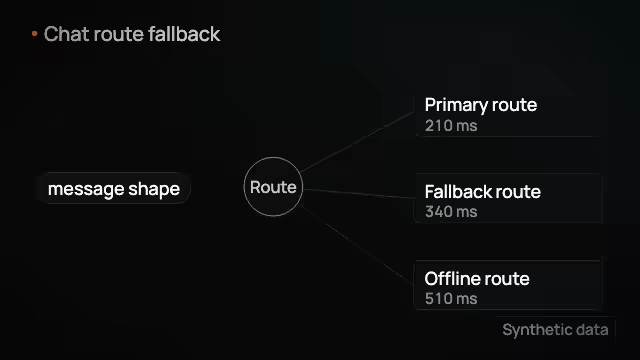
S12 · AI Gateway
Compare and switch models
New models keep arriving: switching may make results worse, not switching may leave you behind.
Compare available services on shared samples, then review differences and adjust primary and fallback choices.
- Check candidate services
- Compare sample results
- Review switch proposalsHuman review
- Configure primary and fallback
- Recheck samplesHuman review
5 steps2 human reviews7 components
S13 · AI Gateway
Check usage and costs
The model bill arrives at month end, and nobody can say which requests the overspend went to.
Check the budget before submitting batch jobs, then reconcile costs against recorded usage.
- Check available budget
- Submit and collect results
- Account for request costs
- Review discrepanciesHuman review
4 steps1 human reviews5 components
S14 · AI Gateway
Set access rules
Everyone uses AI, nobody controls who can call which model or tool, and incidents cannot be traced.
Define team access, review rule changes and test allowed and denied requests.
- Define access scope
- Validate and review changesHuman review
- Apply access rules
- Review request evidenceHuman review
4 steps2 human reviews6 components
S18 · AI Gateway
Connect and check services
Connecting a new service changes live configuration, and when it fails there is no clear way back.
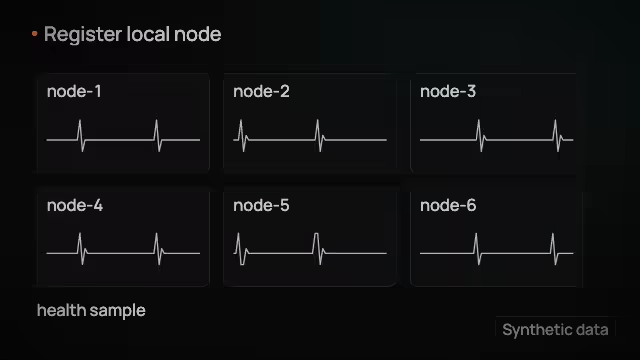
Register service nodes, check configuration and test requests before accepting integration.
- Register connections
- Prepare request paths
- Send bounded trial requests
- Accept or roll back integrationHuman review
4 steps1 human reviews5 components