[Business & General Services] Preventing "Shadow AI" from Becoming Supply-Chain Chaos: Plugin Signature Audits, Gateway Model Routing, and Mobile Privacy Redaction
The real risk of Shadow AI lies in unmanaged model and plugin entry points; enterprises should consolidate access through a signed plugin registry, license audits, and a unified model gateway, while redacting mobile logs before they leave the device.


How Scattered Keys and Unvetted Plugins Bypass Security Boundaries
Consider a common workplace scenario. To speed up meeting summaries and internal lookups, an operational team installs unvetted desktop extensions on company laptops, provisions external large language model API keys on corporate cards, and uses a mobile voice tool on the road to capture follow-up tasks. On the surface, no core database has changed, and drafting feels faster. Yet when security engineers run an inventory, they uncover a fragmented attack surface: internal project context streams to unverified endpoints through personal keys, community plugins run on workstations without digital signatures or license checks, and mobile crash reports upload raw headers, breadcrumbs, and session context directly to external diagnostic servers.
This pattern—commonly called “Shadow AI”—is rarely solved by policy memos alone. The core risk of Shadow AI lies in unmanaged model and plugin entry points. When external model calls, third-party extensions, and mobile telemetry bypass a unified control plane, local productivity workarounds turn into software supply-chain exposure. Rather than relying on blanket bans, enterprises should consolidate entry points through a signed plugin registry, dependency license audits, and a unified model gateway, while redacting sensitive context from mobile logs before they leave the device.
Supply-Chain Exposure, Plugin Boundaries, and Data Leakage: The Mechanism of Unmanaged Entry Points
Why do unsanctioned model endpoints and client extensions expand an organization’s risk profile so rapidly? Security taxonomies, vulnerability research, and software development lifecycle standards explain how these entry points interact.
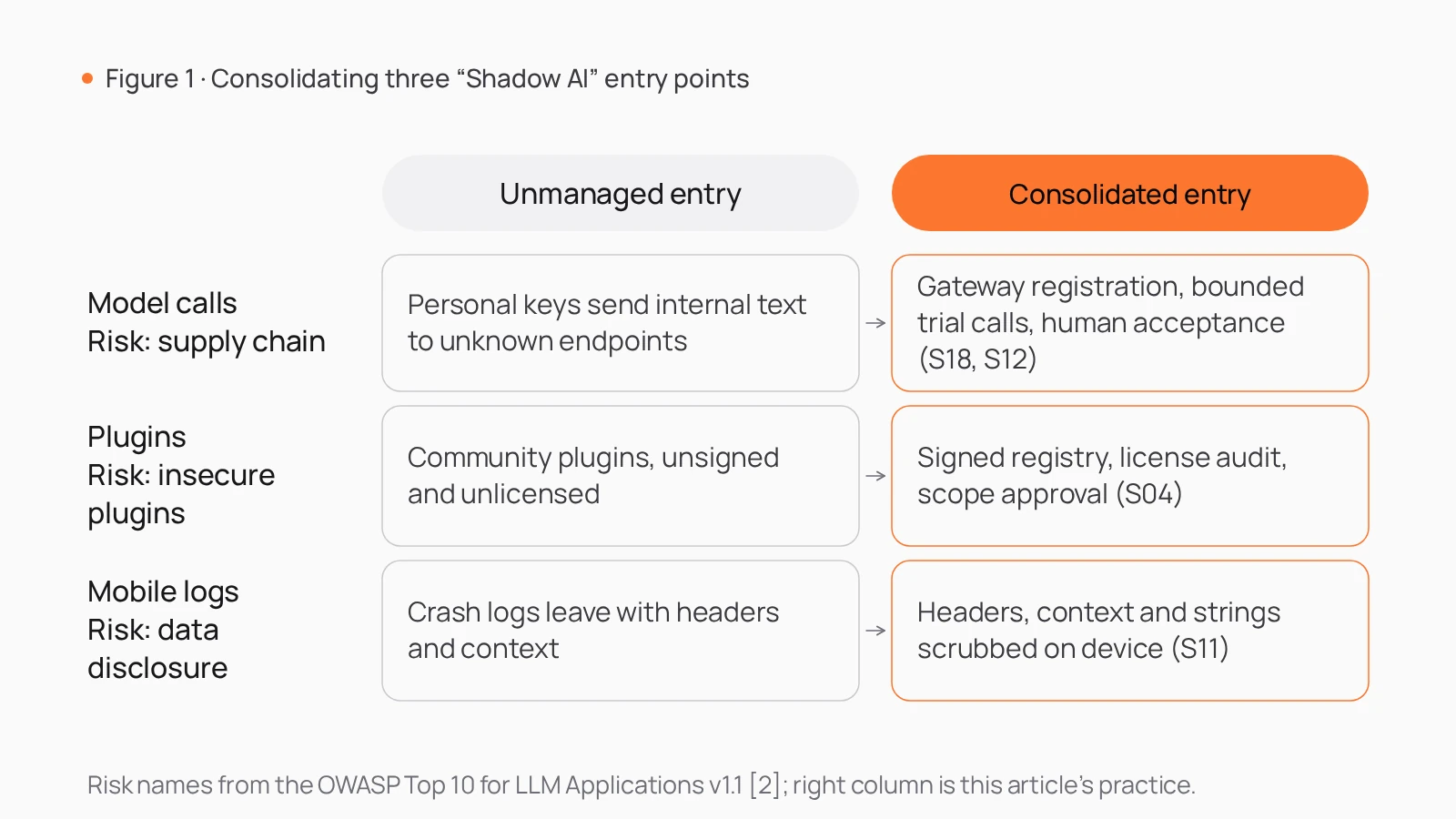
First, the Open Worldwide Application Security Project (OWASP Foundation, 2023) cataloged the ten primary risks for large language model applications in its OWASP Top 10 for Large Language Model Applications (Version 1.1)[2]: Prompt Injection, Insecure Output Handling, Training Data Poisoning, Model Denial of Service, Supply Chain Vulnerabilities, Sensitive Information Disclosure, Insecure Plugin Design, Excessive Agency, Overreliance, and Model Theft. In a Shadow AI environment, several risks converge at the entry point. Connecting to unvetted providers or pulling packages without provenance checks introduces Supply Chain Vulnerabilities; installing extensions without parameter validation or scope limits brings Insecure Plugin Design and Excessive Agency into the network; and transmitting raw prompts, credentials, or crash dumps from clients without sanitization triggers Sensitive Information Disclosure[2].
Third, traditional engineering processes rarely govern these AI entry points by default. In the Secure Software Development Framework (SSDF) Version 1.1 (NIST Special Publication 800-218), the National Institute of Standards and Technology (NIST, 2022) noted that few software development life cycle (SDLC) models address software security in detail, so secure practices must be integrated into each SDLC implementation[3]. Following these core practices helps organizations reduce vulnerabilities in released software, mitigate the impact of undetected or unaddressed vulnerabilities, and address root causes to prevent recurrences; moreover, because the framework provides a common vocabulary, software acquirers can use it to foster communications with suppliers during acquisition and management activities[3]. Applied to enterprise AI, model endpoints, plugins, and mobile telemetry require explicit intake contracts, verification gates, and rollback paths embedded into engineering and procurement workflows.
Engineering Entry-Point Governance: Gateway Routing, Signed Plugins, and Mobile Log Redaction
Translating these principles into architecture requires routing model calls, tool installations, and mobile inputs through auditable workflows with human review gates. On rlab.works, this governance layer spans AI Gateway and Agent OS.
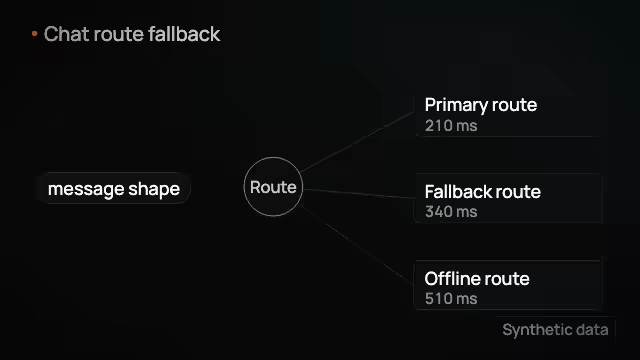
At the model entry layer, organizations replace scattered keys with a sanctioned gateway and an approved model list. Under AI Gateway, the Connect and check services (S18) skill pack structures endpoint onboarding. Starting from Service endpoints, authorization and interface contract, the workflow assists operators to register connections (nodes and health status), prepare request paths (client and interface configurations), and send bounded trial requests (responses and typed errors). Execution pauses at the Accept or roll back integration human gate: an assigned reviewer inspects trial results, and rejected outputs return for revision without advancing, so only human-confirmed integration versions and release records go live. Once endpoints are registered, teams govern the approved model list via the Compare and switch models (S12) skill pack. Using Task samples, available services and selection criteria, it assists in checking candidate services and comparing sample results to log quality, error, and cost records. At the Review switch proposals human gate, a reviewer accepts a routing draft before the system assists in configuring primary and fallback choices and quota rules, followed by a Recheck samples human gate to retain comparison evidence and the retention decision.
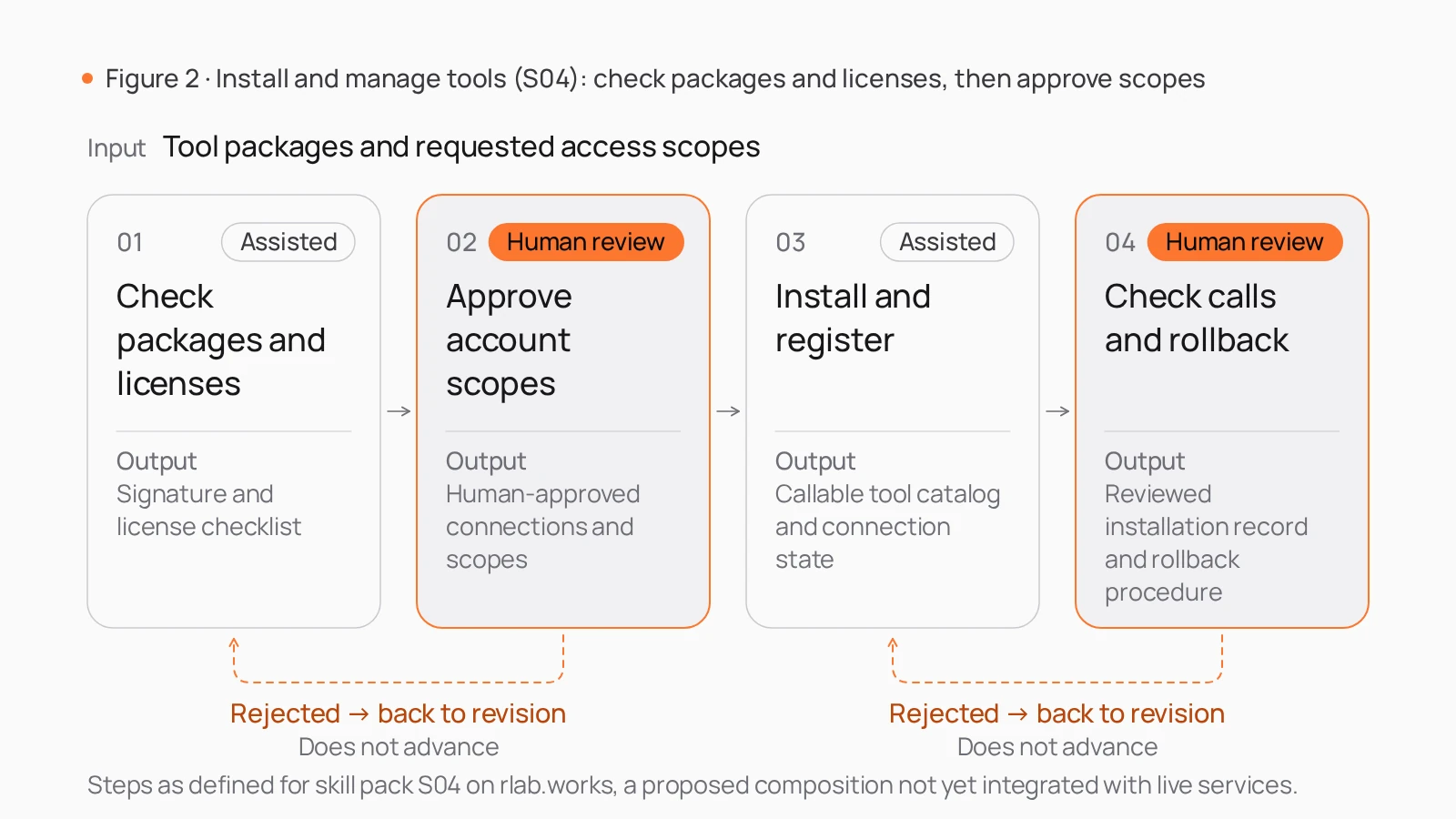
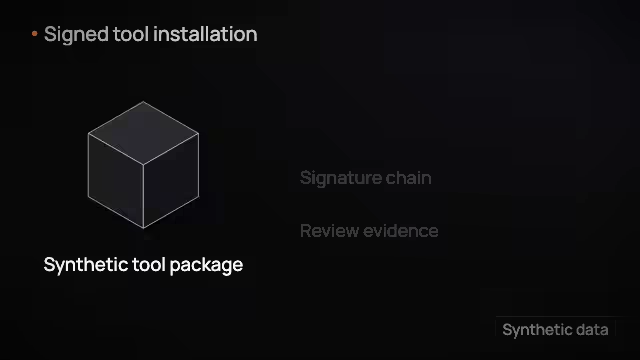
At the plugin layer, the Install and manage tools (S04) skill pack in Agent OS governs workspace extensions. Starting from Tool packages and requested access scopes, the Check packages and licenses step invokes Signed plugin registry and trusted installation—handling discovery, publishing, review, revocation, signed registry records, and local verification at install time—alongside Dependency license policy and metadata audit, which compares lockfile metadata against installed package metadata, classifies licenses into allowed, review-required, and prohibited categories, and supports exceptions by package name, version, and scope to output a signature and license checklist. Next, at the Approve account scopes human gate, a reviewer approves the connection and scope; rejected requests do not advance. The workflow then assists in installing and registering the tool in the callable catalog, and pauses at the Check calls and rollback human gate to retain the verified installation record and rollback procedure.
Architectural honesty requires stating current boundaries. In business and general services, these skill packs are classified as transferable use rather than source-supported industry implementations, requiring domain adaptation: comparing and switching models requires testing compatibility on real internal knowledge-assistant samples, relies on existing recommendation records, and does not promise automatic optimal model selection; connecting and checking services requires separately checking node heartbeats, application responses, and deployment outcomes without assuming SDKs support streaming or automatic retries; installing and managing tools requires choosing adapters by package format and client while preserving failure and revocation paths; and taking spoken requests requires connecting a live transcription endpoint and retention policy, without automatically modifying calendars or sending messages. Every skill pack on the site is a proposed composition demonstrated with synthetic data and not yet connected to live services. The capabilities discussed are rated as working code from static source inspection rather than production deployment, and the production analytics adapter alongside the mobile crash filter is a no-op stub.
Pre-Pilot Checks for Engineering and Security Leaders
Before funding a workplace AI rollout or remediating Shadow AI, leaders can apply these checks:
- Inventory and consolidate model entry points: Check for external provider keys in scripts or extensions, and require all endpoints to pass bounded trial requests, human acceptance, and shared-sample fallback routing through a unified gateway.
- Enforce signatures, license audits, and scope approval for plugins: Verify that no extension installs without cryptographic signature checks against an internal registry, lockfile license classification, human approval of account scopes, and a rollback path.
- Verify explicit consent and on-device log redaction on mobile clients: Confirm that mobile voice capture requires user-initiated recording and human confirmation of the interpreted request, and verify that headers, context, and sensitive strings are scrubbed before crash logs leave the device.
Found it useful? Pass it on.
References
- [1]
Greshake, K., Abdelnabi, S., Mishra, S., Endres, C., Holz, T., & Fritz, M. (2023). Not what you've signed up for: Compromising Real-World LLM-Integrated Applications with Indirect Prompt Injection. Proceedings of the 16th ACM Workshop on Artificial Intelligence and Security (AISec), 79–90. doi.org/10.1145/3605764.3623985
- [2]
OWASP Foundation. (2023). OWASP Top 10 for Large Language Model Applications (Version 1.1). OWASP. owasp.org ↗
- [3]
National Institute of Standards and Technology (NIST). (2022). Secure Software Development Framework (SSDF) Version 1.1: Recommendations for Mitigating the Risk of Software Vulnerabilities (NIST Special Publication 800-218). doi.org/10.6028/NIST.SP.800-218
Related capabilities
Platform modules
Skills packs
S12 · AI Gateway
Compare and switch models
New models keep arriving: switching may make results worse, not switching may leave you behind.
Compare available services on shared samples, then review differences and adjust primary and fallback choices.
- Check candidate services
- Compare sample results
- Review switch proposalsHuman review
- Configure primary and fallback
- Recheck samplesHuman review
5 steps2 human reviews7 components
S04 · Agent OS
Install and manage tools
Adding plugins and account connections to AI is easy, but unknown plugins and broad permissions are a risk.
Check tool provenance and licenses, approve account scopes, install and inspect calls.
- Check packages and licenses
- Approve account scopesHuman review
- Install and register
- Check calls and rollbackHuman review
4 steps2 human reviews7 components
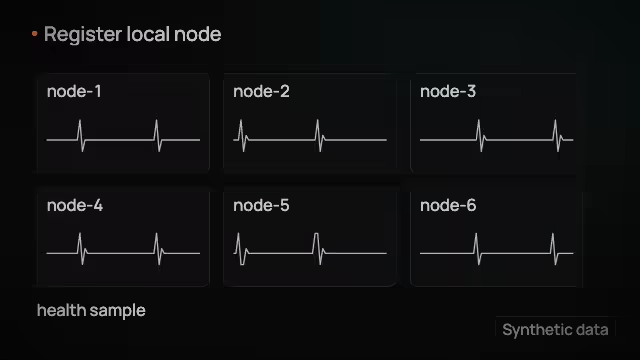
S18 · AI Gateway
Connect and check services
Connecting a new service changes live configuration, and when it fails there is no clear way back.
Register service nodes, check configuration and test requests before accepting integration.
- Register connections
- Prepare request paths
- Send bounded trial requests
- Accept or roll back integrationHuman review
4 steps1 human reviews5 components

S11 · Agent OS
Take spoken requests
Typing is impractical on the move or on site, and voice messages get misheard or lost.
Record spoken requests with consent, confirm the interpretation and retain replies and handling records.
- Capture the request
- Add relevant context
- Confirm understandingHuman review
- Respond and record
4 steps1 human reviews6 components