[Lifestyle & Consumer Apps] Restrained Long-Term Memory and Sandboxed Refund Guardrails: How Consumer Apps Balance Personalization Against Overreach Risks
Personalization memory in consumer applications must remain user-visible and erasable, high-risk conversations must route to human support without recording routine companion memories, and refund orchestration belongs behind idempotency checks and sandbox rehearsal.


When an Attentive Personal Assistant Crosses Privacy, Safety, and Billing Boundaries
Imagine a common scenario in consumer product design. A lifestyle and companion application enables full background memory across all chat sessions to improve retention. Late one evening, a user vents about acute health anxiety and a family crisis. Days later, the assistant casually references those sensitive disclosures inside a routine reminder—and when the user complains in passing about an unexpected subscription charge, the system initiates a refund instruction without verifying account entitlements or isolating test transactions from live payment rails. Features built to feel attentive end up creating privacy intrusion, safety exposure, and billing errors.
This tension defines the core engineering thesis for lifestyle and consumer applications: personalization memory must remain visible and erasable by the user, high-risk conversations must route to human support while halting routine memory capture, and refund orchestration must sit behind idempotency checks, sandbox rehearsal, and human approval.
Memory Synthesis, Contextual Privacy, and Conversational Safety Risks
Why do long-term memory architectures and open-ended conversational interfaces—compelling in demonstrations—cause overreach in consumer software? Research across human-computer interaction, behavioral economics, and medical informatics explains the mechanisms.
At the architectural level, Park et al. (2023) introduced generative agents: computational software agents that simulate believable human behavior by extending a large language model to store a complete natural-language record of experiences, synthesize those memories over time into higher-level reflections, and retrieve them dynamically to plan behavior[2]. The authors instantiated these agents in an interactive sandbox environment inspired by a life-simulation game, populating a small town of 25 agents[2]. Starting from a single user-specified notion that one agent wanted to throw a Valentine’s Day party, the agents autonomously spread invitations over the next two days[2], made new acquaintances, asked each other out on dates to the party, and coordinated to show up together at the right time[2]. Ablation experiments showed that observation, planning, and reflection each contribute critically to agent believability[2]. From a product engineering perspective, however, what makes a sandbox simulation believable is what makes a consumer app intrusive: silently storing a complete record of vulnerable remarks and synthesizing higher-level reflections without consent or editing controls turns personalization into surveillance.
That reaction reflects the mechanics of human privacy. Reviewing empirical research across the social and behavioral sciences, Acquisti, Brandimarte, and Loewenstein (2015) organized privacy behavior around three themes[1]: people’s uncertainty about the consequences of privacy-related behaviors and their own preferences over those consequences[1]; the context-dependence of people’s concern, or lack thereof, about privacy[1]; and the degree to which privacy concerns are malleable—manipulable by commercial and governmental interests[1]. Because privacy preferences are context-dependent, a user’s willingness to disclose a struggle during a late-night check-in does not imply consent for the app to retain that disclosure indefinitely or reuse it in commercial prompts.
When conversations cross into medical or crisis territory, unguarded reliance on conversational assistants poses direct safety risks. Bickmore et al. (2018) conducted an observational study evaluating the harm that could result when patients and consumers use conversational voice assistants for medical information[3]. Participants posed medical problems in their own words and determined an action to take based on the system’s response, rated on an Agency for Healthcare Research and Quality harm scale[3]. Fifty-four subjects completed the study. Across 394 tasks, they completed only 168 (43%); among completed tasks, 49 (29%) led to reported actions that could have caused some degree of patient harm, including 27 (16%) that could have resulted in death[3]. The authors concluded that relying on conversational assistants for actionable medical information is a safety risk and that users should not act on such answers without consulting a health care provider[3].
Engineering Restrained Memory, Crisis Routing, and Refund Guardrails
Translating these findings into software architecture requires replacing silent background inference and autonomous billing actions with explicit lifecycle boundaries and human review gates.
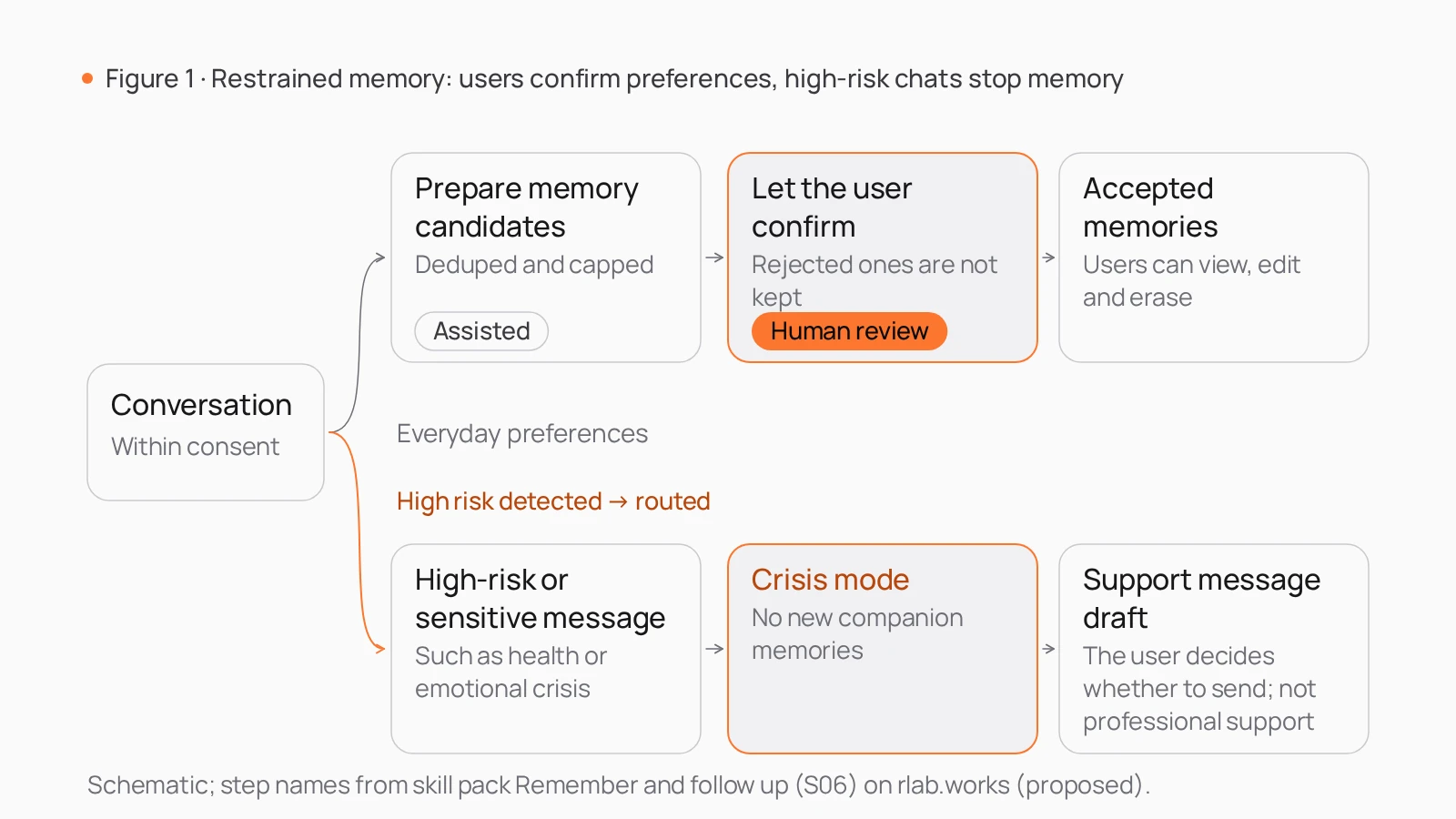
Within the Agent OS module on rlab.works, restrained memory governance is structured through the Remember and follow up (S06) skill pack. Starting from an explicit input contract—User consent, preferences and conversation records—the workflow advances through a governed sequence:
- Collect opt-in preferences and prepare memory candidates (assisted): The system establishes the permitted scope of preferences and dialogue, then uses Personal memory retrieval and lifecycle to extract memory candidates from conversations and check-ins, deduplicate and rank them, and enforce validity windows and retention caps.
- Let the user confirm (human review): Candidate memories pause for confirmation by the requesting user or designated reviewer; rejected outputs return for revision and do not advance. Accepted memories remain user-editable and erasable through manual creation, editing, and deletion controls.
- Continue or route for support, and follow up as requested (assisted): When a conversation contains high-risk or sensitive expressions, the workflow invokes the prototype component Crisis routing and support-message drafts, switching to a crisis-response mode that drafts a help-seeking message for a user-selected support contact and halts new companion memory generation. Subsequent check-ins and reminders proceed at the user’s agreed pace and can be stopped on request.
In lifestyle and consumer apps, Remember and follow up (S06) carries a source-supported industry designation—meaning only that the source repository has an explicit companion and consumer app association, with no claim of customer deployments or outcomes. Its adaptation boundary specifies that crisis prompts are not professional support and help-seeking drafts remain under the user’s decision to send. When a session disconnects, the transferable skill pack Resume interrupted work (S02) recovers read-only history and pauses at a human gate to confirm the resume point before continuing execution and inspecting the result, ensuring imported history never triggers automatic execution or billing.
Pre-Pilot Checks for Consumer Application Leaders
Before launching a conversational assistant in a consumer application, engineering and product leaders can apply the following checks:
- Verify user confirmation and erasure on the memory ledger: Confirm that candidate memories require explicit user review before retention, operate under expiration windows and caps, and remain visible, editable, and erasable by the user.
- Inspect crisis routing and memory freeze behavior: Check that high-risk health or distress expressions immediately halt routine memory extraction, switch out of open-ended companion responses, and leave any support-message draft under the user’s control.
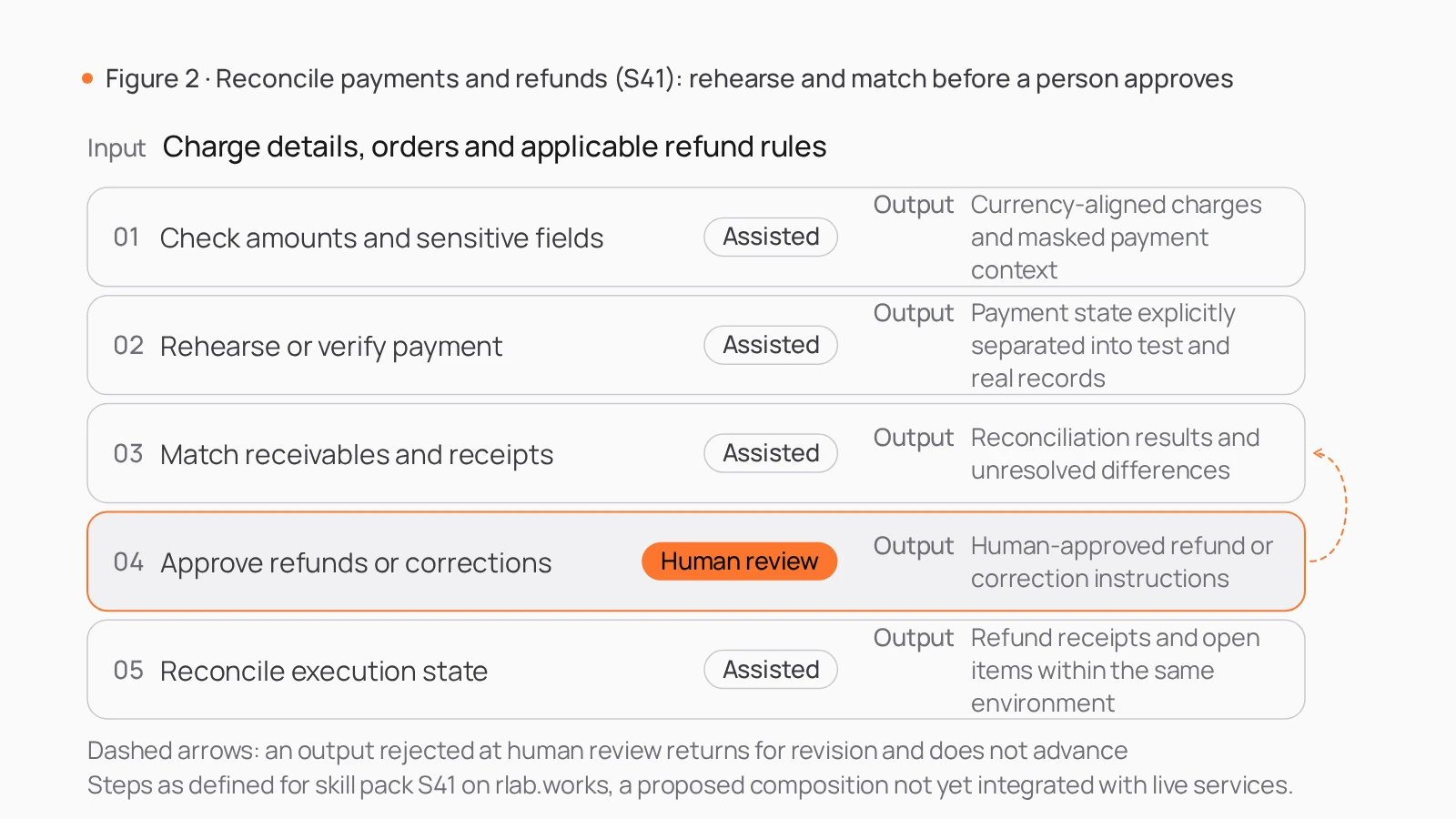
- Enforce environment isolation and human approval on refunds: Ensure that chat complaints cannot directly trigger payment reversals, and that every refund instruction passes through sandbox-versus-live separation, idempotency validation, and human support approval.
Found it useful? Pass it on.
References
- [1]
Acquisti, A., Brandimarte, L., & Loewenstein, G. (2015). Privacy and human behavior in the age of information. Science, 347(6221), 509–514. doi.org/10.1126/science.aaa1465
- [2]
Park, J. S., O'Brien, J. C., Cai, C. J., Morris, M. R., Liang, P., & Bernstein, M. S. (2023). Generative Agents: Interactive Simulacra of Human Behavior. Proceedings of the 36th Annual ACM Symposium on User Interface Software and Technology (UIST), Article 2. doi.org/10.1145/3586183.3606763
- [3]
Bickmore, T. W., Trinh, H., Olafsson, S., O'Leary, T. K., Asadi, R., Rickles, N. M., & Cruz, R. (2018). Patient and Consumer Safety Risks When Using Conversational Assistants for Medical Information: An Observational Study of Siri, Alexa, and Google Assistant. Journal of Medical Internet Research, 20(9), e11510. doi.org/10.2196/11510
Related capabilities
Platform modules
Skills packs
S06 · Agent OS
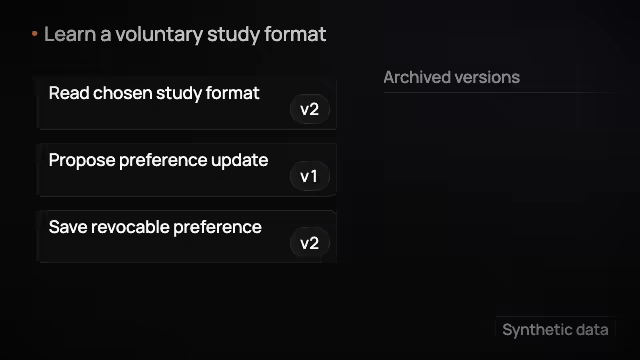
Remember and follow up
Asking the same questions every time feels careless to users; remembering too much feels intrusive.
Keep preferences with consent, review memories and continue conversations at an agreed pace.
- Collect opt-in preferences
- Prepare memory candidates
- Let the user confirmHuman review
- Continue or route for support
- Follow up as requested
5 steps1 human reviews10 components
S02 · Agent OS
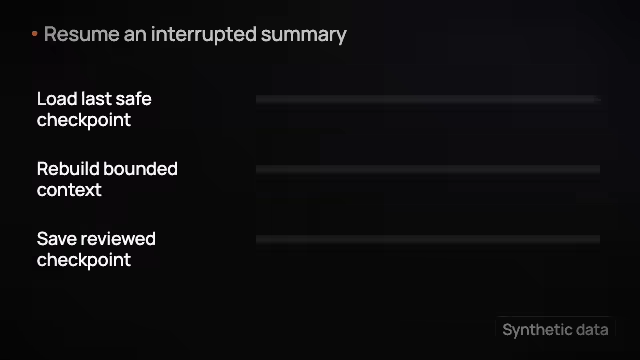
Resume interrupted work
A long job drops halfway through on a disconnect, timeout or restart, and usually starts over.
Check history and runtime readiness, resume unfinished work and review the result.
- Recover the history
- Confirm the resume pointHuman review
- Resume execution
- Inspect the resultHuman review
4 steps2 human reviews6 components
S36 · Commerce
Check benefits and support
When members ask about discounts and points, support checks identity and charges across several systems, and disputes take long.
Check identity and benefits, calculate charges and have support resolve disputes before notification.
- Check identity and benefits
- Calculate adjusted charges
- Review and decide handlingHuman review
- Notify and retain history
4 steps1 human reviews6 components
S41 · Commerce
Reconcile payments and refunds
Many payment channels and currencies mean manual spreadsheet reconciliation, and wrong refunds are hard to recover.
Calculate charges, verify payment events and have reviewers resolve discrepancies and refunds.
- Check amounts and sensitive fields
- Rehearse or verify payment
- Match receivables and receipts
- Approve refunds or correctionsHuman review
- Reconcile execution state
5 steps1 human reviews6 components