[Legal Services] When "Hallucinated Precedents" Cross the Malpractice Line: Source-Grounded Retrieval, Approved Computer Actions, and Verifiable Legal Evidence Memos
Empirical studies show that even commercial AI legal research tools built with retrieval-augmented generation still hallucinate citations and legal facts at substantial rates; a production legal workbench must anchor every claim to authorized source passages and require line-by-line attorney sign-off rather than issuing automated legal opinions.


Why Plausible-Looking Draft Citations Cross the Malpractice Line
Imagine a litigation team preparing a pre-trial brief under tight deadlines. A junior associate uses a generative text assistant to synthesize case law on a procedural dispute. The system returns a polished draft memorandum complete with case names, docket numbers, court jurisdictions, and seemingly authoritative holdings. Yet when the supervising partner checks those citations against official court reporters and statutory databases, several pivotal decisions do not exist at all, while others hold the opposite of what the draft asserts. Submitting unverified, fabricated authority to a court or client crosses a bright line of professional ethics, candor to the tribunal, and malpractice liability.
Replacing a general-purpose chatbot with a specialized legal search product does not eliminate this risk. Empirical research shows that even commercial AI legal research tools using retrieval-augmented generation (RAG) still fabricate legal facts and citations; a legal workbench must bind every sentence to verifiable source texts and require item-by-item attorney review and sign-off, without issuing automated legal opinions.
From General Models to Proprietary Legal RAG: Empirical Evidence on Hallucinations
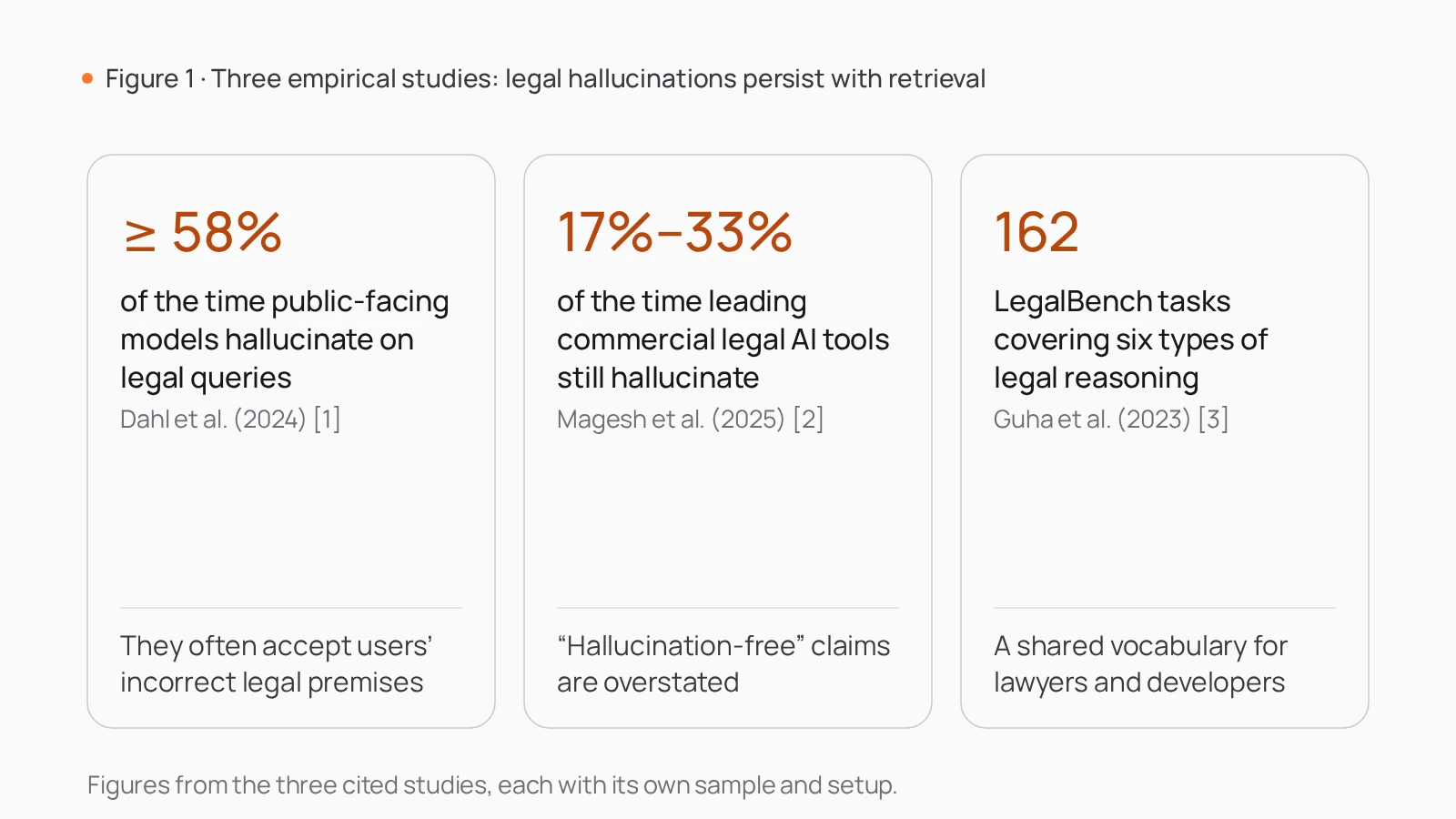
Large language models are increasingly adopted across legal practice, education, and research, yet their potential is threatened by “hallucinations”—textual output inconsistent with legal facts[1]. In the first systematic evaluation of legal hallucinations across public-facing models, Dahl, Magesh, Suzgun, and Ho (2024) documented trends across jurisdictions, courts, time periods, and cases[1]. They show that public-facing models hallucinate at least 58% of the time, struggle to predict their own hallucinations, and often uncritically accept users’ incorrect legal assumptions[1]. Proposing a typology of legal hallucinations, the authors caution against rapid, unsupervised integration of popular models into legal tasks[1].
Certain legal research providers have touted retrieval-augmented generation (RAG) as “eliminating” or “avoid[ing]” hallucinations, or guaranteeing “hallucination-free” legal citations[2]. Because proprietary systems are closed, systematically assessing these claims is challenging[2]. Magesh, Surani, Dahl, Suzgun, Manning, and Ho (2025) designed and reported on the first preregistered empirical evaluation of AI-driven legal research tools, assessing RAG-based proprietary systems[2]. They demonstrate that providers’ claims are overstated: while hallucinations are reduced relative to general-purpose chatbots, leading commercial AI research tools from major legal information providers still hallucinate between 17% and 33% of the time, with substantial differences across systems in responsiveness and accuracy[2]. Alongside a preregistered dataset and a typology differentiating hallucinations from accurate legal responses, the study provides evidence to inform legal professionals’ responsibilities in supervising and verifying AI outputs—a central open question for integrating AI into law responsibly[2].
Why does retrieval augmentation alone fail to guarantee reliable legal reasoning? Guha et al. (2023) introduced LegalBench, a collaboratively constructed benchmark built with legal professionals[3]. LegalBench consists of 162 tasks covering six different types of legal reasoning[3], showing how popular legal frameworks correspond to benchmark tasks and giving lawyers and developers a common vocabulary[3]. Evaluating 20 open-source and commercial models[3] illustrates how varied legal reasoning is. Together, these studies show that neither general chatbots nor proprietary RAG tools can operate as autonomous authorities; source-passage anchoring and lawyer verification are mandatory architectural constraints.
Source Grounding, Approved Actions, and Evidence Memos: Mapping the Legal Workbench
Translating these findings into software architecture requires replacing open-ended chat with structured workflows. A workbench for legal services must decompose research and case preparation into scoped retrieval, adversarial evidence comparison, controlled desktop operations, and human sign-off gates. Within rlab.works, this design maps onto skill packs across the AI Gateway, Intelligence, and Agent OS modules.
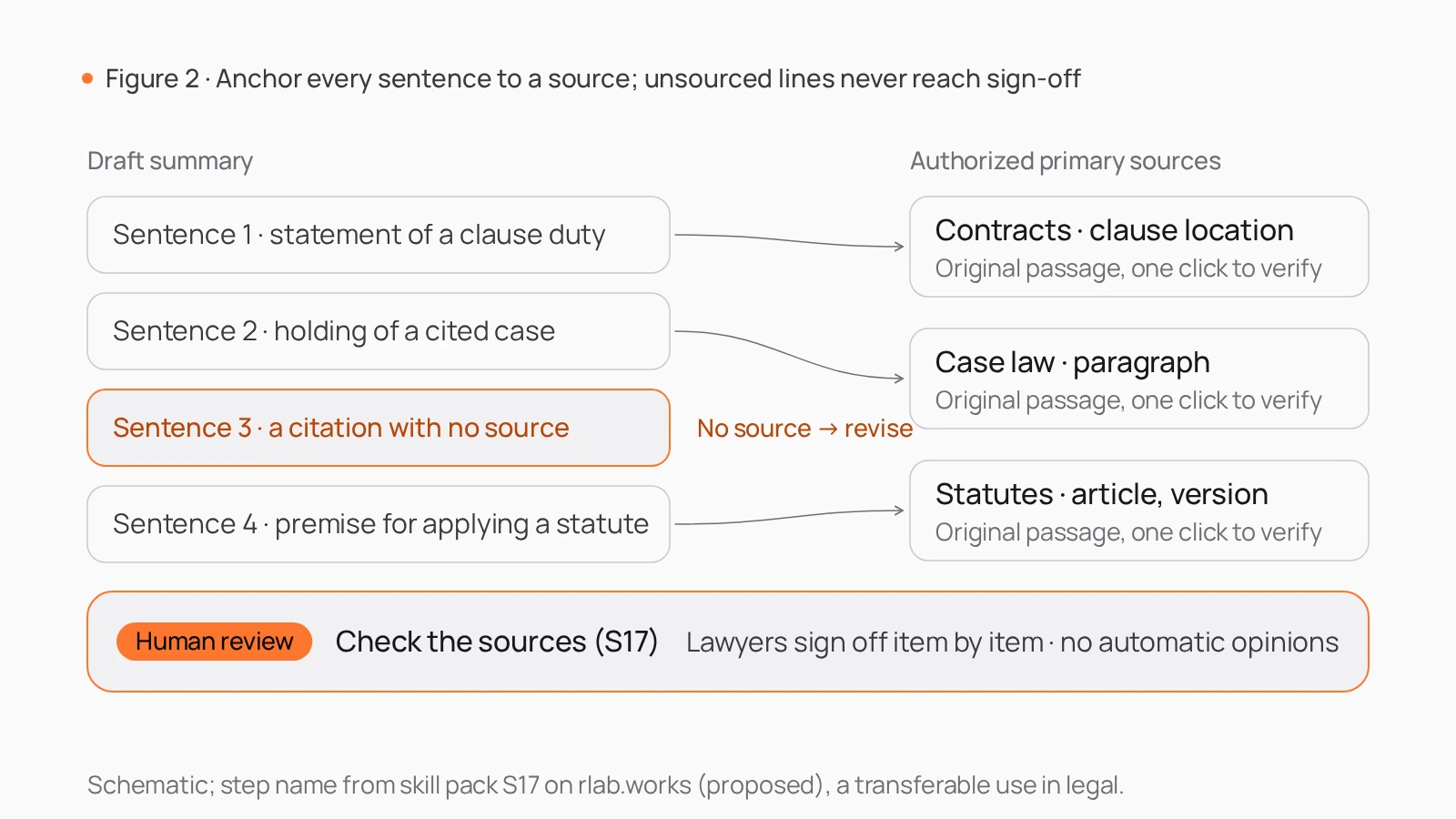
At the clause lookup layer, Connect information search (S17) in the AI Gateway module starts from an explicit input contract: Question, authorized sources and search scope. It collects permitted material with source attribution, builds ranked retrieval candidates from authorized passages, and prepares a summary draft with passage citations before halting at a human review gate—Check the sources. A reviewer confirms the summary and evidence package, while rejected output returns for revision and does not advance. In legal practice, this connects an authorized contract repository to clause search while preserving original passage locations so legal staff can inspect sources line by line.
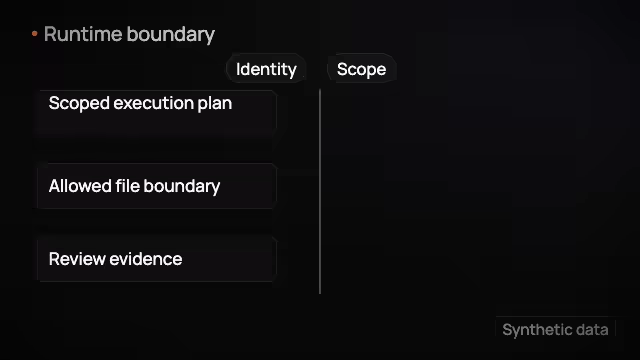
For local docket organization, Approve computer actions (S03) in the Agent OS module takes an Action goal, account and permitted materials, checks readiness, and pauses at Approve the action list. Once approved, it acts via native computer control with permission gates, retaining screenshots, file diffs, and execution receipts before a final Check the changes human review gate.
Architectural honesty requires stating clear boundaries. In the rlab.works catalog, legal services has no skill packs rated as source-supported industry; all packs discussed here are designated for transferable use. Every skill pack is a proposed composition demonstrated with synthetic data and not yet connected to live services, and component maturity reflects static source inspection rather than production deployment. Adapting them to legal practice requires domain engineering:
- Connect information search (S17): wire in document access permissions and clause locations; summary outputs must never stand in as legal opinions.
- Research and write a report (S24): replace academic paper connectors and news topic models, and verify statutory validity and case applicability; the workflow never makes automated legal conclusions.
- Keep an evidence memo (S25): replace disclosure, market-series, and company models entirely with case files, statutes, parties, and timelines; original scores cannot be transferred as legal judgments.
- Approve computer actions (S03): restrict readable and modifiable directories item by item; external submissions remain outside default permissions.
Pre-Pilot Checks for Managing Partners and General Counsel
Before funding a legal AI pilot, a managing partner or General Counsel can apply concrete checks to ensure compliance with professional responsibility:
- Are claims anchored to exact locations in authorized primary sources? Confirm that search is restricted to approved statutory and case databases or permissioned contract stores, and that every drafted sentence links to an inspectable passage.
- Does the workbench place supporting and contrary authority side by side? Because models readily accept incorrect legal assumptions[1], require explicit separation of supporting precedents, adverse authority, and unresolved facts.
- Do human gates enforce attorney sign-off and block external filing? Ensure unapproved summaries, memos, and file edits cannot advance without human review, and keep external submissions disabled by default.
Found it useful? Pass it on.
References
- [1]
Dahl, M., Magesh, V., Suzgun, M., & Ho, D. E. (2024). Large Legal Fictions: Profiling Legal Hallucinations in Large Language Models. Journal of Legal Analysis, 16(1), 64–93. doi.org/10.1093/jla/laae003
- [2]
Magesh, V., Surani, F., Dahl, M., Suzgun, M., Manning, C. D., & Ho, D. E. (2025). Hallucination-Free? Assessing the Reliability of Leading AI Legal Research Tools. Journal of Empirical Legal Studies, 22(2), 216–242 (arXiv:2405.20362, 2024). doi.org/10.1111/jels.12413
- [3]
Guha, N., Nyarko, J., Ho, D. E., Ré, C., Chilton, A., Narayana, A., Chohlas-Wood, A., Peters, A., Waldon, B., Rockmore, D. N., Zambrano, D., Talisman, D., Hoque, E., Surani, F., Fagan, F., Sarfaty, G., Dickinson, G. M., Porat, H., Hegland, J., … Li, Z. (2023). LegalBench: A Collaboratively Built Benchmark for Measuring Legal Reasoning in Large Language Models. Advances in Neural Information Processing Systems, 36 (Datasets and Benchmarks Track). arxiv.org ↗
Related capabilities
Platform modules
Skills packs
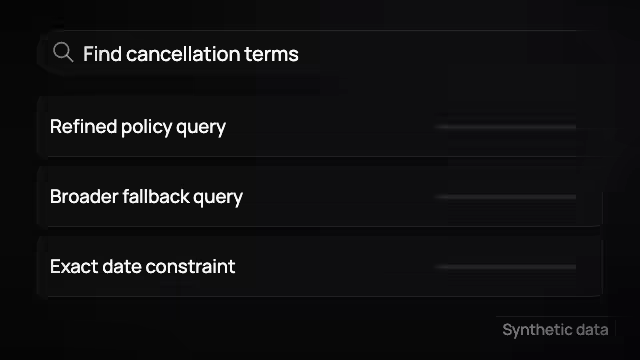
S24 · Intelligence
Research and write a report
Half of writing a research report goes into finding and citing sources, and it still ends up unclear which line came from where.
Plan search scope, collect and cite material, then export a report after human review.
- Plan the search scope
- Collect and extract material
- Organize citations and findings
- Review the evidenceHuman review
- Format and export
5 steps1 human reviews8 components

S17 · AI Gateway
Connect information search
AI answers sound convincing, but without sources nobody dares to use them.
Connect information sources, retrieve relevant passages and check summary sources and access scope.
- Collect permitted material
- Build retrieval candidates
- Prepare the summary
- Check the sourcesHuman review
4 steps1 human reviews5 components
S03 · Agent OS
Approve computer actions
Back-office entry, forms and file edits are repetitive computer work you would hand to AI, if you trusted it not to click and change the wrong things.
Check identity and action scope, run approved actions and retain page and file changes.
- Check readiness
- Approve the action listHuman review
- Act and retain evidence
- Check the changesHuman review
4 steps2 human reviews8 components
S25 · Intelligence
Keep an evidence memo
Research calls are kept as conclusions only, and later nobody can recall the evidence or the objections.
Bring documents, claims and counterevidence together and save a traceable memo after review.
- Collect source evidence
- Resolve entities and relations
- Compare claims and challenges
- Review and save the memoHuman review
4 steps1 human reviews8 components