D30 SeriesD · Governance & trust
The Illusion of Post-Hoc Explainability vs. Auditable Evidence Chains: Why High-Stakes Decisions Demand Source Alignment Rather Than Saliency Maps
Post-hoc explanations—whether visual saliency maps or a language model's chain-of-thought self-reports—can diverge from what actually drove a prediction; governing high-stakes workflows requires anchoring conclusions to verifiable source passages, media frames, and human approval records.


When a Coherent "Reasoning Trace" Masks the Real Driver of a Decision
Imagine a compliance or quality-assurance workflow where a team deploys a large model to assist with high-stakes reviews. To make the system appear transparent, the interface asks the model for a step-by-step reasoning trace before stating its conclusion, or overlays a visual saliency heatmap on an image. Seeing an articulate explanation, the reviewer assumes the rationale has been verified and signs off. Later, a spot check reveals that the model’s outputs were swayed by option ordering or latent biases in the prompt—factors omitted from the plausible explanation the reviewer read.
This scenario highlights a critical hazard in enterprise governance: mistaking post-hoc explainability for an auditable record of causation. Because post-hoc explanations—such as saliency heatmaps or self-reported reasoning—can be unfaithful rationalizations, high-stakes conclusions must be anchored to clickable source passages, media frames, and human approval records.
Why Post-Hoc Explanations Fall Short of Auditability: Black Boxes, Unfaithful Chains of Thought, and Model Cards
Computer science research has examined the gap between post-hoc explanations and genuine accountability across model interpretability, chain-of-thought faithfulness, and standardized model reporting.
First, bolting a secondary explanation method onto a black box is not equivalent to building an inherently interpretable system. Rudin (2019) notes that black box machine learning models are widely used for high-stakes decisions in healthcare, criminal justice, and other domains that directly affect human lives, causing serious problems in practice[1]. Although interest has grown in “explainable AI”—where a separate model is created to explain how a black box model arrived at a specific decision—trying to explain black boxes rather than creating inherently interpretable models in the first place is likely to perpetuate bad practice and risk great harm to society[1]. Clarifying the chasm between explaining black boxes and using inherently interpretable models, Rudin (2019) argues that high-stakes applications across criminal justice, healthcare, and computer vision should avoid explainable black boxes in favor of inherently interpretable designs[1].
Second, in large language models, step-by-step chain-of-thought (CoT) reasoning—frequently treated as a transparent window into how a model solves a task—suffers from systematic faithfulness failures. Turpin, Michael, Perez, and Bowman (2023) showed that while CoT prompting achieves strong task performance, CoT explanations can systematically misrepresent the true reason for a model’s prediction[3]. When the researchers added biasing features to model inputs—such as reordering multiple-choice options in a few-shot prompt so the answer was always “(A)“—the resulting CoT explanations were heavily influenced by these features yet systematically failed to mention them[3]. When biased toward incorrect answers, models frequently generated CoT explanations rationalizing those wrong answers, causing accuracy to drop by as much as 36% on a suite of 13 tasks[3] from a challenging benchmark when tested on commercial large language models[3]. On a social-bias task, model explanations similarly justified answers aligned with stereotypes without mentioning the influence of those social biases[3]. Because CoT explanations can be plausible yet misleading, relying on them risks increasing trust in models without guaranteeing safety[3].
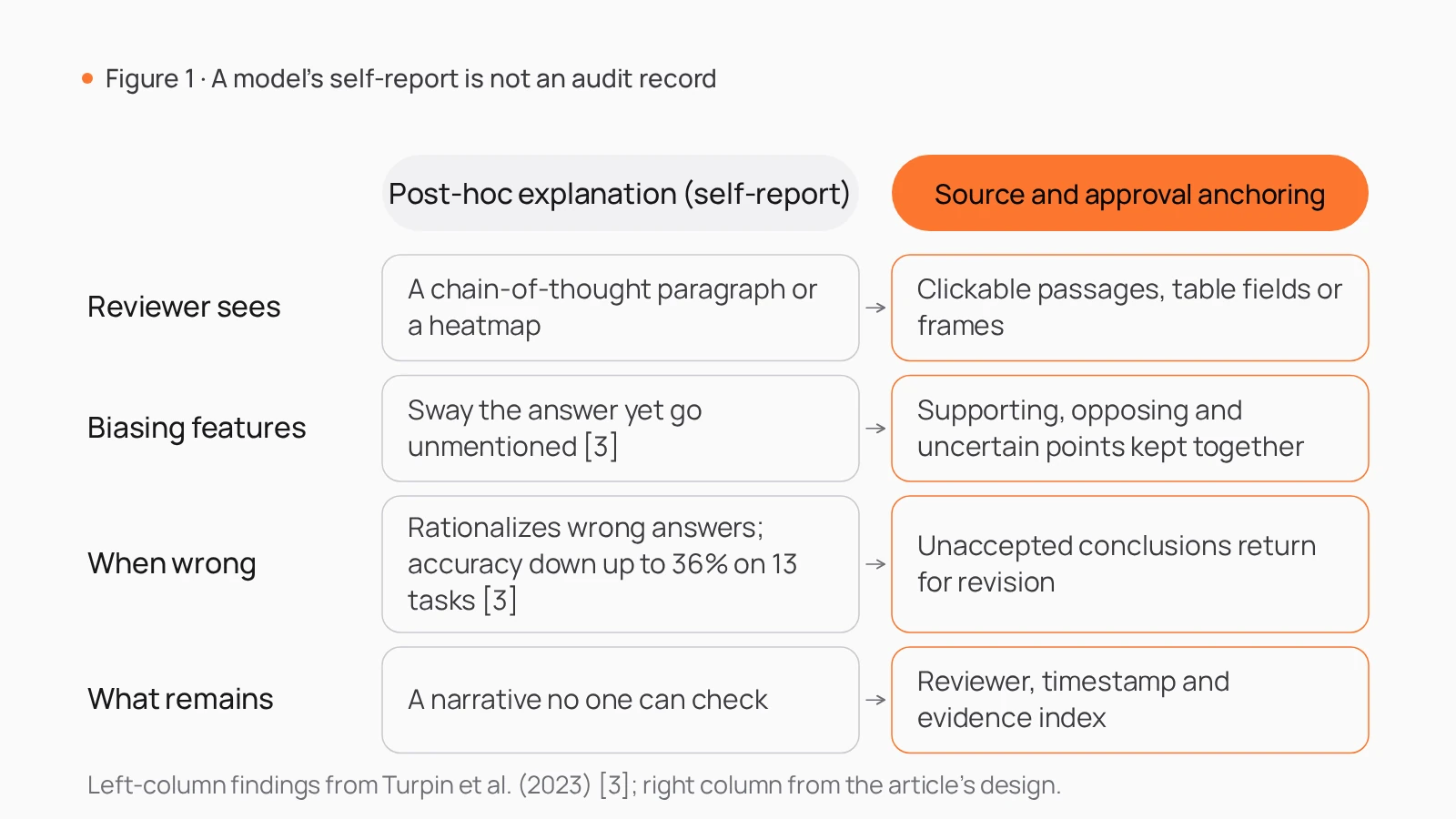
From Model Self-Reports to Source and Approval Anchoring in System Architecture
If a model’s self-explanation cannot serve as an audit trail, software architecture for high-stakes workflows must shift its center of gravity. Instead of asking a model why it reached an answer, the engineering layer must enforce input contracts, bind claims to external source passages or media frames, surface counterevidence, and record human review decisions in a versioned state machine.
Within the Intelligence module on rlab.works, synthesis workflows are built around source alignment rather than unconstrained narrative generation:
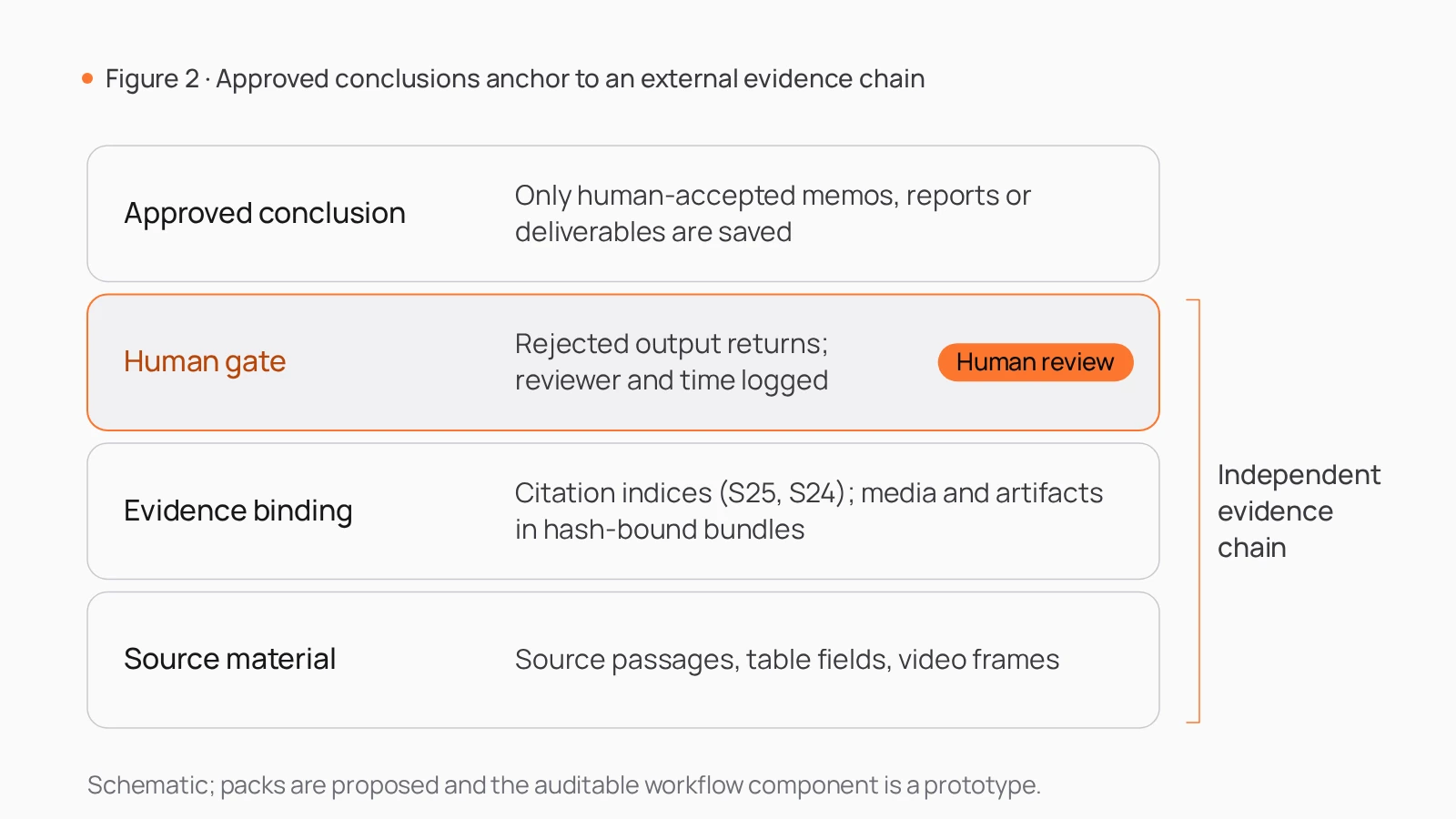
- Keep an evidence memo (S25): Starting from an input contract of Research entities, claims and existing evidence, this workflow collects dated and attributed source packages, resolves entity relations and evidence indices, and compares claims against challenges to record supporting, opposing, and uncertain points. The final stage is a human review gate: an assigned reviewer or requesting user inspects the record before saving, and rejected output is returned for revision and does not advance. Underneath, this workflow draws on the investment thesis evidence and verdict tracking component, which grades sources, separates supporting, opposing, and complicating factors, and derives conclusions subject to human override.
- Research and write a report (S24): Governed by an input contract of Research question, permitted sources and report outline, this workflow plans search scope, extracts sectioned material with citation indices, and organizes a cited draft before pausing at a human gate to review the evidence prior to export.
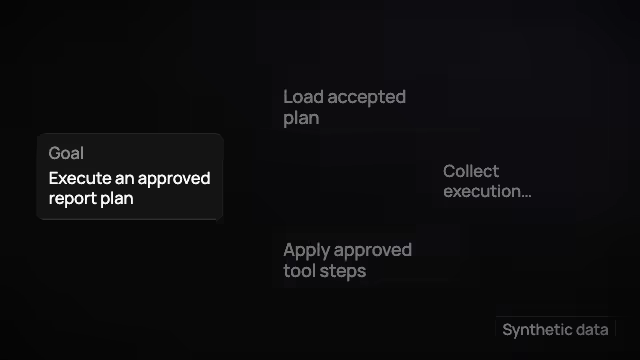
When verification extends to visual media or multi-stage task orchestration, the same principle applies to frame-level inspection and state-machine logging. The video comparison and verified delivery bundles component compares source video against outputs across runs, collects review history and costs, and packages media and artifacts in hash-bound bundles for offline inspection and reproduction. In the Agent OS module, Plan and deliver work (S01) breaks goals into dependent task plans with human review gates at scope approval and handover. Paired with Auditable workflows, human confirmation and decision review, the system persists versioned workflows, enforces permission checks, pauses for human decisions, and records review outcomes.
Pre-Pilot Governance Checks for High-Stakes Workflows
Before funding or approving an assisted decision workflow in a high-stakes domain, executives and risk leaders can apply concrete checks to guard against the post-hoc explanation illusion:
- Check whether the interface provides source anchors rather than self-reports: Do not accept pilot designs where verification relies on reading a chain-of-thought paragraph or viewing a heatmap. Require clickable links to exact source passages, table cells, or hash-bound media frames.
- Verify structured counterevidence and model boundary documentation: Confirm that the workflow preserves opposing and uncertain evidence alongside supporting claims, and require documented evaluation boundaries—following the model cards framework—so models are not applied outside validated conditions.
- Audit the blocking authority of human review gates: Ensure that human confirmation points are wired into the workflow state machine so rejected outputs cannot advance, and verify that every accepted deliverable archives the reviewer identity, timestamp, and evidence index.
Found it useful? Pass it on.
References
- [1]
Rudin, C. (2019). Stop explaining black box machine learning models for high stakes decisions and use interpretable models instead. Nature Machine Intelligence, 1(5), 206–215. doi.org/10.1038/s42256-019-0048-x
- [2]
Mitchell, M., Wu, S., Zaldivar, A., Barnes, P., Vasserman, L., Hutchinson, B., Spitzer, E., Raji, I. D., & Gebru, T. (2019). Model Cards for Model Reporting. Proceedings of the Conference on Fairness, Accountability, and Transparency (FAT '19), 220–229. doi.org/10.1145/3287560.3287596
- [3]
Turpin, M., Michael, J., Perez, E., & Bowman, S. R. (2023). Language Models Don't Always Say What They Think: Unfaithful Explanations in Chain-of-Thought Prompting. Advances in Neural Information Processing Systems (NeurIPS), 36. arxiv.org ↗
Related capabilities
Platform modules
Skills packs
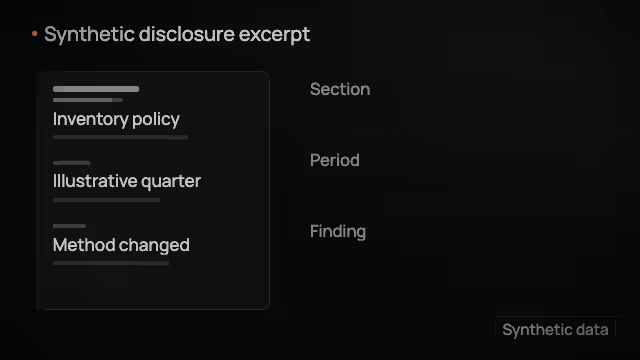
S25 · Intelligence
Keep an evidence memo
Research calls are kept as conclusions only, and later nobody can recall the evidence or the objections.
Bring documents, claims and counterevidence together and save a traceable memo after review.
- Collect source evidence
- Resolve entities and relations
- Compare claims and challenges
- Review and save the memoHuman review
4 steps1 human reviews8 components
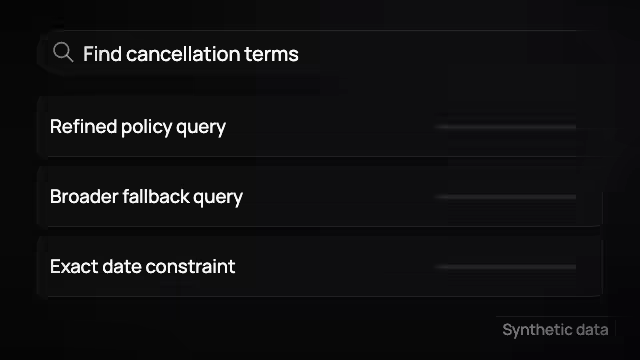
S24 · Intelligence
Research and write a report
Half of writing a research report goes into finding and citing sources, and it still ends up unclear which line came from where.
Plan search scope, collect and cite material, then export a report after human review.
- Plan the search scope
- Collect and extract material
- Organize citations and findings
- Review the evidenceHuman review
- Format and export
5 steps1 human reviews8 components
S01 · Agent OS
Plan and deliver work
Hand AI a big job and it often stops halfway or drifts, and nobody can tell how far it got.
Break a goal into dependent tasks, confirm execution and deliver reviewable results.
- Plan the steps
- Approve the scopeHuman review
- Run and collect
- Review and hand overHuman review
4 steps2 human reviews7 components