D29 SeriesD · Governance & trust
Data Provenance and Catalog Hygiene: Why Upstream Data Contracts Matter More Than Downstream Fine-Tuning for System Ceilings
In our view, many AI quality failures start in upstream data; organizations should enforce ingestion contract validation, media provenance review, and source-change alerting before data ever enters a retrieval or generation pipeline.


Why Downstream Tuning Cannot Rescue an Unchecked Upstream Catalog
Consider a common scenario. An organization deploys a retrieval-augmented knowledge assistant and content generation pipeline, only to find that the system regularly surfaces outdated pricing, conflates product attributes across suppliers, or incorporates third-party media whose licensing scope was never verified. Engineering teams may respond by treating the symptoms at the model layer—rewriting system prompts, adjusting chunking heuristics, or fine-tuning model weights. Yet a closer audit of the underlying tables reveals that upstream supplier schemas changed silently weeks ago, legacy migrations left behind orphaned records, and unverified media assets were ingested directly into production indexes.
When upstream catalogs suffer from entity collisions, missing lineage, and silent drift, downstream model tuning merely packages corrupted inputs into more fluent prose. In our view, many AI quality issues start in upstream data; organizations should enforce ingestion contract validation, media provenance review, and source-change alerting before data enters a retrieval or generation pipeline. Upstream data provenance and catalog hygiene—not downstream parameter tuning—set the ceiling on system reliability.
Datasheets, Data Statements, and Content Credentials: The Foundations of Upstream Governance
Model architecture usually gets the attention, while the boundary conditions of datasets are rarely written down in a standard form. Across computer science research and industry standards bodies, complementary frameworks address how data lineage and context should be recorded and verified.
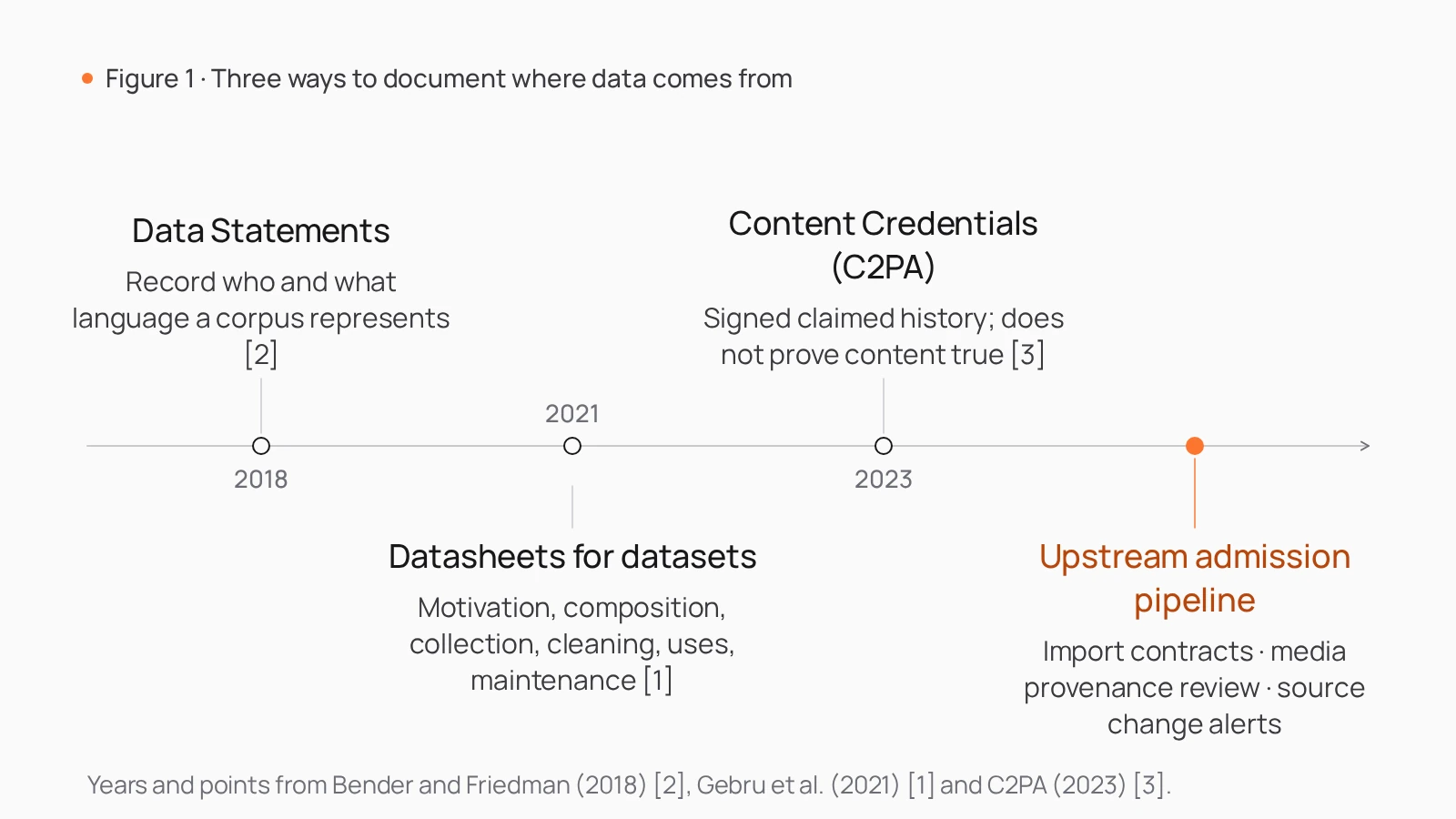
The first framework is standardized documentation for general datasets. Gebru et al. (2021) propose that every dataset be accompanied by a datasheet documenting its motivation, composition, collection process, preprocessing, cleaning, and labelling, recommended uses, distribution, and maintenance[1]. The authors model this practice on the datasheets that accompany electronic components in hardware engineering[1]. Just as an electrical engineer would not wire a component into a circuit without knowing its operating characteristics, software teams need explicit documentation to improve communication between dataset creators and consumers and to encourage transparency and accountability across the data supply chain[1].
A second framework addresses population and linguistic context for text corpora. Bender and Friedman (2018) propose data statements as a design solution and professional practice for natural language processing technologists across both research and development[2]. They observe that critical scientific and ethical issues arise when data collected from certain populations is used to develop language technology deployed for other populations[2]. Adopting data statements as part of regular practice helps alleviate issues tied to exclusion and bias in language technology, leads to better precision in claims about how natural language processing research can generalize—and thus better engineering results—protects companies from public embarrassment, and ultimately leads to language technology that meets users in their preferred linguistic style without misrepresenting them to others[2].
A final framework provides cryptographic provenance for rich media assets. Because images, audio, and video move across organizational boundaries where metadata is easily stripped or altered, the Coalition for Content Provenance and Authenticity (C2PA, 2023) established an open technical standard for content provenance[3]. Under the C2PA specification, a manifest containing assertions—such as how and by whom content was created or edited—is cryptographically signed and bound to the asset, enabling downstream consumers to verify its origin and edit history as “Content Credentials”[3]. A critical engineering boundary applies here: C2PA provenance shows a claimed history and who signed it, but it does not prove that the underlying content is true[3]. Cryptographic signatures verify custody and tamper evidence; factual accuracy still requires domain rules and human review.
Engineering Provenance into the Pipeline: Catalog Unification, Change Monitoring, and Media Review
Translating these principles into software architecture means placing contract validation, provenance checks, and human review gates upstream of model inference. Within the Intelligence module on rlab.works, this governance layer is structured through relevant skill packs and supporting components.
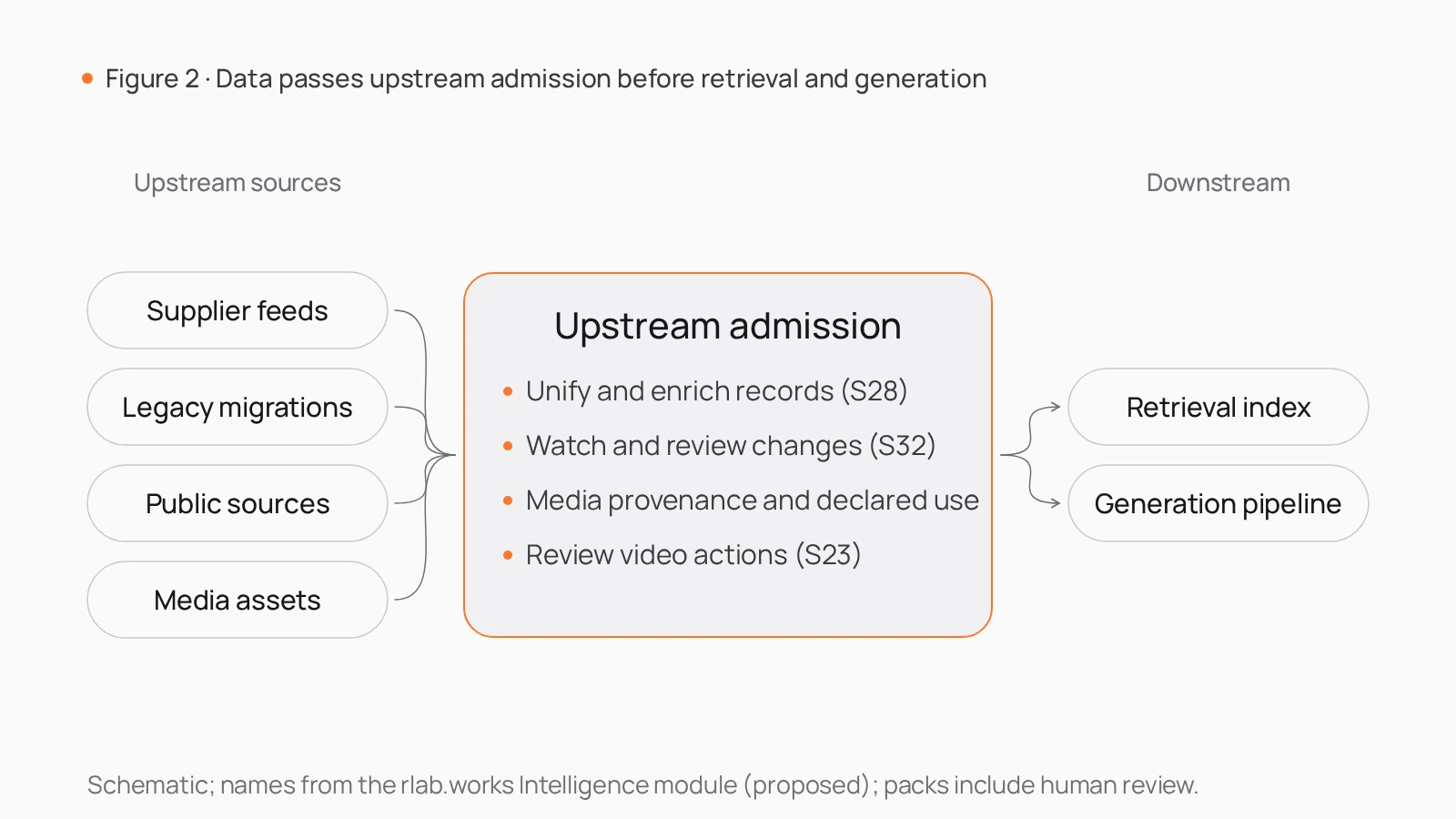
For continuous external source monitoring, the skill pack Watch and review changes (S32) takes Permitted sources, topic terms and tracked entities and runs Register and collect sources (timestamped raw signals with provenance), Deduplicate and compare changes (change diffs and announcement evidence), and Organize relevant signals (candidate items with rationale and evidence), before pausing at a human gate: Review and archive, which outputs reviewer-selected items, archive bundles, and follow-up suggestions. At ingestion, the Reusable B2B signal dataset registration component registers external signal datasets via validated contracts and normalizes public community data for reuse. This pack is tagged for transferable use in Sports (monitoring permitted public updates around match schedules to build evidenced editorial queues, though financial and travel vocabularies must be replaced and public social posts cannot replace official team confirmation) and in Government & public services (routing public notice and resident feedback changes into a review queue, without treating post counts as representative public opinion and while replacing source event models). It has no tag for Travel & hotels or Media & content.
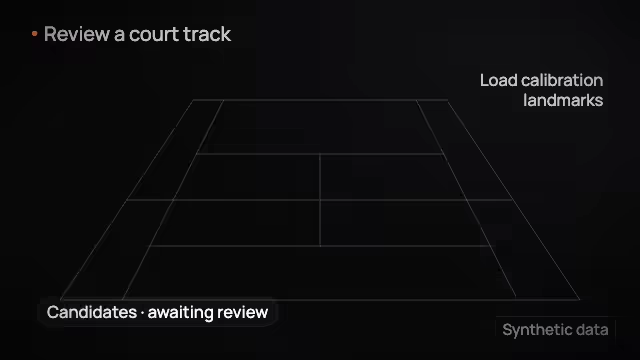
For rich media and video governance, the Media provenance and declared-use review component binds source identity, archival evidence, and declared-use scope to media assets, blocking reuse when provenance is unconfirmed or evidence changes. For video analysis, the skill pack Review video actions (S23) takes Authorized footage, venue information and review goal and places a human gate at the initial Confirm footage sources step before Normalize timing and frames and Propose motion candidates. A subsequent human gate at Review against requirements requires human reviewers to verify trajectories before the pipeline can Summarize confirmed events, Build annotated replays, and Hand over the review pack. This pack is a source-supported industry pattern in Sports (scoped to designated court ball-tracks, with speed readings bounded by calibration and event conditions) and a transferable use in manufacturing (requiring new station calibration and motion candidates, without automated standard-operating-procedure recognition or violation ruling), with no tag for Travel & hotels, Media & content, or Government & public services.
Architectural candor requires stating current limits: every skill pack is a proposed composition demonstrated with synthetic data and not yet connected to live services. Component maturity (working code) comes from static source inspection rather than production deployment, and a source-supported industry label means only that source data has an explicit industry association—not customers, deployments, or outcomes.
Upstream Hygiene Checks Before Funding an AI Pilot
Before approving budgets for retrieval pipelines or downstream model fine-tuning, a CEO, CDO, or department head can apply these concrete checks:
- Enforce blocking ingestion contracts: Verify that legacy migrations and multi-supplier feeds automatically generate orphan-record and missing-dimension reports. Datasets lacking documented provenance, collection context, and declared scope should be quarantined in staging rather than merged into production indexes.
- Bind provenance and declared-use scope to media and external signals: Confirm that media assets and external updates carry verifiable origin records and usage constraints, that assets are blocked automatically if provenance changes, and that workflows distinguish between a verified cryptographic signature and verified factual truth.
- Gate entity resolution and fact completion behind human review: Ensure that conflicting supplier attributes, external change alerts, and video trajectory candidates pause in a human review queue where rejected items return for revision, preventing unverified candidates from cascading into downstream outputs.
Found it useful? Pass it on.
References
- [1]
Gebru, T., Morgenstern, J., Vecchione, B., Vaughan, J. W., Wallach, H., Daumé III, H., & Crawford, K. (2021). Datasheets for datasets. Communications of the ACM, 64(12), 86–92. doi.org/10.1145/3458723
- [2]
Bender, E. M., & Friedman, B. (2018). Data Statements for Natural Language Processing: Toward Mitigating System Bias and Enabling Better Science. Transactions of the Association for Computational Linguistics (TACL), 6, 587–604. doi.org/10.1162/tacl_a_00041
- [3]
Coalition for Content Provenance and Authenticity (C2PA). (2023). C2PA Technical Specification (v1.3 / v2.0). C2PA. c2pa.org ↗
Related capabilities
Skills packs
S28 · Intelligence
Unify and enrich records
The same item exists in several systems under different names with missing fields, and it gets messier over time.
Merge source records into one catalog, identify gaps and have reviewers accept additional facts.
- Ingest and stage sources
- Normalize and resolve entities
- Classify and locate gaps
- Investigate and accept factsHuman review
4 steps1 human reviews10 components
S32 · Intelligence
Watch and review changes
Competitors, policies and announcements change daily; checking pages by hand means hearing about important changes late.
Monitor permitted sources, surface evidenced changes and let reviewers decide follow-up actions.
- Register and collect sources
- Deduplicate and compare changes
- Organize relevant signals
- Review and archiveHuman review
4 steps1 human reviews8 components
S23 · Intelligence
Review video actions
Finding key moments frame by frame is slow and tiring, and the conclusions are hard to check later.
Preserve footage sources, propose motion candidates and create evidence-linked replays after human correction.
- Confirm footage sourcesHuman review
- Normalize timing and frames
- Propose motion candidates
- Review against requirementsHuman review
- Summarize confirmed events
- Build annotated replays
- Hand over the review pack
7 steps2 human reviews8 components