D31 SeriesD · Governance & trust
Defense-in-Depth for Agent Tool Use: Mitigating Indirect Prompt Injection, OAuth Token Escalation, and Plugin Supply-Chain Poisoning
Once an agent can read external content and invoke tools, indirect prompt injection and confused-deputy privilege escalation become primary engineering threats. Production defenses require signed plugins and license audits, least-privilege per-agent identities, and policy gateways paired with human approval gates for high-risk actions.


When Untrusted Retrieval Meets Broad Credentials
Consider a plausible engineering scenario: an internal operations or legal team connects an assistant agent to a document-fetching plugin and an internal workspace connector. To avoid repeated authorization prompts, the team configures the agent with a shared OAuth token that holds read-and-write permissions across team folders and messaging channels. When a staff member asks the agent to summarize an external vendor brief or web page, hidden text inside the retrieved file instructs the model to query internal draft notes in the same directory and transmit them through an outbound API call. Without triggering a syntax error or authentication failure, a summarization helper becomes an automated exfiltration path.
This scenario highlights the core security boundary of tool-using agents. Once an agent can read external content, indirect prompt injection becomes a primary operational threat. Because prompt wording alone cannot reliably separate untrusted data from legitimate instructions, defenses must be built in depth: scanning plugin signatures and licenses before installation, enforcing least-privilege identities per agent, and routing high-risk calls through policy gateways and mandatory human confirmation.
Blurred Instruction Boundaries, Memorization Leakage, and the Confused Deputy
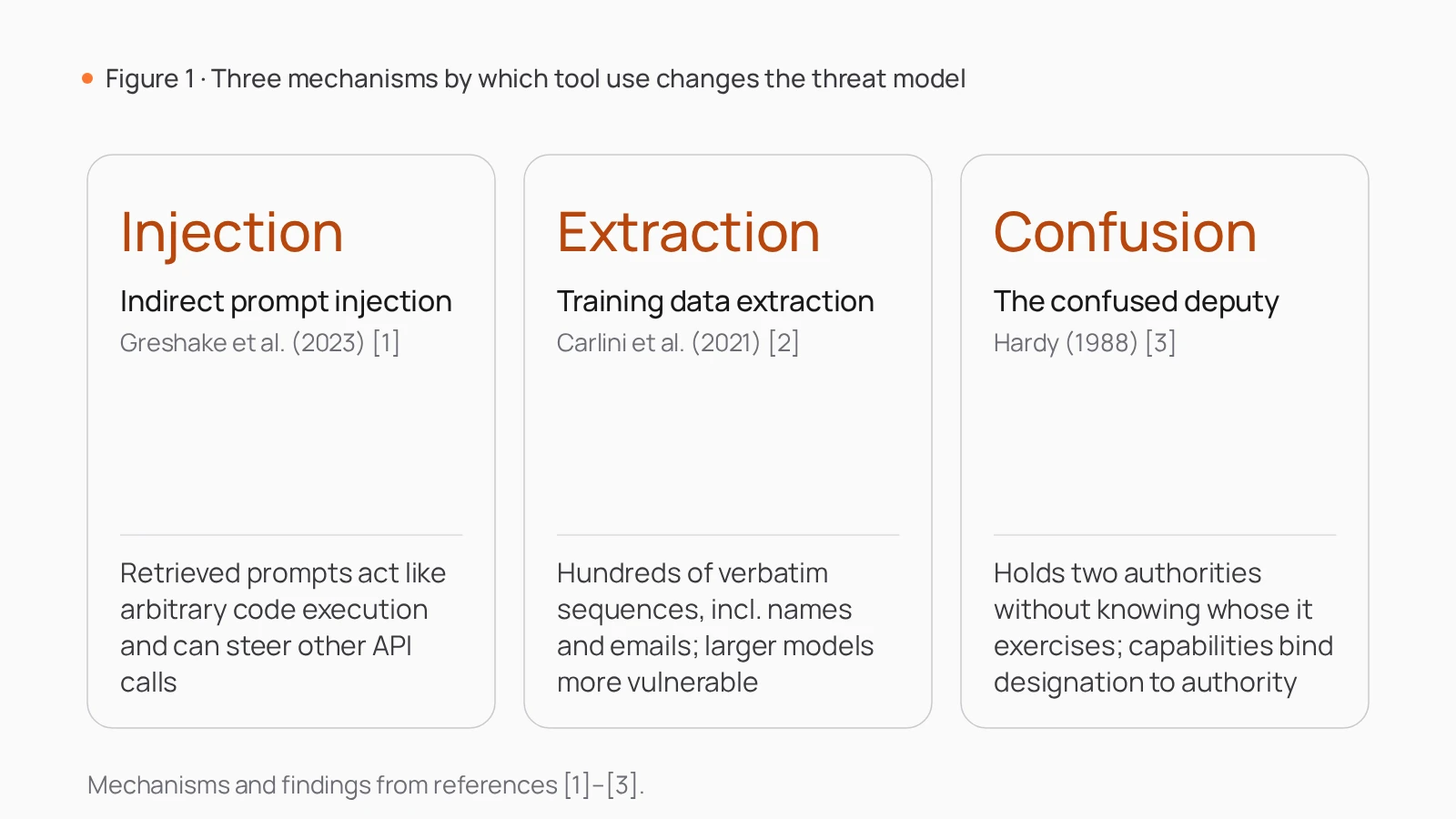
Why does combining language models with external tools alter the threat model so sharply? Security research across machine learning and operating systems explains how three mechanisms interact.
First is the collapse of the boundary between data and instructions. Greshake et al. (2023) note that prior work assumed the user was directly prompting the language model; however, applications integrated with large language models blur the line between data and instructions[1]. By strategically injecting prompts into data likely to be retrieved at inference time, adversaries can use Indirect Prompt Injection to remotely exploit these applications without a direct interface[1]. Deriving a taxonomy from a computer security perspective, the authors examine impacts including data theft, worming, and information ecosystem contamination, and demonstrate practical viability against real-world systems—such as web-connected chat systems and code-completion engines—and synthetic applications[1]. They show that processing retrieved prompts can act as arbitrary code execution, manipulate application functionality, and control whether and how other APIs are called, while effective mitigations remain lacking[1].
Second is the risk of training data extraction from the model itself. Carlini et al. (2021) showed that an adversary can perform a training data extraction attack to recover individual training examples by querying a large language model[2]. On a publicly available model trained on public internet data, they extracted hundreds of verbatim text sequences from the training data, including personally identifiable information (names, phone numbers, email addresses), code, and identifiers, finding that larger models were more vulnerable than smaller ones[2]. When injected prompts steer how an agent queries a model and where it sends the output, extraction risks and tool channels reinforce each other.
Third is a classic operating systems vulnerability. Hardy (1988) described a compiler service given authority to write to a billing file; when a user asked the compiler to write its output to the billing file’s name, the compiler acted with its own authority on the user’s behalf and overwrote it[3]. Hardy called the program a “confused deputy” because it held two authorities and could not tell which one it was exercising for whom[3]. He argued that capabilities—which bundle the designation of an object with the authority to use it—avoid this problem[3]. An agent holding broad OAuth tokens or desktop control while acting on instructions parsed from untrusted documents is a modern confused deputy.
Engineering Defense-in-Depth: Provenance Checks, Policy Gateways, and Human Gates
Countering these compounded threats requires moving controls out of natural-language prompts and into deterministic runtime gates. Within the Agent OS and AI Gateway modules on rlab.works, this architecture is expressed through four skill packs and scoped runtime components.
The first layer governs tool supply-chain intake. In Install and manage tools (S04), the input contract specifies the tool packages and requested access scopes. The workflow checks packages and licenses—backed by Signed plugin registry and trusted installation—to verify signatures and produce a signature and license checklist. Execution then pauses at a human review gate (Approve account scopes), where a designated reviewer or requesting user approves the connection and scope; rejected outputs return for revision and do not advance. After installation and registration, a second human gate (Check calls and rollback) verifies invocation behavior and records a rollback plan.
The second layer enforces least-privilege identity and policy routing. Under AI Gateway, Set access rules (S14) takes team roles, the service catalog, and access requirements to draft role and request rules. After a human reviewer validates diffs and approves the rule version, the policy-controlled MCP gateway and Scoped agent identity and authorization bind operations to accounts, enforce tool permission scopes, and apply endpoint and namespace policies before a final human review inspects request evidence.
The third layer gates high-risk local actions and releases. When an agent interacts with desktop interfaces or files, Approve computer actions (S03) requires the action goal, account, and permitted materials upfront. It checks readiness to create a restricted context, pauses for human approval of the action list, executes while retaining screenshots, file diffs, and receipts, and finishes with a human check of all changes. For software updates, “Release and restore apps” (S05) pairs release manifests and isolated recovery readiness checks with human approval of release conditions, staged rollout, and human acceptance or rollback decisions.
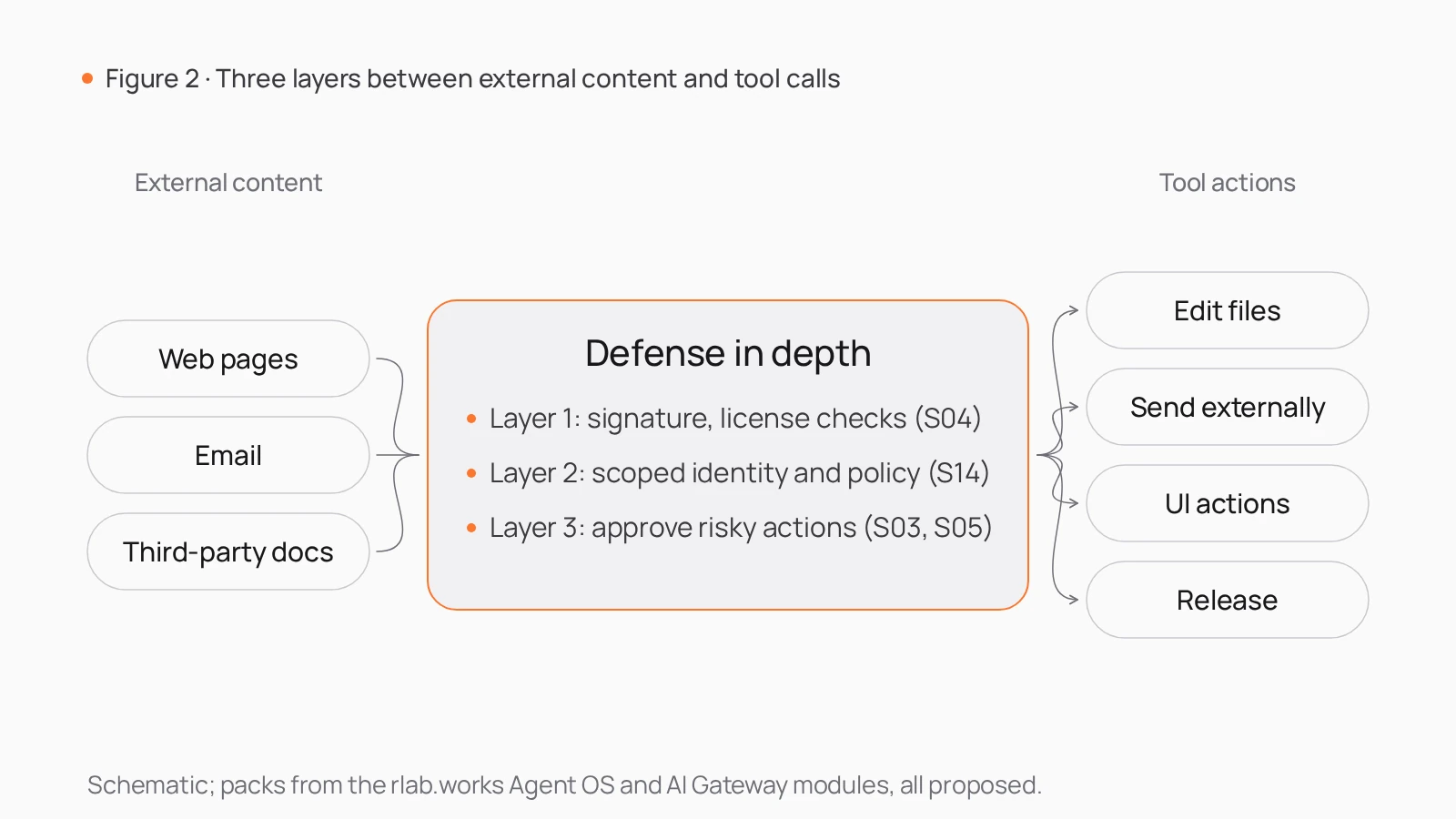
In addition, every skill pack on the site is a proposed composition demonstrated with synthetic data and not yet connected to live services; component maturity reflects static source inspection rather than production deployment.
Pre-Pilot Checks for Engineering and Risk Leaders
Before funding an agent pilot that combines external content reading with tool execution, leaders can apply three concrete checks:
- Are credentials bound to specific objects and narrow scopes? Verify that agents do not share broad service accounts or long-lived tokens; each call should bundle target designation with scoped authorization so the runtime cannot exercise broad privileges on behalf of untrusted text.
- Do policy gateways and human gates separate untrusted reading from state changes? Once a session ingests external web pages, emails, or documents, any subsequent file modification, outbound request, or interface action must pause for deterministic policy validation and human approval, with rejected actions blocked from advancing.
- Can every plugin installation and release be audited and rolled back? Confirm that third-party packages undergo signature and license verification before registration, and that recovery evidence and rollback procedures are verified before updates reach users.
Found it useful? Pass it on.
References
- [1]
Greshake, K., Abdelnabi, S., Mishra, S., Endres, C., Holz, T., & Fritz, M. (2023). Not what you've signed up for: Compromising Real-World LLM-Integrated Applications with Indirect Prompt Injection. Proceedings of the 16th ACM Workshop on Artificial Intelligence and Security (AISec), 79–90. doi.org/10.1145/3605764.3623985
- [2]
Carlini, N., Tramer, F., Wallace, E., Jagielski, M., Herbert-Voss, A., Lee, K., Roberts, A., Brown, T., Song, D., Erlingsson, U., Oprea, A., & Raffel, C. (2021). Extracting Training Data from Large Language Models. 30th USENIX Security Symposium (USENIX Security 21), 2633–2650. usenix.org ↗
- [3]
Hardy, N. (1988). The Confused Deputy: (or why capabilities might have been invented). ACM SIGOPS Operating Systems Review, 22(4), 36–38. doi.org/10.1145/54289.871709
Related capabilities
Platform modules
Skills packs
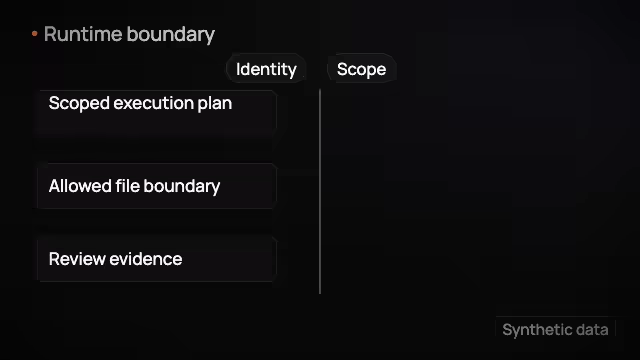
S03 · Agent OS
Approve computer actions
Back-office entry, forms and file edits are repetitive computer work you would hand to AI, if you trusted it not to click and change the wrong things.
Check identity and action scope, run approved actions and retain page and file changes.
- Check readiness
- Approve the action listHuman review
- Act and retain evidence
- Check the changesHuman review
4 steps2 human reviews8 components
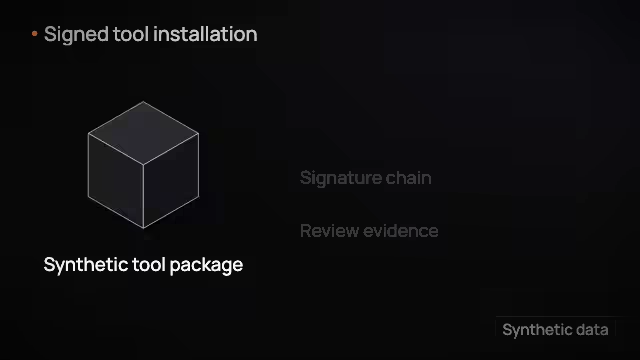
S04 · Agent OS
Install and manage tools
Adding plugins and account connections to AI is easy, but unknown plugins and broad permissions are a risk.
Check tool provenance and licenses, approve account scopes, install and inspect calls.
- Check packages and licenses
- Approve account scopesHuman review
- Install and register
- Check calls and rollbackHuman review
4 steps2 human reviews7 components
S05 · Agent OS
Release and restore apps
A new release breaks in production, and only then does it turn out there is no working backup.
Prepare release files, check recovery readiness, then decide on release and acceptance.
- Prepare release manifests
- Check recovery readiness
- Approve release conditionsHuman review
- Stage the release
- Accept or restoreHuman review
5 steps2 human reviews11 components
S14 · AI Gateway
Set access rules
Everyone uses AI, nobody controls who can call which model or tool, and incidents cannot be traced.
Define team access, review rule changes and test allowed and denied requests.
- Define access scope
- Validate and review changesHuman review
- Apply access rules
- Review request evidenceHuman review
4 steps2 human reviews6 components