[Media & Content] From Information Overload to Accountable Editorial Workflows: Daily Brief Graphs, Multilingual Adaptation Review, and Cross-Channel Attribution
As synthetic content proliferates, source traceability and editorial accountability become scarcer than raw drafting speed; media workflows must anchor daily briefs in original sources and gate multilingual adaptation, narrated video assembly, and campaign attribution behind responsible editors.


Why Surging Draft Output Leaves Newsrooms with a Trust Deficit
Consider a hypothetical international business newsroom that connects large language models and automated translation scripts to its daily publishing pipeline. Within days, the volume of aggregated morning briefs, localized articles, and short narrated video scripts rises sharply. Yet managing editors soon find their review burden heavier rather than lighter: automated morning digests blend unverified secondary claims without linking back to original sources, localized versions drift away from the approved factual baseline across languages, and short video clips arrive without clear timecode mappings between visual cuts and voiceover scripts.
This bottleneck reflects a structural shift in digital publishing. Once generative tools make raw text and audiovisual drafting abundant, production volume ceases to be a competitive advantage; source traceability and editorial accountability become the true scarce resources. For media organizations, deploying artificial intelligence responsibly requires workflows where daily briefs carry explicit source citations, and where multilingual rewrites, narrated video synthesis, and post-publication attribution pass through human editorial gates and structured campaign review.
Scarcity of Attention, Algorithmic Journalism, and the Boundaries of Public Trust
Why does expanding content supply intensify rather than relieve the editorial burden? In his foundational analysis of organizations in an information-rich world, Herbert A. Simon (1971) observed that an abundance of information creates a scarcity of what information consumes—namely, the attention of its recipients[2]. As Simon wrote, “a wealth of information creates a poverty of attention”[2]. Consequently, designing effective information systems in an information-rich environment must focus on conserving attention through filtering, rather than on supplying ever more raw information[2]. When a media workflow uses automation merely to multiply unverified summaries and localized variants without rigorous filtering and provenance, it taxes the attention of both internal editors and external readers.
As computational systems moved deeper into newsrooms, Nicholas Diakopoulos (2019) examined the present and future of algorithmic media in his book on how algorithms are rewriting the media[1]. From uncovering hidden connections in big data to bots spreading fake news, journalism is increasingly computer-generated; yet Diakopoulos shows why journalists—and their professional values—are at little risk of being replaced[1]. Algorithms can assist in ingesting feeds, linking entities, and formatting drafts, but verifying facts, weighing editorial judgment, and standing behind published claims remain irreducibly human responsibilities.
Audience research reinforces this division of labor. The Reuters Institute’s 2024 digital news report (Newman et al., 2024), an annual study of digital news consumption based on an online survey of around 95,000 respondents across 47 markets[3], documents clear boundaries in public attitudes toward artificial intelligence in journalism. The report finds widespread public discomfort with news produced mostly by artificial intelligence with only some human oversight, alongside greater comfort when artificial intelligence is used behind the scenes to support journalists, all against a backdrop of continuing public concern about what is real and fake online[3]. Using computational pipelines behind the scenes to structure evidence while keeping editorial sign-off firmly in human hands aligns engineering architecture with audience trust.
Engineering Accountable Editorial Workflows: Brief Graphs, Multilingual Gates, and Attribution Review
Translating these principles into software architecture means replacing unconstrained generation with source-anchored pipelines and blocking human review gates. Across the Intelligence and Commerce modules on rlab.works, this editorial lifecycle is organized into four connected skill packs.
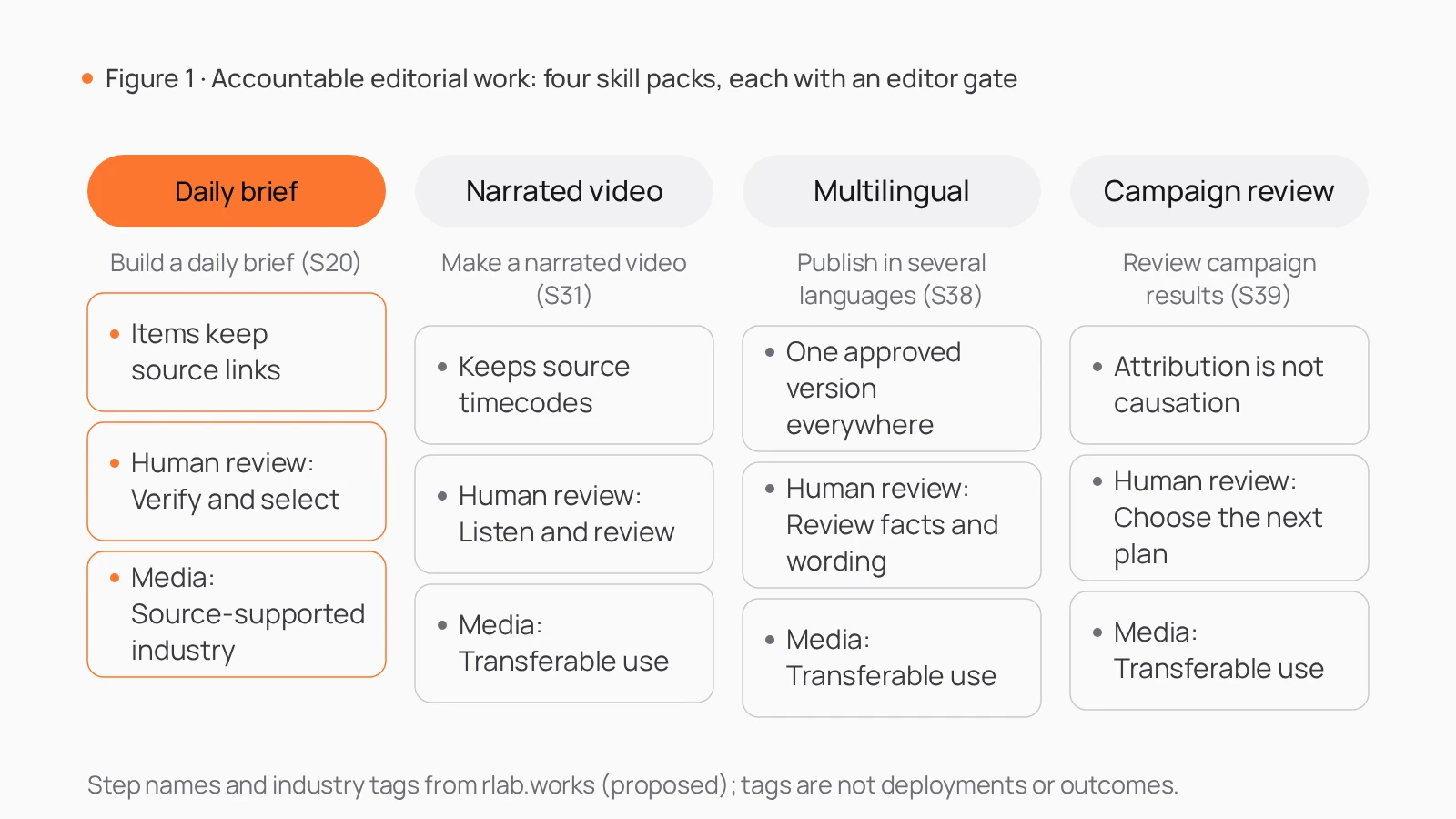
For cross-border distribution, Publish in several languages (S38) in the Commerce module takes accepted facts, audiences, languages, and target channels as input. It executes preparing content candidates (assisted), translating and checking versions (assisted), reviewing facts and wording (human review), publishing pages and messages (assisted), and completing discovery and sharing (assisted). A transferable use in both media and public services, its translation pipeline originally used hospitality fields that must be adapted for general articles, and every outlet must reference the same human-approved version so facts stay consistent across languages and channels.
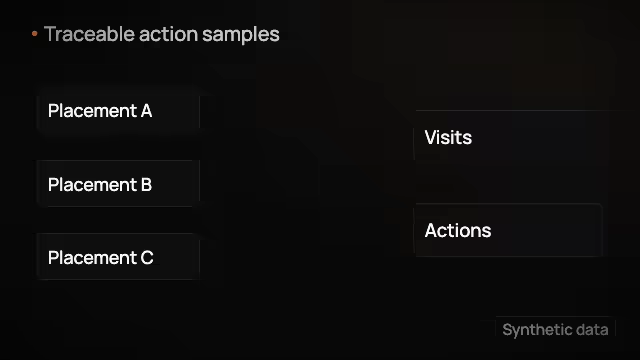
Post-publication learning is handled by Review campaign results (S39) in the Commerce module. Starting from published content, permitted analytics, and campaign goals, it links sources and actions (assisted, using the attribution and conversion feedback component to connect tracked links with registration and conversion data), checks performance and health (assisted), drafts adjustments (assisted), pauses for a human reviewer to choose the next plan (human review), and schedules and retains history (assisted). As a transferable use in media, it aligns article referral links with reading and subscription actions so editors can select the next topics and channels—requiring teams to distinguish reads, sign-ups, and paid events, while recognizing that attribution correlation does not prove causal impact.
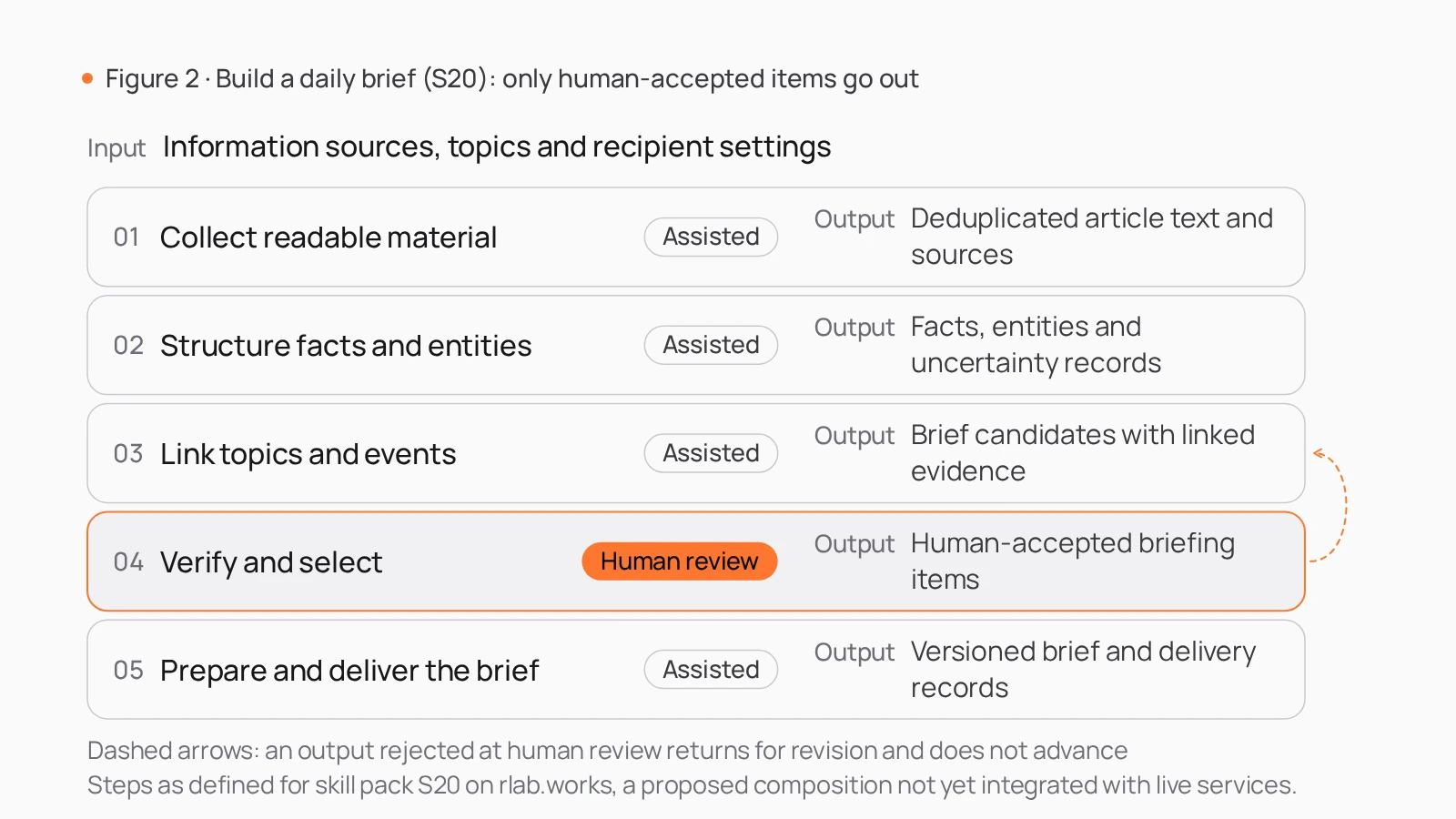
Honesty about system maturity is essential. Every skill pack on rlab.works is a proposed composition demonstrated with synthetic-data walkthroughs and is not yet connected to live services. Component maturity reflects static code inspection rather than production deployment. Even where Build a daily brief (S20) is a source-supported industry pack for media, that label means only that the source data has an explicit industry association—never customer deployments or live outcomes.
Pre-Pilot Checks for Editorial and Media Engineering Leaders
Before funding an editorial automation pilot, an editor-in-chief or media technology lead can apply three concrete checks to verify whether the proposed system protects editorial accountability:
- Verify source and timecode traceability contracts: Ensure that every candidate brief item retains links to deduplicated original texts and explicit uncertainty flags, and that narrated video edits preserve source time mappings. Drafts without verifiable provenance should be blocked from entering the review queue.
- Enforce a single approved factual baseline across languages: Confirm that multilingual adaptation workflows ingest only human-verified facts and pause at a mandatory editorial gate before publication, returning rejected translations for revision so localized channels cannot drift from the source record.
- Separate engagement tiers from causal claims in attribution review: Check that campaign review pipelines distinguish page views, newsletter sign-ups, and paid conversions, and require a human editor to approve schedule adjustments rather than letting short-term click correlations automatically dictate future editorial coverage.
Found it useful? Pass it on.
References
- [1]
Diakopoulos, N. (2019). Automating the News: How Algorithms Are Rewriting the Media. Harvard University Press. doi.org/10.4159/9780674239302
- [2]
Simon, H. A. (1971). Designing Organizations for an Information-Rich World. In M. Greenberger (Ed.), Computers, Communications, and the Public Interest (pp. 37–72). Johns Hopkins Press. gwern.net ↗
- [3]
Newman, N., Fletcher, R., Robertson, C. T., Arguedas, A. R., & Nielsen, R. K. (2024). Reuters Institute Digital News Report 2024. Reuters Institute for the Study of Journalism, University of Oxford. reutersinstitute.politics.ox.ac.uk ↗
Related capabilities
Platform modules
Skills packs
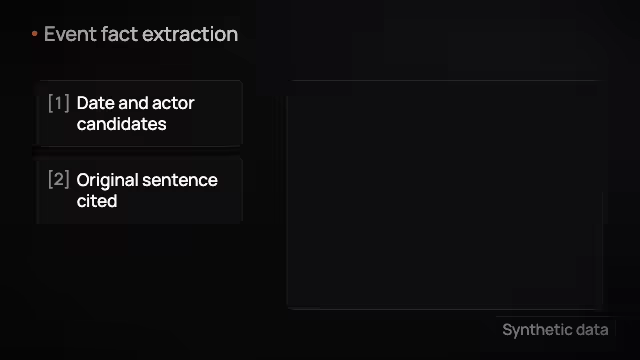
S20 · Intelligence
Build a daily brief
Dozens of sources a day, mostly repeats, and the source gets lost when someone retells it.
Turn multiple sources into cited facts and review them before preparing a subscribable brief.
- Collect readable material
- Structure facts and entities
- Link topics and events
- Verify and selectHuman review
- Prepare and deliver the brief
5 steps1 human reviews9 components
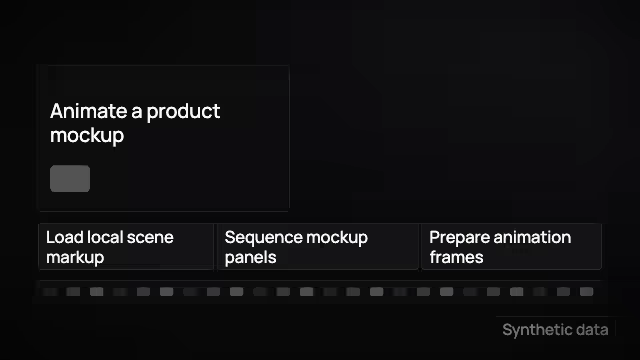
S31 · Intelligence
Make a narrated video
An explainer video means editing, narration and timing, and one change means realigning everything.
Build scenes and edits from a script, add audio and check narration and timing.
- Prepare scene visuals
- Arrange edits and replays
- Add narration and audio
- Listen and reviewHuman review
4 steps1 human reviews7 components

S38 · Commerce
Publish in several languages
One piece of content in several languages across web and social channels quickly ends up with mismatched versions.
Prepare grounded copy, translate and review it, then publish to selected pages and channels.
- Prepare content candidates
- Translate and check versions
- Review facts and wordingHuman review
- Publish pages and messages
- Complete discovery and sharing
5 steps1 human reviews8 components
S39 · Commerce
Review campaign results
After a campaign only the totals get read, and nobody can say which content or channel did better.
Check visits and action records, compare content results and confirm the next schedule.
- Link sources and actions
- Check performance and health
- Draft adjustments
- Choose the next planHuman review
- Schedule and retain history
5 steps1 human reviews9 components