[Logistics & Supply Chain] Taming the Bullwhip Effect and Dynamic Rescheduling: Geocoding Verification, Multi-Warehouse Wave Fulfillment, and Batch Exception Interception
In logistics and supply chains, AI does not replace mathematical optimization solvers; instead, it cleans noisy address and constraint inputs upstream of the solver, traces affected orders during batch exceptions, and presents rescheduling options for human dispatchers to sign off.

When Mathematical Solvers Meet Noisy Addresses and Sudden Disruptions
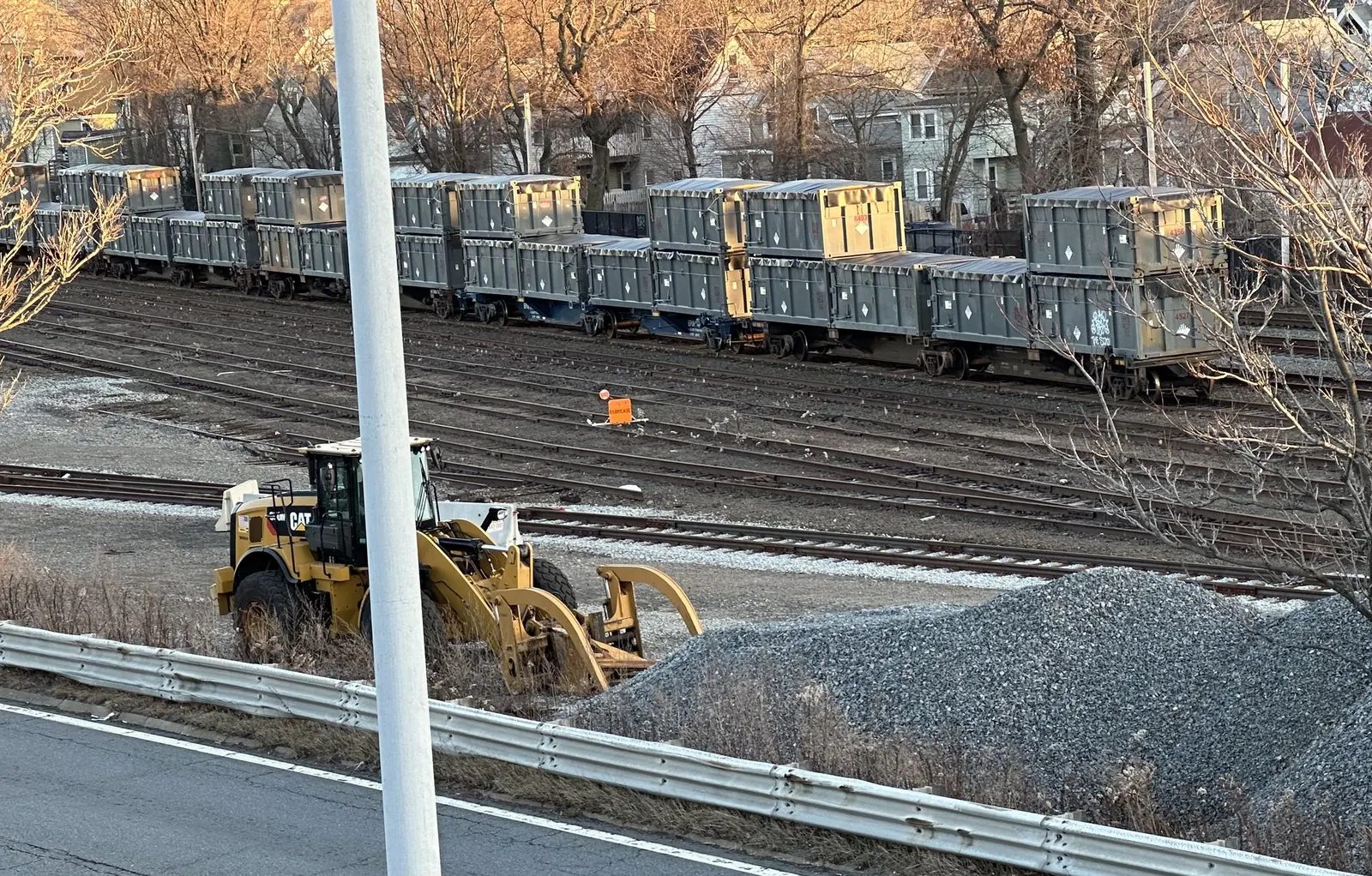
Imagine a regional distribution hub equipped with a mature vehicle routing solver. On a morning when promotional waves collide with severe weather, dispatch sheets generated by the software fail on the loading dock. Distributors submit delivery addresses with colloquial notes, causing geocoded coordinates to miss actual unloading bays. Meanwhile, returnable totes on a trunk line register damage or temperature excursions in transit, yet staff cannot quickly isolate which outbound orders contain items from that compromised batch before wave picking begins. Dispatchers fall back on phone calls and spreadsheets to hold shipments and reroute trucks manually.
Some teams ask a large language model to generate dispatch routes directly, only to find that conversational models neither enforce capacity and time-window constraints reliably nor bear accountability for misrouted freight. In production logistics, AI does not replace mathematical solvers; it cleans noisy address and constraint inputs upstream, traces affected orders during batch exceptions, and prepares adjustment drafts for dispatchers to sign off. In the rlab.works catalog, all relevant skill packs for Logistics & supply chain are transferable use, requiring domain contract and interface adaptation before deployment.
Information Distortion, Combinatorial Routing, and Supply Chain Digital Twins
Clarifying the division of labor between language workflows and optimization algorithms requires examining core mechanisms in supply chain and operations research.
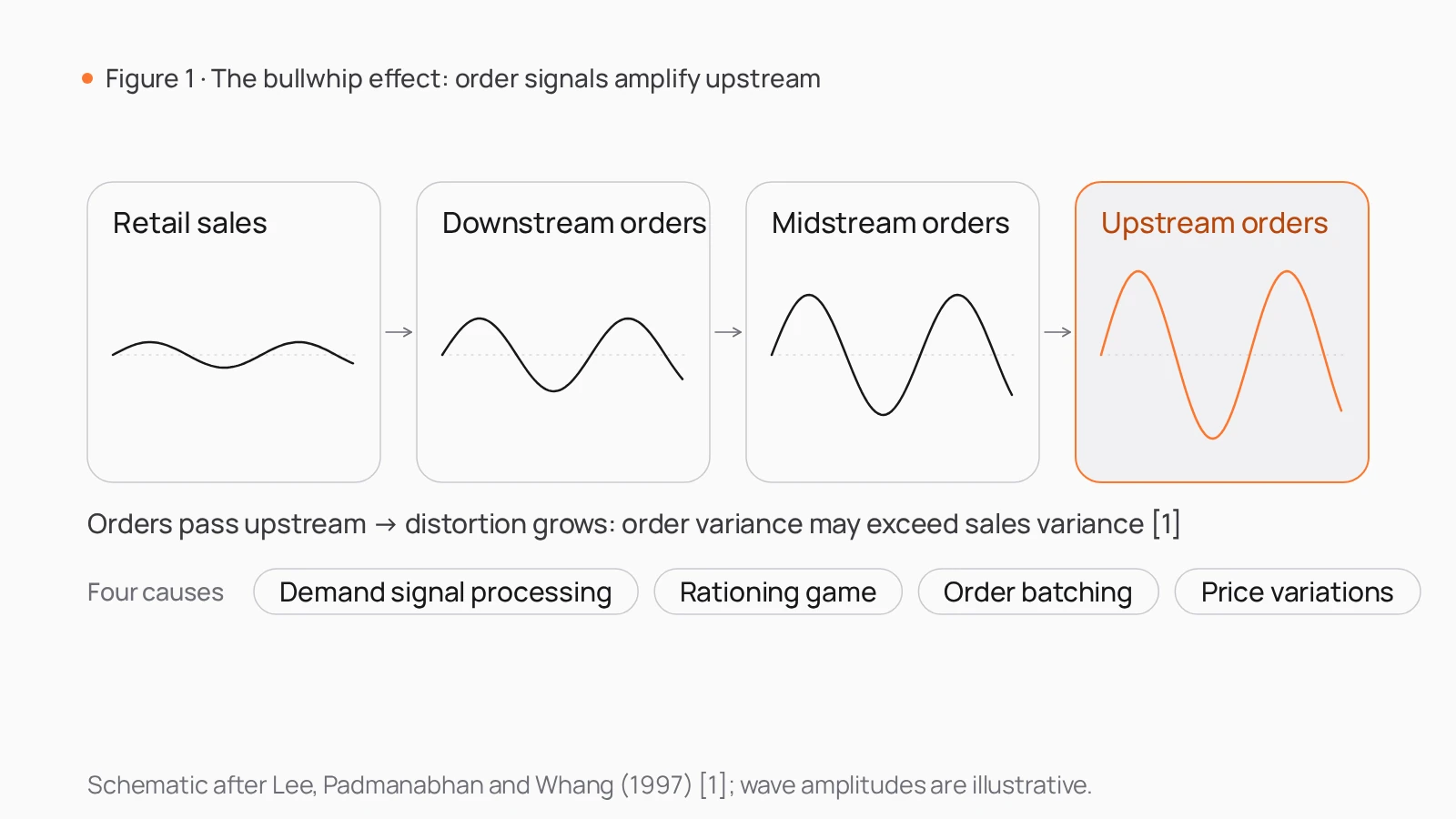
First is structural information distortion. Lee, Padmanabhan, and Whang (1997) studied a supply chain where each member orders from its immediate upstream partner, and inbound orders serve as an informational input to upstream production and inventory decisions[1]. Information transferred as “orders” tends to be distorted and can misguide upstream decisions; specifically, order variance may exceed sales variance, and distortion increases upstream—termed the “bullwhip effect”[1] The authors analyze four sources of the bullwhip effect: demand signal processing, rationing game, order batching, and price variations, plus mitigating actions[1]. On the warehouse floor, order batching and price variations flood fulfillment centers with waves of non-standard addresses, split-shipment requests, and last-minute edits that invalidate static schedules.
Third is visibility during disruptions. Ivanov and Dolgui (2021) theorize a digital supply chain (SC) twin—a computerized model representing network states for any given moment in real time—and explore conditions for designing and implementing digital twins to manage disruption risks[3]. Combining model-based and data-driven approaches uncovers interrelations among risk data, disruption modeling, and performance assessment, while supply chain shocks and adaptations amid the COVID-19 pandemic and post-pandemic recoveries show the urgent need for digital twins to map supply networks and ensure visibility[3]. Utilizing supply chain visualization, historical disruption data analysis, and real-time disruption data enhances predictive and reactive decisions for end-to-end visibility and business continuity[3]. Operationally, reactive resilience requires linking scan receipts, container movements, and inspections into an auditable chain so teams know which orders to intercept or reschedule.
Engineering Mapping: Input Cleaning, Wave Fulfillment, and Human Gates
Translating these mechanisms into software engineering means separating unstructured data normalization, state tracking, and human review gates. Across Intelligence, Commerce, and Agent OS on rlab.works, the skill packs below form this workflow. Notably, the logistics and supply chain industry has no skill packs marked as source-supported industry in the catalog; all packs below are transferable use only. Every skill pack on the site is a proposed composition demonstrated with synthetic data and not yet connected to live services, and component maturity ratings reflect static source inspection rather than production deployment.
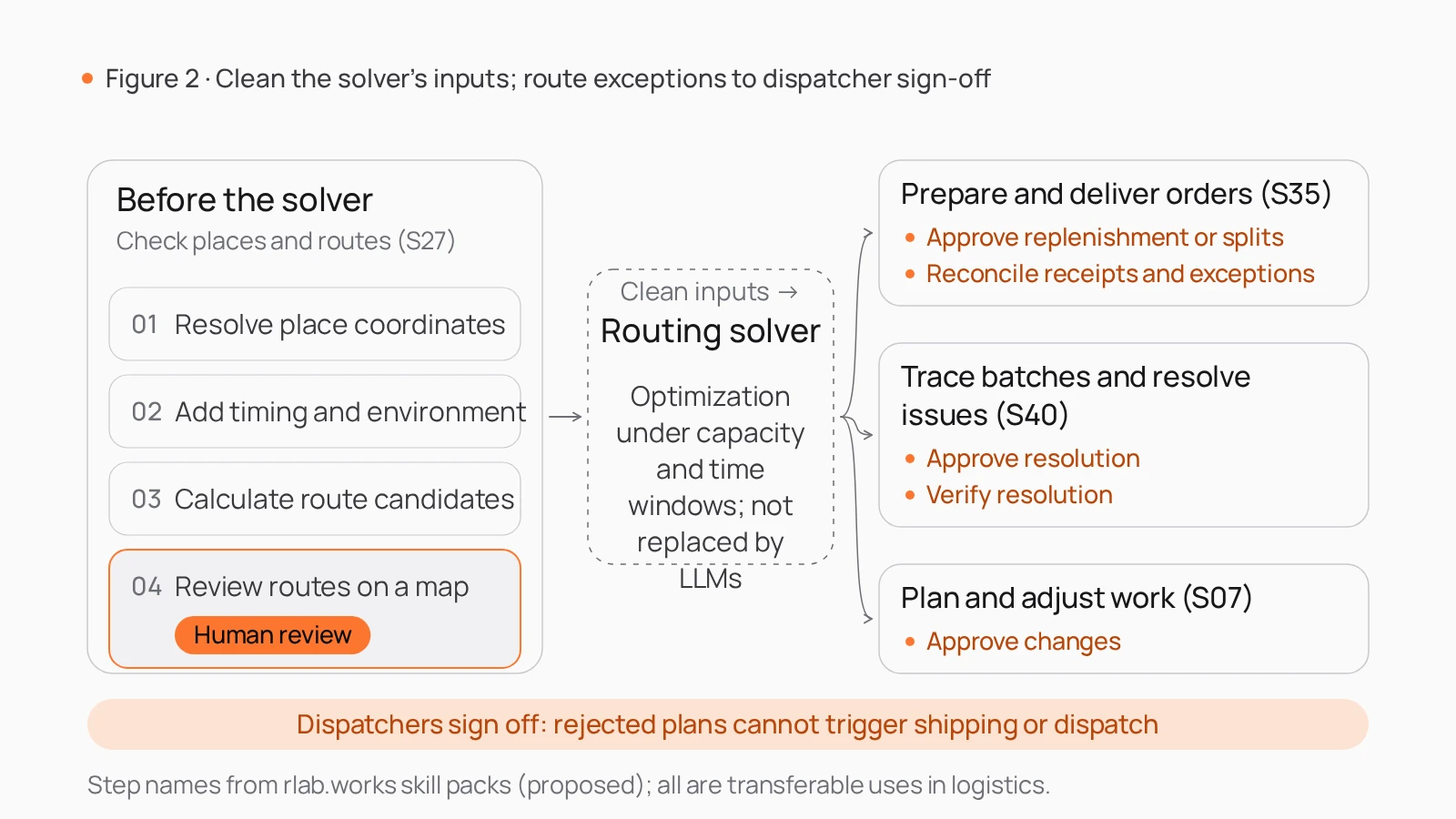
Upstream of the solver, Check places and routes (S27) in Intelligence takes Addresses, visit times and route requirements as input. It resolves place coordinates (located points and ambiguous addresses), adds timing and environment (weather and event times), and calculates route candidates with distances, durations, and restrictions. Execution pauses at the human review gate Review routes on a map, where the reviewer inspects candidates; rejected outputs return for revision and do not advance, producing a human-confirmed route reference map only upon approval. Transferred to logistics, this turns ambiguous notes into map points and lists route candidates with weather and time windows for dispatcher review—without promising optimal routes or real-time passability, and requiring licensed maps, coordinate conversion, and field dispatch judgment.
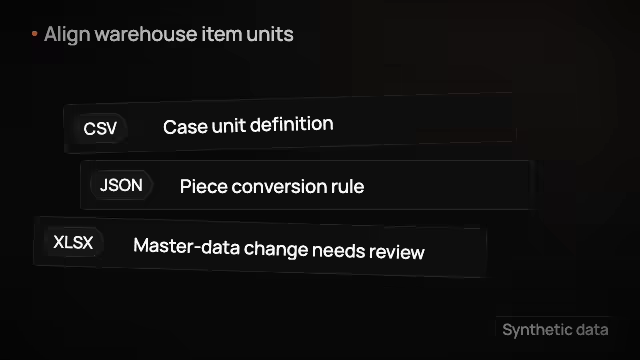
For wave fulfillment, Prepare and deliver orders (S35) in Commerce starts from Customer orders, stock and delivery requirements. It aligns orders and items into unit- and address-calibrated orders, checks supply and reservations, and pauses at the human review gate Approve replenishment or splits. Once approved, assisted execution runs Pick and schedule delivery—where working-code components such as Warehouse receiving, putaway, waves, picking and recheck release waves into picking tasks and verify scans and rechecks before outbound deduction—before a final human review gate, Reconcile receipts and exceptions, records proofs of delivery, returns, and open exceptions. Originating in retail, transferring this pack to logistics requires mapping consignors, cargo ownership, service commitments, and settlement boundaries, while vehicle routes remain advisory. If teams adapt the working-code component Flower presales, quality/loss inspection and fulfillment to log quality and loss checks, flag threshold breaches, and generate fulfillment tasks for perishable freight, they must note its origin in flower presales and re-engineer domain rules for cold-chain logistics.
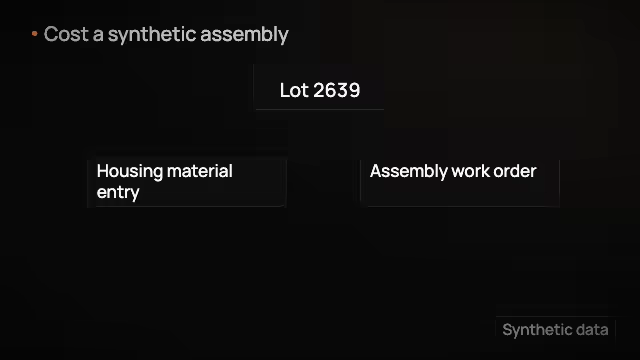
When transit damage or quality alerts arise, Trace batches and resolve issues (S40) in Commerce takes Batch origins, inspection records and movement events. It records batches and inspections linked to work orders or reservations, collects scan and movement receipts, and traces affected stock, orders, and resolution candidates. Consecutive human review gates—Approve resolution and Verify resolution—require reviewers to authorize isolation, recall, or replacement tasks and verify resolution evidence. In logistics, this links returnable totes, fragile cargo, and scan receipts into an evidence chain. If engineers draw on the working-code component Liquor packaging, deposits, channel pricing and trace codes for case-to-bottle conversion, deposit tracking, and trace-code scanning, they must note its origin in liquor distribution: logistics use requires adapting product packaging models to general containers and cargo events, and recognizing that scan registration never means physical interception has occurred.
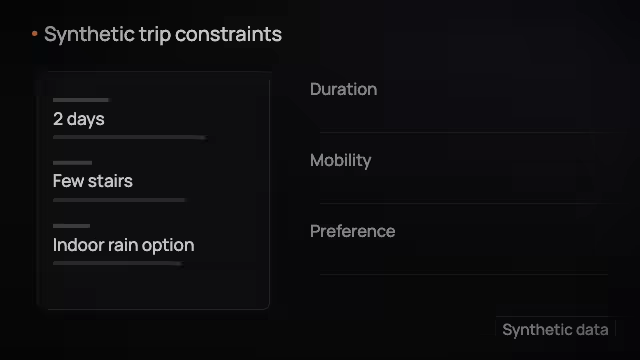
When exceptions force schedule changes, Plan and adjust work (S07) in Agent OS accepts a Natural-language goal, time and resource constraints. It completes hard constraints and preferences, gathers candidates, and compiles comparable plan drafts with diffs against the prior version. At the human review gate Approve changes, the dispatcher selects the plan version before execution data and task states refresh. Transferred from travel itinerary management to delivery shift rescheduling, it helps collect time windows, compare stop arrangements, and update task records after dispatcher confirmation—provided teams wire in dispatch data, capacity constraints, and task interfaces, without claiming a built-in route optimizer.
Pre-Pilot Checks for Logistics and Supply Chain Leaders
Before funding a pilot in warehouse or transport operations, leaders can apply these checks:
- Is input normalization kept distinct from mathematical routing? Ensure language workflows clean ambiguous addresses and structure time-window constraints upstream rather than replacing combinatorial routing solvers.
- Do order splits, batch holds, and schedule changes enforce blocking human gates? Confirm that shortage splitting, batch isolation, and shift version rollouts require human sign-off, and rejected proposals cannot trigger wave release or carrier dispatch.
- Have cross-industry components been adapted to logistics contracts and physical realities? When transferring components from retail, flower fulfillment, liquor distribution, or travel planning, verify that cargo ownership, returnable container rules, and physical interception workflows are re-mapped.
Found it useful? Pass it on.
References
- [1]
Lee, H. L., Padmanabhan, V., & Whang, S. (1997). Information Distortion in a Supply Chain: The Bullwhip Effect. Management Science, 43(4), 546–558. doi.org/10.1287/mnsc.43.4.546
- [2]
Toth, P., & Vigo, D. (Eds.). (2014). Vehicle Routing: Problems, Methods, and Applications (2nd ed.). Society for Industrial and Applied Mathematics (SIAM). doi.org/10.1137/1.9781611973594
- [3]
Ivanov, D., & Dolgui, A. (2021). A digital supply chain twin for managing the disruption risks and resilience in the era of Industry 4.0. Production Planning & Control, 32(9), 775–788. doi.org/10.1080/09537287.2020.1768450
Related capabilities
Platform modules
Skills packs
S27 · Intelligence
Check places and routes
Addresses come in every format and many places share a name, so checking locations alone takes a long time before routing.
Check addresses, add environmental and timing context and review routes and maps.
- Resolve place coordinates
- Add timing and environment
- Calculate route candidates
- Review routes on a mapHuman review
4 steps1 human reviews9 components
S35 · Commerce
Prepare and deliver orders
With many orders, shortages, split shipments and delivery problems are tracked by hand, and nobody can tell customers where their order is.
Check orders and stock, approve shortage handling, then pick, deliver and reconcile exceptions.
- Align orders and items
- Check supply and reserve
- Approve replenishment or splitsHuman review
- Pick and schedule delivery
- Reconcile receipts and exceptionsHuman review
5 steps2 human reviews9 components
S40 · Commerce
Trace batches and resolve issues
When a batch has a quality problem and nobody can trace which warehouses and orders it reached, the recall has to be broad.
Record batch and quality events, trace the impact and have reviewers decide and verify resolution.
- Record batches and inspections
- Collect movement events
- Trace the impact
- Approve resolutionHuman review
- Verify resolutionHuman review
5 steps2 human reviews6 components
S07 · Agent OS
Plan and adjust work
The plan is barely set when time, budget or resources change, and it has to be redone by hand.
Gather constraints, build comparable plans, confirm changes and preserve versions.
- Complete the constraints
- Gather candidates
- Plan and compare
- Approve changesHuman review
- Refresh execution data
5 steps1 human reviews6 components