[Travel & Hotels II] Cross-OTA Rate Parity Monitoring and Weekly Revenue Attribution: From Screenshot Extraction to the Revenue Management Loop
Effective cross-OTA rate parity monitoring combines link collection, multi-image rate extraction, and tax-inclusive term normalization with weekly performance attribution and human review gates, giving hotel revenue teams verifiable evidence for pricing decisions.


Promotional Layering, Rate Parity Blind Spots, and the Weekly Attribution Gap
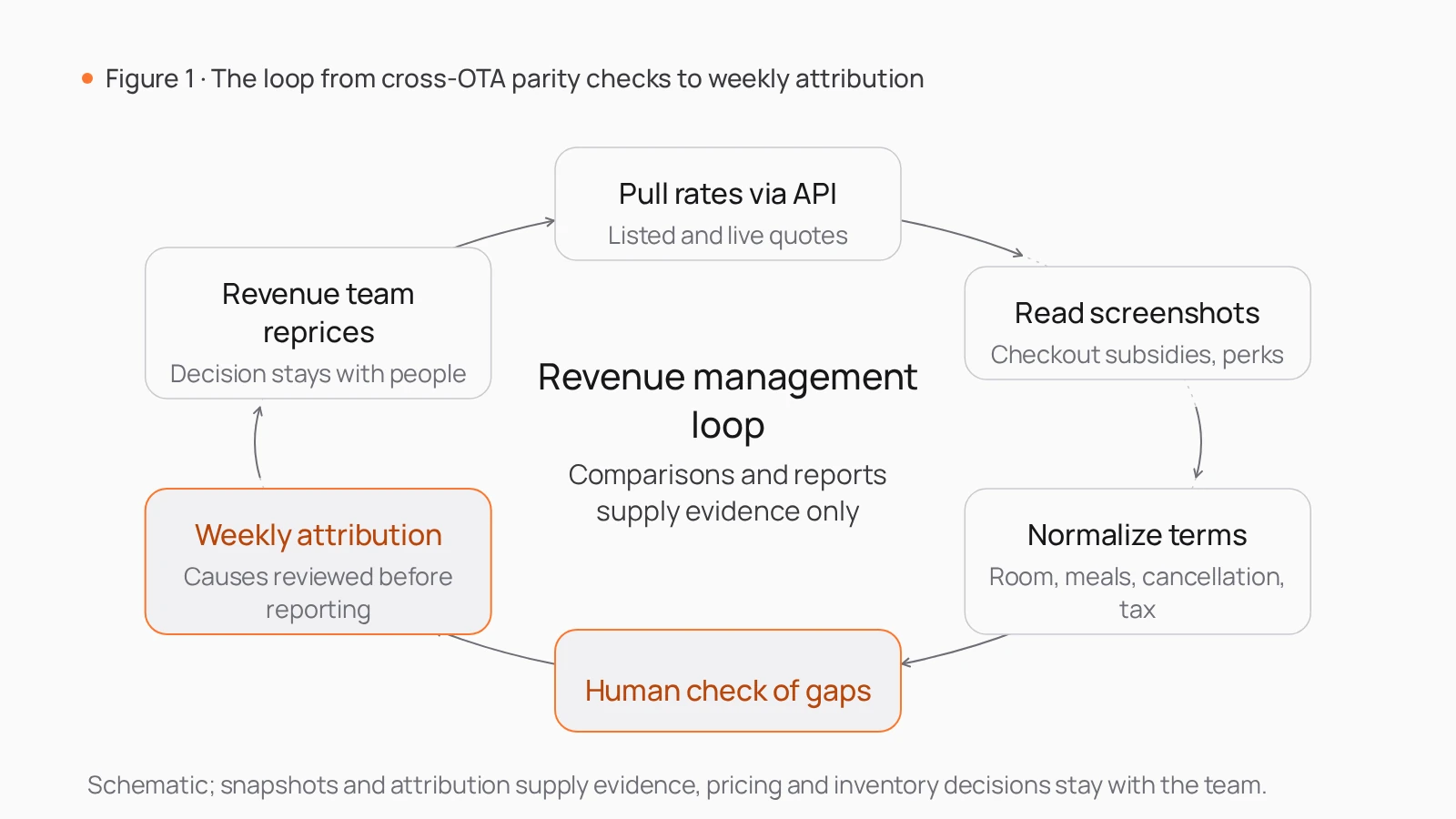
Consider a common scenario in hospitality distribution. A hotel group’s revenue management team signs rate parity agreements with multiple online travel agencies (OTAs) and pushes uniform base room rates through its channel manager. Over a weekend or holiday window, however, certain channels apply platform-funded coupons, member discounts, or bundled breakfast perks at checkout, pushing the effective tax-inclusive price paid by travelers below the hotel’s direct channel rate. When the team meets the following week to review performance, data warehouse tables show sharp shifts in channel bookings and page traffic. Yet because front-end rate screenshots sit scattered across chat threads without standardized room-type, meal, or tax definitions, analysts cannot rigorously link front-end parity breaches to back-end conversion shifts.
In multi-channel hotel distribution, relying solely on base-rate feeds or ad-hoc manual screenshots neither captures checkout-stage price divergence nor supports structured post-hoc attribution. Cross-OTA rate parity monitoring requires combining interface rate collection, screenshot extraction, and tax-inclusive term normalization, and then connecting those records to weekly performance attribution so the revenue team can make informed pricing decisions.
Price Coherence, Demand Elasticity, and the Evolution of Revenue Management
Why do front-end price consistency checks and weekly channel attribution matter to hotel revenue management? Three streams of research—operations research on capacity and pricing, platform economics on price coherence, and the strategic evolution of hospitality revenue management—explain the mechanisms.
First, Talluri and van Ryzin (2004) provide a comprehensive treatment of revenue management that frames the field as demand-management decisions on price and capacity under uncertainty, covering single-resource capacity control, network capacity control, overbooking, dynamic pricing, auctions, customer-behavior and demand models, forecasting, and implementation[1]. Within this framework, dynamic pricing and capacity control depend on accurate observations of market demand and effective channel prices. When third-party platforms alter effective transaction prices through subsidies or bundled perks while the hotel’s forecasting engine assumes uniform base rates, demand models and inventory controls absorb systematic noise.
Second, why do online intermediaries clash with suppliers over rate parity and buyer perks? Edelman and Wright (2015) model “price coherence” in intermediated markets: when an intermediary provides a benefit to buyers who purchase from sellers using its technology, the intermediary wants to restrict sellers from charging buyers more for transactions it intermediates[2]. By eliminating any extra price buyers face when purchasing through the platform, the intermediary can profitably raise demand for its services[2]. Their model shows that this restriction leads to inflated retail prices, excessive adoption of intermediaries’ services, over-investment in benefits to buyers, and a reduction in consumer surplus and sometimes welfare[2]. Competition among intermediaries intensifies these problems by increasing the magnitude of their effects and broadening the circumstances in which they arise; the authors discuss applications to travel reservation systems, payment card systems, and rebate services[2]. In our reading, when hotel distribution channels stack buyer benefits or promotions at checkout, the final price can diverge from the published base rate, so checks that look only at base rates can miss the gap.
Third, Cross, Higbie, and Cross (2009) note that the era has ended when revenue management could stand alone as a tactical approach to room management[3]. With technological and management support, revenue management is being integrated into all aspects of hotel marketing and operating strategies, considering total revenue contributions—including group business and ancillary revenues—and the interaction of room sales and food and beverage sales[3]. Because hotel prices are essentially transparent, hotels must consider customer price elasticity rather than simply matching competitors’ prices, with a goal of optimizing prices[3]. While revenue per available room (RevPAR) has been a good performance measure, a revenue generation index comparing competitors’ RevPARs is even more useful, and a revenue opportunity model that monitors inventory control effectiveness and analyzes the effects of revenue management decisions offers deeper insight, alongside customer-focused approaches that track purchases and target promotions based on responses to prior offers[3].
Engineering the Loop: From Screenshot Rate Comparison to Weekly Operations Review
Translating these mechanisms into software requires explicit normalization contracts and human review gates. Within the Intelligence module on rlab.works, this loop is modeled by two skill packs that carry a source-supported industry association for travel and hotels: the “Read and compare prices” skill pack (S22) and the “Review weekly operations” skill pack (S26).
Front-end parity inspection is structured by the “Read and compare prices” skill pack (S22), starting from quote screenshots, links, and comparison conditions:
- Locate source offers: Traces the quote source and collection record for each screenshot or link, combining diagnostic metadata from live page or interface collection attempts.
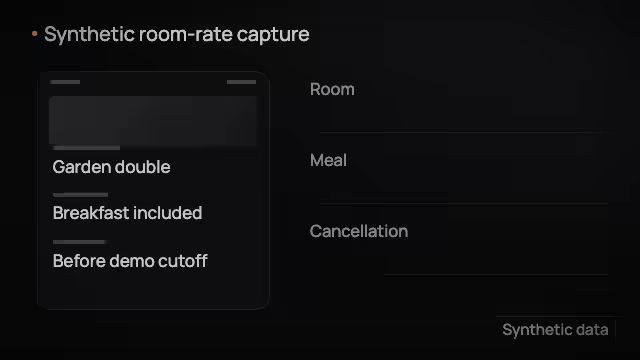
- Read key fields: Invokes Multi-image OTA rate extraction to jointly read multiple screenshots from the hotel’s channel and competing platforms, extracting hotel and room-type identifiers, check-in dates, occupancy, breakfast inclusions, selling prices, and promotions with provenance.
- Align comparison terms: Uses Normalized rate snapshots and history to standardize room types, meal plans, cancellation policies, currencies, and tax-inclusive prices, deduplicate snapshots, and distinguish display-only benefits from checkout-verified commitments.
- Compare and review (human review gate): Pauses at a human gate where the designated reviewer or requesting user inspects aligned price differences and pending items; rejected outputs are returned for revision and do not advance.
Back-end attribution is handled by the “Review weekly operations” skill pack (S26), taking authorized business tables, comparison periods, and previous reports as input:
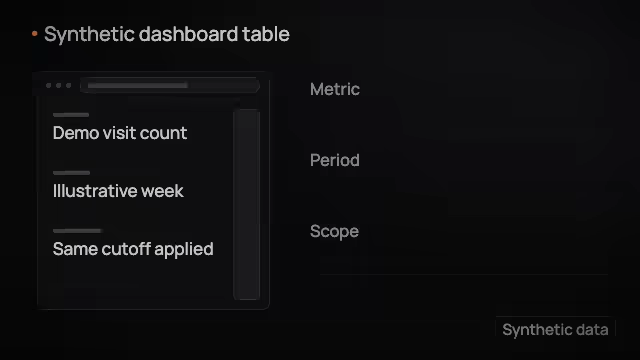
- Table alignment and exception detection: Collects and aligns order, room-night, traffic, and channel tables into unified data preserving provenance, definitions, and attribution; compares periods and segments to surface exception candidates with low-base and definition prompts.
- Check causes and evidence (human review gate): Pauses at a human gate before explanations enter the report. Analysts verify anomalies against rate-parity snapshots, partner attribution, and campaign records; rejected explanations return for revision.
- Assemble report and follow-ups: Once approved, Bilingual weekly hotel performance reports combines official dashboard KPI series with warehouse order and traffic data to generate weekly comparisons, channel mix, multi-week context, and follow-up items carried over from prior weeks.
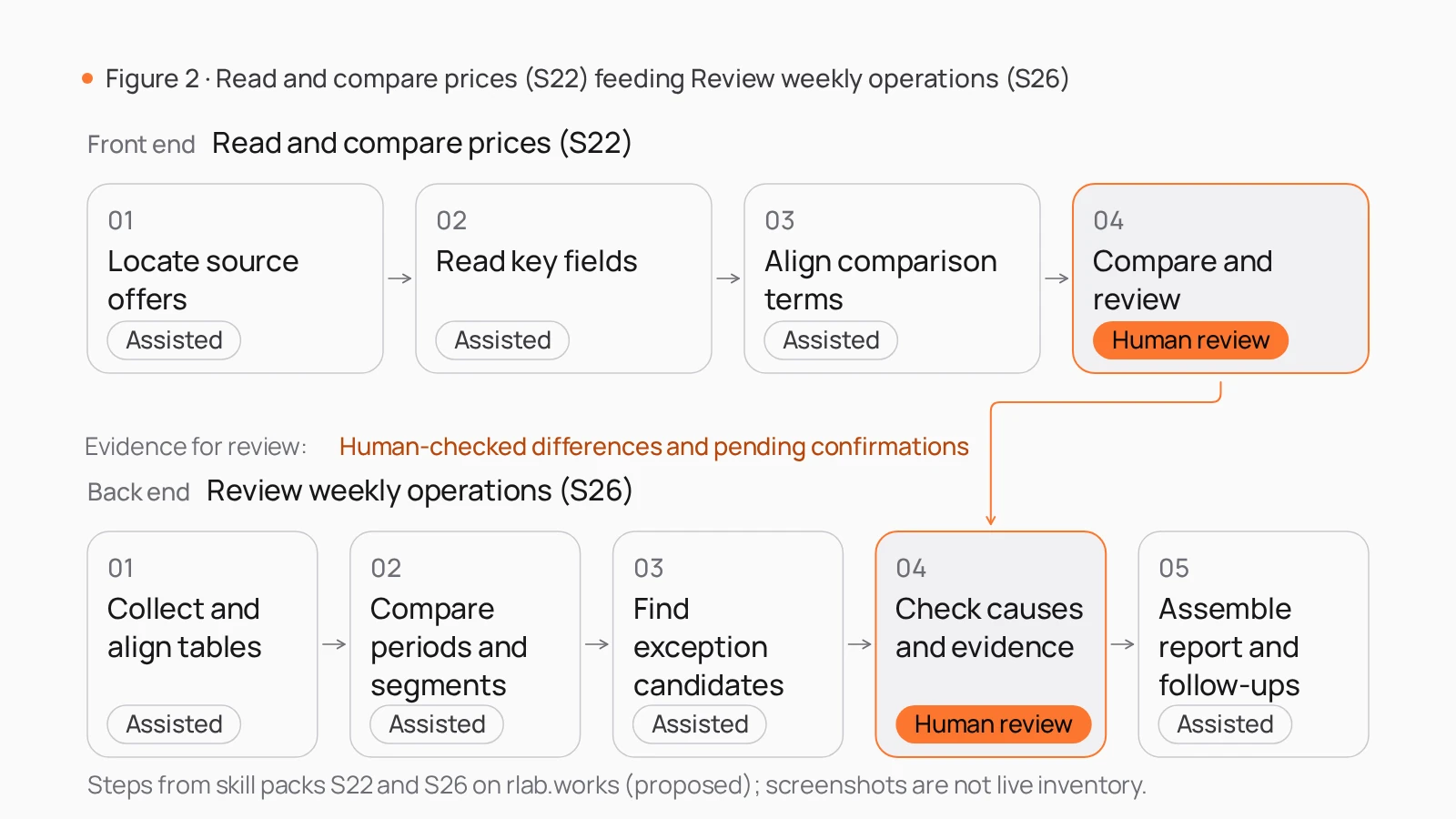
On rlab.works, every skill pack is a proposed composition demonstrated with synthetic data and not yet connected to live services. Component maturity labels (such as working code) reflect static source inspection rather than production deployment, and “source-supported industry” means only that the source data has an explicit industry association—it makes no claims about customer deployments or business outcomes.
Pre-Pilot Checks for Hospitality and Data Leaders
Before funding a cross-OTA rate monitoring and weekly attribution pilot, a hospitality COO, CDO, or revenue management lead can apply three checks:
- Does the comparison contract enforce tax-inclusive and policy-aligned normalization? Verify that the pipeline normalizes room categories, meal plans, cancellation policies, and checkout promotions into one schema rather than comparing raw headline rates under mismatched stay conditions.
- Does weekly attribution enforce a blocking human gate before recording causes? Confirm that warehouse anomaly candidates require human verification—with explicit flags for low-base effects and metric-definition differences—so holiday overlaps are not automatically logged as verified causes.
- Are analytical diagnostics separated from pricing execution? Ensure that parity snapshots and weekly reports supply structured evidence to the revenue management team while keeping rate changes and inventory controls under human authorization.
Found it useful? Pass it on.
References
- [1]
Talluri, K. T., & van Ryzin, G. J. (2004). The Theory and Practice of Revenue Management. Springer. doi.org/10.1007/b139000
- [2]
Edelman, B., & Wright, J. (2015). Price Coherence and Excessive Intermediation. The Quarterly Journal of Economics, 130(3), 1283–1328. doi.org/10.1093/qje/qjv018
- [3]
Cross, R. G., Higbie, J. A., & Cross, D. Q. (2009). Revenue Management's Renaissance: A Rebirth of the Art and Science of Profitable Revenue Generation. Cornell Hospitality Quarterly, 50(1), 56–81. doi.org/10.1177/1938965508328716
Related capabilities
Platform modules
Skills packs
S22 · Intelligence
Read and compare prices
Quote screenshots differ in format, tax and inclusions, so manual comparisons often compare unlike with unlike.
Read prices from screenshots and links, align comparison terms and review differences and tradeoffs.
- Locate source offers
- Read key fields
- Align comparison terms
- Compare and reviewHuman review
4 steps1 human reviews7 components
S26 · Intelligence
Review weekly operations
Most of the weekly report goes into reconciling spreadsheets, and the real anomalies get no attention.
Align table definitions, identify changes worth checking and draft a weekly report with follow-ups.
- Collect and align tables
- Compare periods and segments
- Find exception candidates
- Check causes and evidenceHuman review
- Assemble report and follow-ups
5 steps1 human reviews11 components
S34 · Commerce
Confirm and cancel reservations
Bookings depend on price-lock windows and cancellations on supplier receipts, and local success often does not match the supplier's state.
Check available resources and short-lived quotes, then follow supplier states and cancellation requests after confirmation.
- Intake and check availability
- Create a short-lived confirmation
- Confirm or cancel with a personHuman review
- Reconcile resource-provider state
- Sync and notify
5 steps1 human reviews9 components