[Sports] From Footage to Reviewable Tactical Evidence: A Video Action Review Workflow for Performance Analysis
Sports performance analysis cannot treat unverified computer vision detections as match facts; normalizing frame timing and camera views first, proposing motion and ball-track candidates next, and having analysts review actions beat by beat on a timeline before exporting evidence-linked replays is what produces trustworthy tactical records.

The Gap Between Raw Match Footage and Trustworthy Tactical Evidence
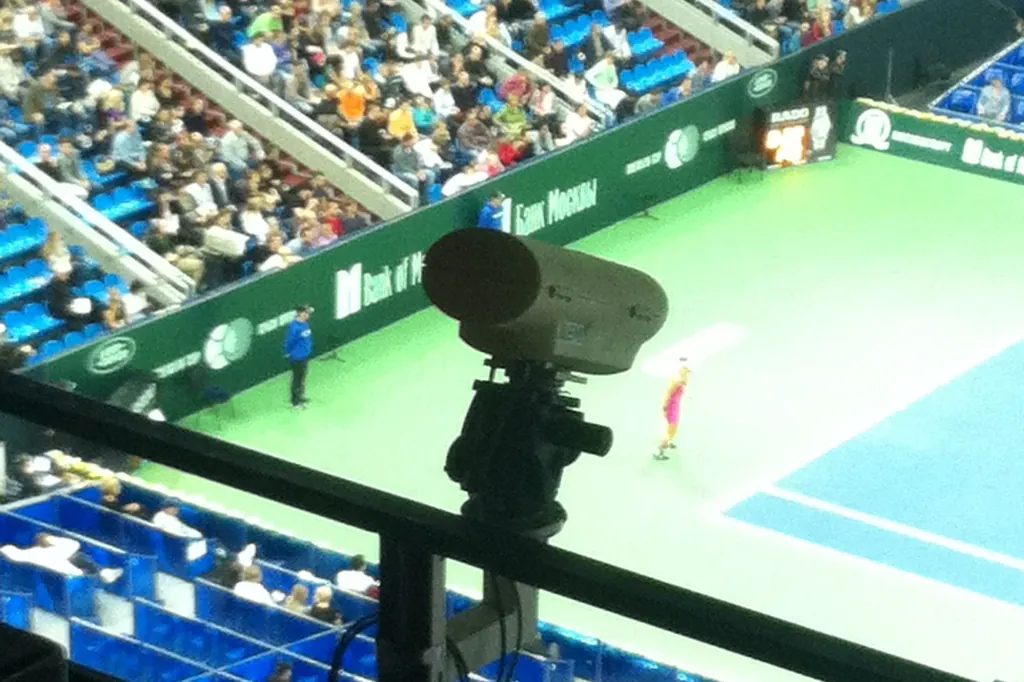
Consider a routine post-match review scenario. A coaching staff wants to evaluate shot placement patterns and rally transitions from match recordings. An engineering team feeds multi-camera video directly into an automated detection script to produce trajectory heatmaps and event tallies. During the debrief, however, coaches notice that several critical shots and rally outcomes in the summary table contradict what happened on the court. Because the source recordings varied in frame rate, suffered from camera jitter, and included brief occlusions during high-speed exchanges, the detector mistook background artifacts for ball trajectories. Worse, because the report stripped away frame-accurate links to the source footage, analysts must reopen the raw video and scrub through the timeline manually from scratch.
This breakdown illustrates a core engineering requirement in sports performance analysis: raw visual detections are probabilistic candidates, not match facts. Turning footage into dependable tactical evidence requires normalizing frame rates and camera views first, having visual models propose motion and ball-track candidates next, and requiring statisticians to verify those candidates beat by beat along a timeline before exporting evidence-linked replays. In the capability catalog, this Review video actions (S23) workflow is a source-supported industry pattern for sports.
Spatio-Temporal Traces, Multidisciplinary Integration, and Multiresolution Modeling
Why does sports analytics require rigorous trajectory verification rather than unexamined event tallies or raw detection boxes? Research across computer science, artificial intelligence, and statistics explains the underlying mechanisms.
Gudmundsson and Horton (2017) surveyed computational research on spatio-temporal analysis in team sports[1]. In invasion sports such as football, basketball, and hockey, players move freely across the playing area, meaning individual and team performance cannot be fully analyzed without considering the movements and interactions of all players as a group[1]. Modern tracking systems produce high-definition, high-frequency spatio-temporal traces of player trajectories, enabling multidisciplinary research that applies non-trivial computation to extract insight from trajectories; the authors categorized these efforts into a coherent framework and identified open research questions[1]. Their synthesis underscores that higher-level tactical analysis depends on the continuity and fidelity of underlying spatio-temporal traces.
Examining artificial intelligence in professional sports, Tuyls et al. (2021) noted that machine learning advances have opened analytical possibilities across baseball, basketball, tennis, and increasingly football—driven by expanded club data collection, computational power, and machine learning methods aimed at analyzing individual players and coordinated team behaviors[2]. Crucially, predictive and prescriptive football analytics require progress at the intersection of statistical learning, game theory, and computer vision[2]. Combining these fields enables capabilities such as counterfactual analysis with predictive models and pairing game-theoretic penalty kick analysis with statistical learning of player attributes, offering mutual benefits for teams, spectators, and broadcasters while extending to other real and virtual sports[2]. Computer vision serves as the perceptual entry point, but it must operate alongside statistical modeling and domain structure.
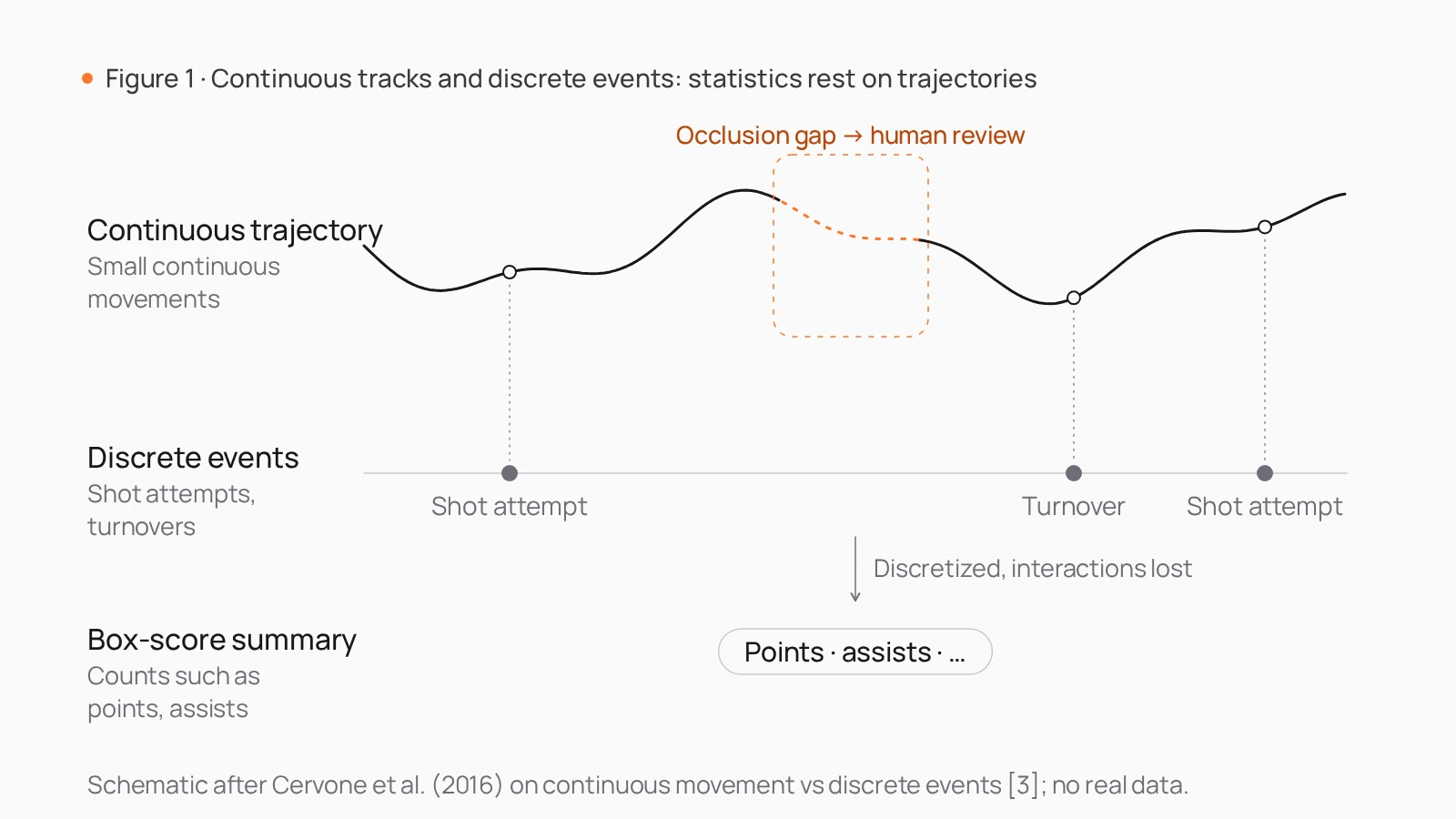
From a statistical perspective, Cervone, D’Amour, Bornn, and Goldsberry (2016) showed why continuous spatial movement and discrete events must be coupled carefully[3]. Basketball games evolve continuously in space and time through constant interactions among teammates, opponents, and the ball, whereas conventional analyses reduce those interactions to discretized summaries such as points and assists[3]. Using optical tracking data, the authors proposed a real-time framework for estimating expected possession value (EPV)—the expected points obtained by the end of a possession[3]. Their multiresolution stochastic process model distinguishes between continuous, infinitesimal player movements and discrete events such as shots and turnovers, estimating transition kernels via hierarchical spatiotemporal models that share information across players while remaining computationally tractable on large datasets, and revealing players’ decision-making tendencies as a function of spatial strategy[3].
Together, these studies show that discrete event tallies and continuous trajectories are inseparable: if camera timing drifts, court calibration is off, or occlusion gaps go unverified, downstream tactical evaluations lose their empirical foundation.
From Frame Normalization and Motion Proposals to Beat-by-Beat Human Review
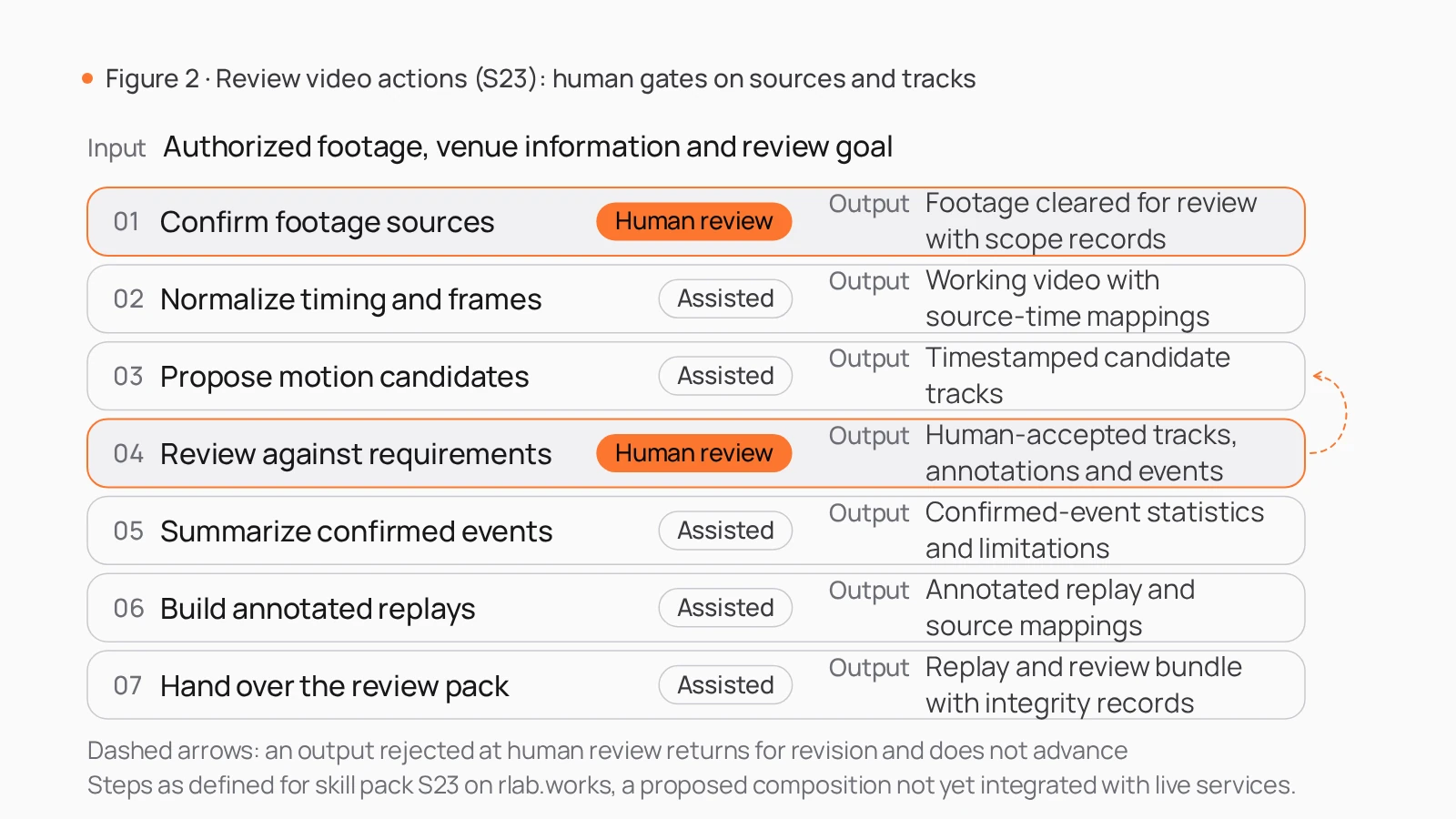
Translating these principles into software architecture requires preserving footage provenance, proposing motion candidates conservatively, and mandating human review before generating annotated replays. Within the Intelligence module on rlab.works, the Review video actions (S23) skill pack structures this pipeline for Sports around explicit input contracts and human gates:
- Confirm footage sources (human review): Starting from authorized footage, venue information, and a review goal, an assigned reviewer verifies source recordings and scope; rejected outputs return for revision and do not advance.
- Normalize timing and frames (assisted): Using Media inspection and frame-accurate normalization, the pipeline inspects media properties, normalizes video to a constant frame rate and resolution, preserves source timing and identity, and outputs frame-accurate working video.
- Propose motion candidates (assisted): Through Camera registration and ball-track proposals, the workflow estimates camera motion, detects color and local motion candidates, and conservatively links ball-track candidates with timeline positions before review.
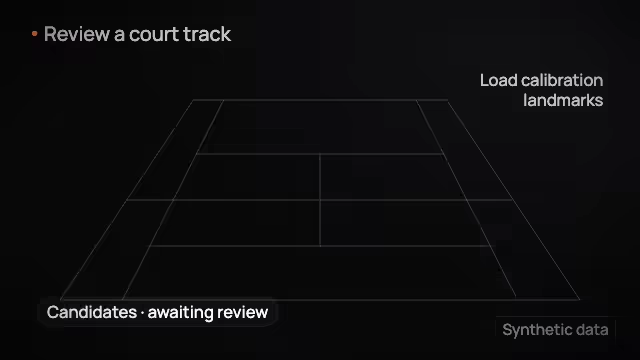
- Review against requirements (human review): A statistician inspects proposed tracks beat by beat alongside Court calibration and reviewed trajectory reconstruction, which ingests court and ball annotations, audits revision history, reconstructs trajectories strictly within bounded gaps, and reuses validated court and camera calibrations. Unaccepted outputs do not advance.
- Summarize events, build replays, and hand over the review pack (assisted): After human acceptance, the system compiles conditional event statistics with limitation notes, builds annotated replays mapped to source timestamps, and packages an integrity-verifiable review bundle.
When verified tactical evidence feeds coaching materials, video clips, or team briefings, three adjacent skill packs in the Intelligence module offer controlled extensions for transferable use in sports:
- Prepare visual material (S30) turns authorized athlete reference images and reviewed text into training cards after a coach verifies movement illustrations at a human gate; generated visuals are illustrative only, never evidence of actual performance or a basis for inferring injury or results.
- Make a narrated video (S31) cuts reviewed training explanations and replays into short clips, locking video edits before aligning narration for a coach to verify; generated narration does not constitute action recognition, and edit changes require re-alignment.
- Watch and review changes (S32) monitors permitted public sources around match schedules to surface evidenced updates for editorial review; sports adaptation requires replacing financial and travel lexicons, and public social posts cannot replace official team confirmation.
Finally, architectural candor requires stating current system status: every skill pack on the site is a proposed composition demonstrated with synthetic data and not yet connected to live services. Component maturity reflects static source inspection rather than production deployment, and a source-supported industry label means only that source data carries an explicit sports association—never implying customer deployments or business outcomes.
Pre-Pilot Checks for Sports Analytics and Technical Leads
Before funding a video performance analysis pilot, leaders can apply three concrete checks:
- Verify frame normalization and source-time mapping: Does the pipeline confirm footage provenance and normalize frame rates upfront so every statistic and replay maps back to an exact source frame?
- Check bounded reconstruction and human blocking gates: Under occlusion or camera motion, does the software reconstruct trajectories only within bounded gaps and pause at a mandatory timeline gate where analysts can reject flawed tracks?
- Audit calibration constraints and downstream asset boundaries: Does the review pack state the calibration conditions governing speed readouts, and do downstream workflows separate verified match replays from illustrative coaching graphics?
Found it useful? Pass it on.
References
- [1]
Gudmundsson, J., & Horton, M. (2017). Spatio-Temporal Analysis of Team Sports. ACM Computing Surveys, 50(2), Article 22. doi.org/10.1145/3054132
- [2]
Tuyls, K., Omidshafiei, S., Muller, P., Wang, Z., Connor, J., Hennes, D., Graham, I., Spearman, W., Waskett, T., Steel, D., Luc, P., Recasens, A., Galashov, A., Thornton, G., Elie, R., Sprechmann, P., Moreno, P., Cao, K., Garnelo, M., … Hassabis, D. (2021). Game Plan: What AI can do for Football, and What Football can do for AI. Journal of Artificial Intelligence Research, 71, 41–88. doi.org/10.1613/jair.1.12505
- [3]
Cervone, D., D'Amour, A., Bornn, L., & Goldsberry, K. (2016). A Multiresolution Stochastic Process Model for Predicting Basketball Possession Outcomes. Journal of the American Statistical Association, 111(514), 585–599. doi.org/10.1080/01621459.2016.1141685
Related capabilities
Skills packs
S23 · Intelligence
Review video actions
Finding key moments frame by frame is slow and tiring, and the conclusions are hard to check later.
Preserve footage sources, propose motion candidates and create evidence-linked replays after human correction.
- Confirm footage sourcesHuman review
- Normalize timing and frames
- Propose motion candidates
- Review against requirementsHuman review
- Summarize confirmed events
- Build annotated replays
- Hand over the review pack
7 steps2 human reviews8 components
S30 · Intelligence
Prepare visual material
Pitch and marketing material means endless rounds of images, captions and layout, and facts slip through.
Collect permitted assets, generate visual candidates and check facts before assembling presentation material.
- Prepare reference assets
- Create visual candidates
- Check visual contentHuman review
- Assemble and export
4 steps1 human reviews8 components
S31 · Intelligence
Make a narrated video
An explainer video means editing, narration and timing, and one change means realigning everything.
Build scenes and edits from a script, add audio and check narration and timing.
- Prepare scene visuals
- Arrange edits and replays
- Add narration and audio
- Listen and reviewHuman review
4 steps1 human reviews7 components
S32 · Intelligence
Watch and review changes
Competitors, policies and announcements change daily; checking pages by hand means hearing about important changes late.
Monitor permitted sources, surface evidenced changes and let reviewers decide follow-up actions.
- Register and collect sources
- Deduplicate and compare changes
- Organize relevant signals
- Review and archiveHuman review
4 steps1 human reviews8 components