[Government & Public Services] Street-Level Bureaucracy and Algorithmic Accountability: Access Policies, Budget Verification, and Multilingual Notice Review in Public Administration
Public-sector artificial intelligence belongs in back-office governance rather than frontline discretion: enforcing role-based access rules and reconciling departmental usage budgets at the gateway while keeping human sign-off on public change monitoring and multilingual notices.


Unchecked Frontline Replies and Opaque Ledgers: Why Public-Sector Pilots Stall on Accountability
Consider a hypothetical municipal service center that opens a general-purpose large language model assistant to both frontline counter staff and back-office administrative units. Within weeks, governance gaps emerge at both ends of the workflow. At the counter, staff with different departmental mandates query internal documents through a shared interface and occasionally publish machine-translated service guides directly to public portals; when a translated eligibility requirement diverges from current rules, the agency cannot trace who authorized the wording. In the back office, multiple departments draw from a pooled API quota; at month-end, finance officers cannot reconcile batch job costs against departmental budgets or isolate duplicate and unpriced calls.
Public administration operates under strict legal accountability and fiscal discipline. Public-sector AI should therefore focus on back-office workflows: enforcing role-based access policies at the gateway, reconciling model usage costs by department, and keeping mandatory human sign-off on public feedback monitoring and multilingual notice publishing. Across the capability catalog, all relevant skill packs for government and public services represent transferable applications rather than pre-verified sector deployments.
Street-Level Discretion and Administrative Law: The Governance Mechanism Behind Public-Sector AI
Why does deploying generative tools directly to citizen-facing decision points or unreviewed publishing channels create institutional risk? Public administration theory and administrative law research explain the mechanism.
In his classic theory of street-level bureaucracy, Michael Lipsky (2010) showed that frontline public-service workers—teachers, police officers, social workers, and benefit officers—exercise substantial discretion under chronic resource constraints and ambiguous goals[1]. The routines and simplifications they develop to cope effectively become public policy as citizens experience it[1]. When an algorithmic assistant enters this environment without clear access boundaries or review gates, its hidden simplifications reshape frontline routines directly. An unverified draft or over-broad document retrieval turns into de facto public policy without institutional oversight.
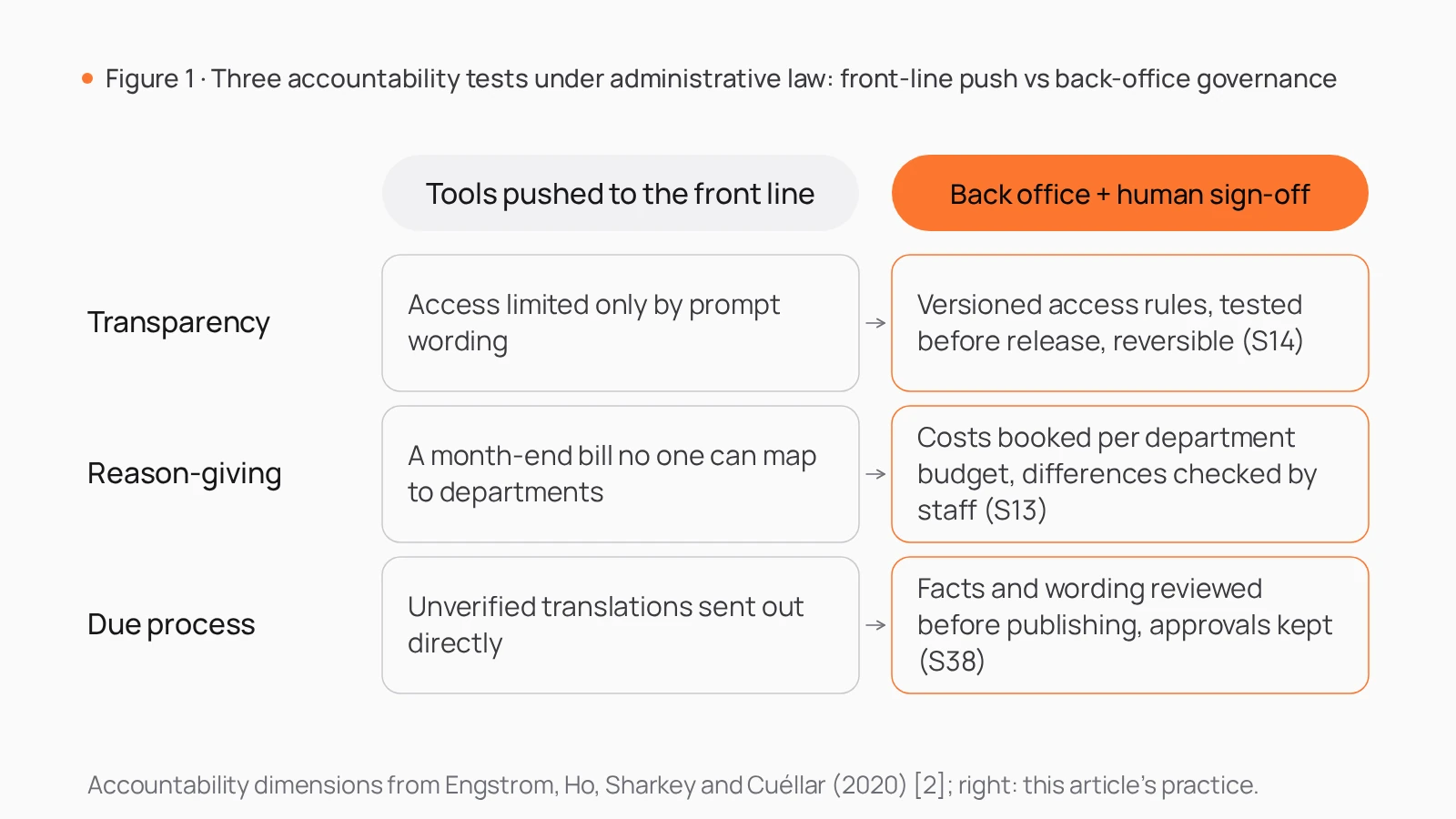
Empirical legal scholarship shows how algorithmic governance strains administrative accountability. In a 2020 report to the Administrative Conference of the United States (ACUS), Engstrom, Ho, Sharkey, and Cuéllar studied AI use across US federal administrative agencies[2]. They found that AI use was already widespread across agencies—a substantial share of the agencies studied had experimented with AI or machine learning—but relatively few uses were highly sophisticated[2]. The report stresses that agencies need sufficient internal technical capacity to build, procure, and oversee such systems, and warns that algorithmic governance raises accountability questions under administrative law around transparency, reason-giving, and due process[2]. If access boundaries rely on prompt instructions and public notices bypass human sign-off, an agency cannot meet administrative standards for transparency and reasoned decision-making.
Back-Office Governance and Human Sign-Off: Capability Mapping and Adaptation Boundaries
Translating administrative accountability into software engineering requires structured input contracts and blocking human gates across gateway access, budget reconciliation, source monitoring, and multilingual publishing. Architectural honesty is essential: in the site catalog for government and public services, no skill pack carries a source-supported industry tag. All four skill packs below are proposed compositions demonstrated with synthetic data and not yet connected to live services, and each is a transferable use in the public sector requiring domain adaptation.
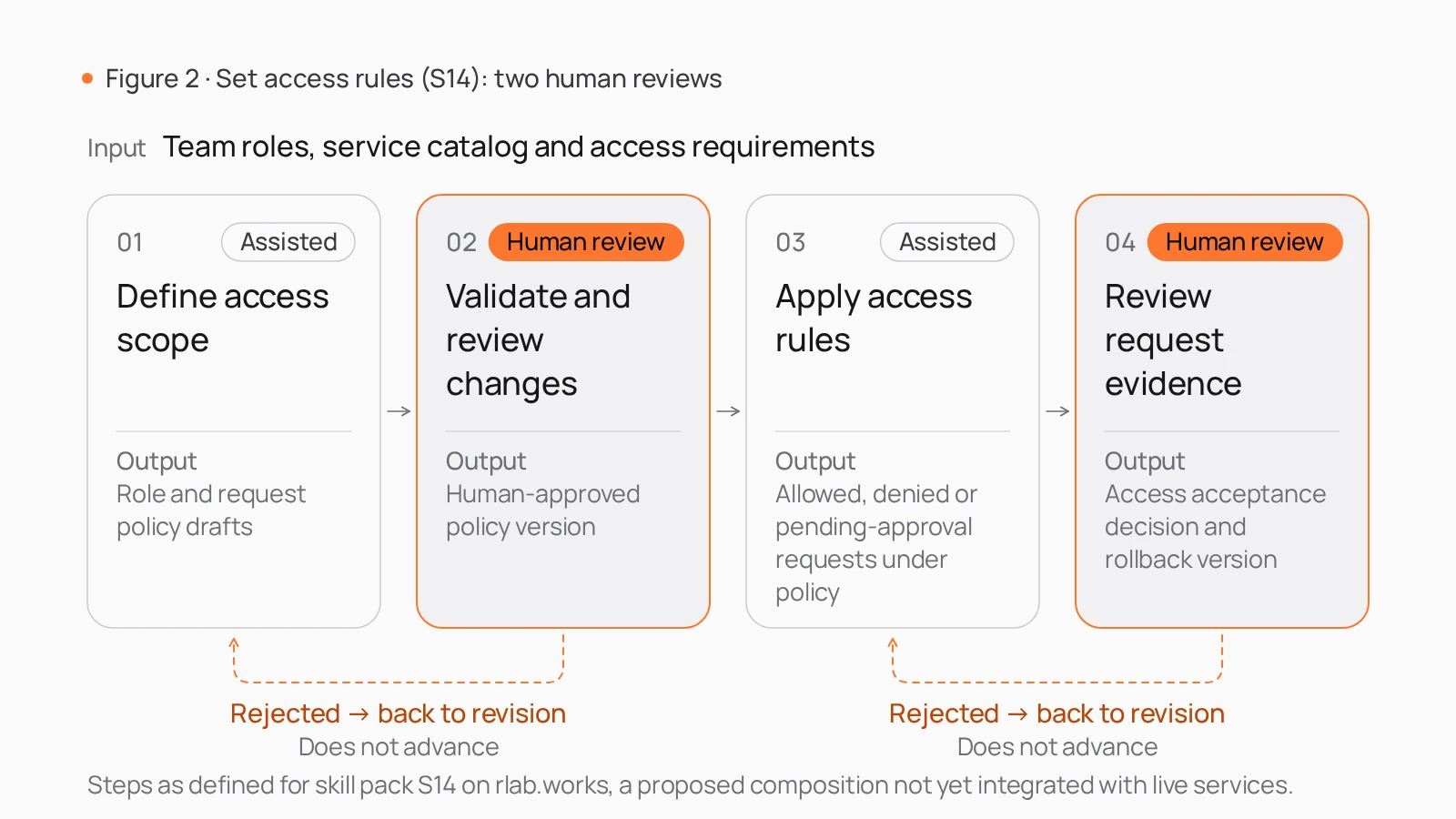
Within the AI Gateway module, back-office governance starts by replacing prompt restrictions with enforceable access rules. Set access rules (S14) takes Team roles, service catalog and access requirements as input and runs in four steps: first, assisted definition of access scope to draft role and request rules; second, a human review gate (Validate and review changes) where an assigned reviewer or requesting user inspects diffs—rejected output returns for revision and does not advance, producing a human-approved rule version only upon acceptance; third, assisted rule application to sort allowed, denied, or pending requests; and fourth, a human review of request evidence to record an acceptance conclusion and rollback version. This workflow can draw on versioned gateway policy rollout (working code from static inspection that validates policy drafts, diffs versions, and executes rollout, archival, and rollback). In the public sector, Set access rules (S14) defines what a consultation tool can read and do by counter and department role, testing allowed and denied requests before release. Adaptation requires connecting to organizational identity and actual document permissions rather than relying on prompts to restrict access.
In the Intelligence and Commerce modules, workflows touching public feedback or external communication likewise keep AI in back-office preparation while reserving sign-off for staff. Watch and review changes (S32) takes Permitted sources, topic terms and tracked entities, running three assisted steps—registering and collecting sources, deduplicating and comparing changes, and organizing relevant signals—before halting at step four (Review and archive) for a human reviewer to select items, archive packages, and follow-up recommendations. In public administration, Watch and review changes (S32) routes changes in public notices and resident feedback into a review queue so staff can verify whether to follow up. Adaptation requires replacing financial and travel event schemas, retaining original texts and human judgment, and never treating public post volume as representative public opinion. For external notices, Publish in several languages (S38) starts from Accepted facts, audience, languages and target channels, assisting with grounded drafts and translation checks before enforcing a human gate at step three (Review facts and wording). Backed by editorial review and A/B test management components that persist draft queues and review decisions, rejected wording returns for revision and does not advance to publishing or discovery. In public services, Publish in several languages (S38) synchronizes a service guide’s facts across languages and portals after a responsible officer verifies procedures and effective dates; adaptation requires replacing hospitality translation fields, verifying official wording, and retaining human approval records before release.
Three Pre-Pilot Checks for Public-Sector Digital Leaders
Before funding an administrative AI pilot, a public-sector digital leader can apply three checks to preserve accountability:
- Are access boundaries enforced by gateway policies and organizational identity rather than prompts? Verify that role rules undergo version diffing, dry-run testing, and human approval before rollout, binding access to real document permissions.
- Does every batch workload reserve budget upfront and reconcile usage receipts afterward? Confirm that departmental calls generate a traceable cost ledger and require human review of unpriced or duplicate entries before interfacing with agency accounting.
- Do public feedback queues and multilingual notices require a blocking human signature? Ensure state machines halt for an assigned official to verify facts, effective dates, and official wording before any translated guide or follow-up item advances.
Found it useful? Pass it on.
References
- [1]
Lipsky, M. (2010). Street-Level Bureaucracy: Dilemmas of the Individual in Public Services (30th Anniversary Expanded ed.). Russell Sage Foundation. russellsage.org ↗
- [2]
Engstrom, D. F., Ho, D. E., Sharkey, C. M., & Cuéllar, M.-F. (2020). Government by Algorithm: Artificial Intelligence in Federal Administrative Agencies. Administrative Conference of the United States (ACUS). law.stanford.edu ↗
- [3]
OECD. (2024). Governing with Artificial Intelligence: Are governments ready? (OECD Artificial Intelligence Papers, No. 20). OECD Publishing. doi.org/10.1787/26324bc2-en
Related capabilities
Platform modules
Skills packs
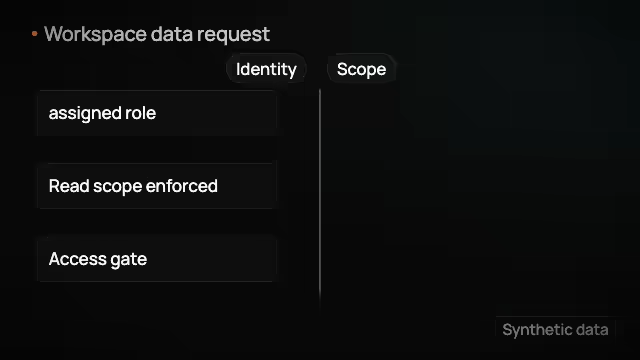
S14 · AI Gateway
Set access rules
Everyone uses AI, nobody controls who can call which model or tool, and incidents cannot be traced.
Define team access, review rule changes and test allowed and denied requests.
- Define access scope
- Validate and review changesHuman review
- Apply access rules
- Review request evidenceHuman review
4 steps2 human reviews6 components
S13 · AI Gateway
Check usage and costs
The model bill arrives at month end, and nobody can say which requests the overspend went to.
Check the budget before submitting batch jobs, then reconcile costs against recorded usage.
- Check available budget
- Submit and collect results
- Account for request costs
- Review discrepanciesHuman review
4 steps1 human reviews5 components
S32 · Intelligence
Watch and review changes
Competitors, policies and announcements change daily; checking pages by hand means hearing about important changes late.
Monitor permitted sources, surface evidenced changes and let reviewers decide follow-up actions.
- Register and collect sources
- Deduplicate and compare changes
- Organize relevant signals
- Review and archiveHuman review
4 steps1 human reviews8 components
S38 · Commerce
Publish in several languages
One piece of content in several languages across web and social channels quickly ends up with mismatched versions.
Prepare grounded copy, translate and review it, then publish to selected pages and channels.
- Prepare content candidates
- Translate and check versions
- Review facts and wordingHuman review
- Publish pages and messages
- Complete discovery and sharing
5 steps1 human reviews8 components