Beyond Leaderboard Chasing: From Static Benchmarks to Production Shadow Evaluation and Task-Level Verification
Public leaderboard scores do not predict performance on proprietary enterprise tasks; model selection should combine multi-metric evaluation, shadow-traffic comparison, and task-level routing verified against fixed scoring criteria.


High Leaderboard Scores, Broken Production Workflows
Consider a common engineering scenario. A platform team selects a newly released language model after seeing it top public leaderboards, and swaps it into an internal knowledge assistant and a structured ticket-extraction pipeline. In sandbox chats, the model produces fluent answers. Under production traffic, however, schema validation errors spike on proprietary formats, multi-turn queries drift under domain-specific negations, and latency and token costs exceed budget—forcing an immediate rollback.
This failure stems from a methodological error in model selection. Public leaderboard scores cannot represent performance on proprietary enterprise tasks; model selection should combine multi-dimensional evaluation, shadow-traffic comparison, and task-aware routing, verified against fixed scoring criteria. Treating an aggregate rank on static public datasets as proof of production readiness obscures critical trade-offs across robustness, calibration, efficiency, and task-specific behavioral boundaries.
Why Static Single-Metric Accuracy Fails: Multi-Metric Trade-Offs, Judge Models, and Behavioral Testing
Empirical research on language model evaluation explains why aggregate accuracy on static benchmarks misleads engineering teams, highlighting gaps in scenario coverage, open-ended preference alignment, and behavioral testing.
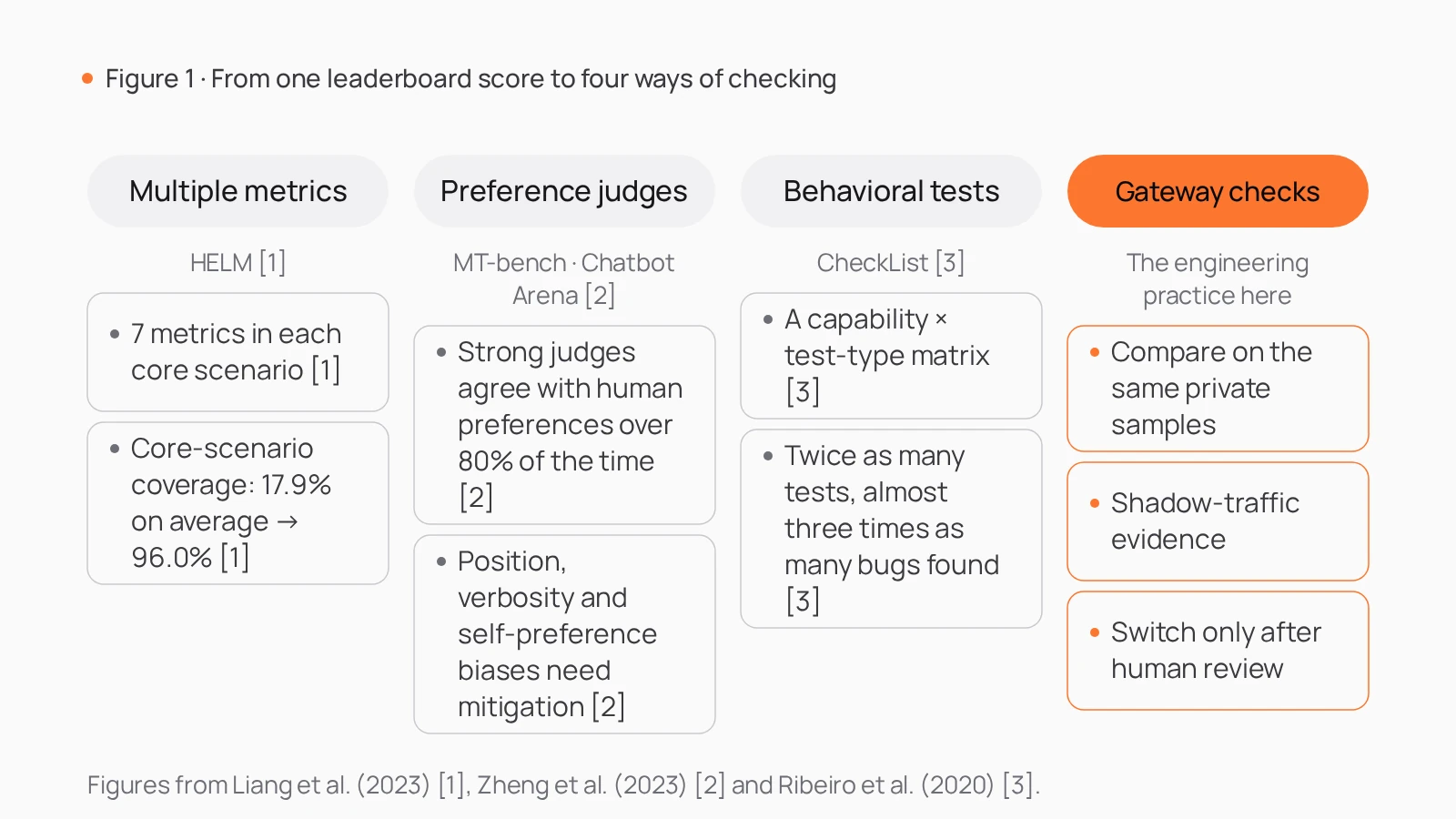
The initial gap is sparse scenario coverage combined with single-metric myopia. Liang et al. (2023) introduced Holistic Evaluation of Language Models (HELM) to improve model transparency[1]. Prior to HELM, models on average were evaluated on just 17.9%[1] of the core HELM scenarios, with some prominent models sharing no common scenario[1]. To address this, the authors taxonomized potential scenarios and metrics, selecting a broad subset while noting underrepresented areas such as neglected English dialects and trustworthiness metrics[1]. HELM adopts a multi-metric approach: whenever possible (87.5% of the time[1]), it measures 7 metrics (accuracy, calibration, robustness, fairness, bias, toxicity, and efficiency) across each of 16 core scenarios[1], ensuring non-accuracy metrics are not ignored and clearly exposing trade-offs[1]. Alongside 7 targeted evaluations across 26 targeted scenarios analyzing aspects like reasoning and disinformation[1], the researchers evaluated 30 prominent language models (open, limited-access, and closed) across all 42 scenarios—21 of which were not previously used in mainstream evaluation—raising core scenario coverage to 96.0% under standardized conditions and surfacing 25 top-level findings[1]. For enterprise architects, the implication is clear: accuracy alone conceals operational trade-offs in calibration, robustness, and efficiency.
A further challenge arises when evaluating chat assistants on open-ended, multi-turn questions where existing benchmarks struggle to measure human preferences. Zheng et al. (2023) explored using strong language models as judges (LLM-as-a-judge) on open-ended questions, examining position, verbosity, and self-enhancement biases as well as limited reasoning ability, and proposing mitigations[2]. To verify agreement between model judges and human preferences, they introduced two benchmarks—MT-bench, a multi-turn question set, and Chatbot Arena, a crowdsourced battle platform—and released 3K expert votes and 30K conversations with human preferences[2]. Their results show that strong language model judges match controlled and crowdsourced human preferences well, achieving over 80% agreement[2], matching the agreement level between humans[2]. Evaluating several model variants also showed that preference benchmarks and traditional benchmarks complement each other[2].
Finally, held-out accuracy often overestimates generalization. Inspired by software behavioral testing, Ribeiro et al. (2020) introduced CheckList, a task-agnostic methodology for testing natural language processing models[3]. Whereas alternative approaches focus on individual tasks or specific behaviors, CheckList pairs a matrix of general linguistic capabilities and test types with tooling to generate diverse test cases quickly[3]. Tests across three tasks[3] identified critical failures in commercial and state-of-the-art models[3]. In a user study, a team responsible for a commercial sentiment analysis model found new, actionable bugs in an extensively tested model[3]; in another user study, practitioners with CheckList created twice as many tests and found almost three times as many bugs as users without it[3].
Embedding Evaluation into Gateway Engineering: Sample Contracts, Shadow Traffic, and Human Gates
Together, these studies imply that model selection must be built into the gateway layer as a repeatable workflow governed by input contracts, side-by-side sample evaluation, and human review gates. Within the AI Gateway module on rlab.works, this discipline is organized through structured skill packs and atomic components.
Before candidate models enter an evaluation tournament, the skill pack Connect and check services (S18) turns endpoint onboarding into a verifiable gate. Starting from Service endpoints, authorization and interface contract, the workflow runs through controlled steps:
- Register connections (assisted execution): Registers service nodes and outputs enrolled nodes and health status.
- Prepare request paths (assisted execution): Produces client and interface configurations pending acceptance.
- Send bounded trial requests (assisted execution): Sends bounded trial requests, capturing responses and typed error records.
- Accept or roll back integration (human review): Pauses for the designated reviewer or requesting user to accept or roll back integration; rejected output returns for revision and does not advance, leaving a human-confirmed integration version and release record.
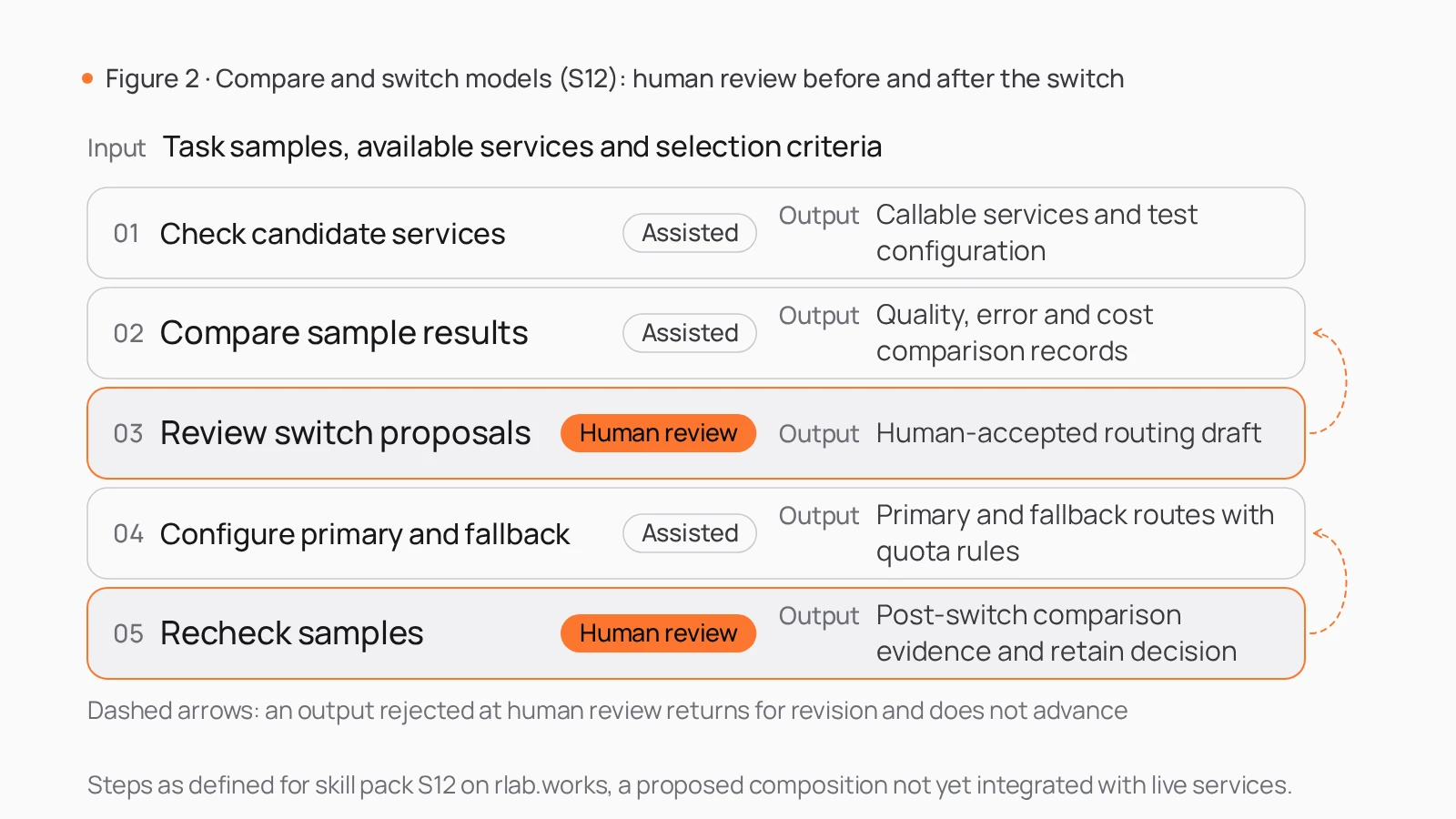
Once endpoints pass onboarding, the skill pack Compare and switch models (S12) governs model comparison and primary/fallback routing adjustments from Task samples, available services and selection criteria:
- Check candidate services (assisted execution): Verifies callable services and test configurations.
- Compare sample results (assisted execution): Uses Model comparison and shadow evaluation (comparing primary and candidate models on datasets with optional model judging, collecting shadow-traffic and routing-feedback evidence) and Task-aware model routing and structured evaluation (falling back in sequence, selecting configured task tiers, and validating structured outputs against deterministic test cases) to produce a quality, error, and cost comparison record.
- Review switch proposals (human review): Lists saved routing recommendations via Routing recommendation review for human inspection; rejected output returns for revision and does not advance, while approval produces a human-accepted routing draft.
- Configure primary and fallback (assisted execution): Sets primary and fallback routing and quota rules.
- Recheck samples (human review): Rechecks samples under human review, recording post-switch comparison evidence and the retention decision.
Moreover, every skill pack on rlab.works is a proposed composition demonstrated with synthetic data only and is not yet connected to live services. While the atomic components above exist as working code, their maturity reflects static source inspection rather than production deployment: task-aware model routing and structured evaluation maps logical tiers to configured models rather than acting as a multi-provider billing gateway, and routing recommendation review only applies or ignores saved recommendations against a validated policy draft—no automatic recommendation generation was confirmed in the inspected services.
Pre-Pilot Verification Checks for Engineering and Executive Leaders
Before funding a model migration or gateway routing pilot, a CEO, CDO, or chief architect can apply these checks:
- Are single leaderboard scores replaced by multi-metric criteria and behavioral checklists? Verify that candidates are evaluated across accuracy, efficiency, robustness, and deterministic schema compliance, alongside capability-by-test-type behavioral suites covering domain edge cases.
- Is every routing change backed by shared-sample and shadow-traffic evidence? Require side-by-side records comparing primary and candidate services on identical proprietary samples or shadow traffic—documenting quality, typed errors, and cost—before changing routes.
- Do endpoint onboarding and routing switches enforce blocking human gates? Confirm that neither newly connected nodes nor primary/fallback switches take effect without a blocking human review gate, rollback capability, and post-switch sample recheck.
Found it useful? Pass it on.
References
- [1]
Liang, P., Bommasani, R., Lee, T., Tsipras, D., Soylu, D., Yasunaga, M., Zhang, Y., Narayanan, D., Wu, Y., Kumar, A., Newman, B., Yuan, B., Yan, B., Zhang, C., Cosgrove, C., Manning, C. D., Ré, C., Acosta-Navas, D., Hudson, D. A., ... Koreeda, Y. (2023). Holistic Evaluation of Language Models. Transactions on Machine Learning Research (TMLR). arxiv.org ↗
- [2]
Zheng, L., Chiang, W.-L., Sheng, Y., Zhuang, S., Wu, Z., Zhuang, Y., Lin, Z., Li, Z., Li, D., Xing, E. P., Zhang, H., Gonzalez, J. E., & Stoica, I. (2023). Judging LLM-as-a-Judge with MT-Bench and Chatbot Arena. Advances in Neural Information Processing Systems (NeurIPS), 36. arxiv.org ↗
- [3]
Ribeiro, M. T., Wu, T., Guestrin, C., & Singh, S. (2020). Beyond Accuracy: Behavioral Testing of NLP Models with CheckList. Proceedings of the 58th Annual Meeting of the Association for Computational Linguistics (ACL), 4902–4912. doi.org/10.18653/v1/2020.acl-main.442
Related capabilities
Skills packs
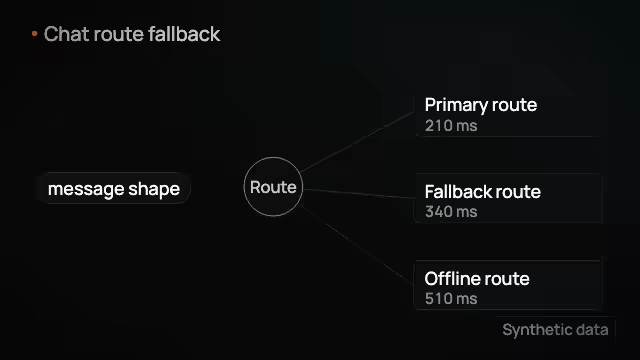
S12 · AI Gateway
Compare and switch models
New models keep arriving: switching may make results worse, not switching may leave you behind.
Compare available services on shared samples, then review differences and adjust primary and fallback choices.
- Check candidate services
- Compare sample results
- Review switch proposalsHuman review
- Configure primary and fallback
- Recheck samplesHuman review
5 steps2 human reviews7 components
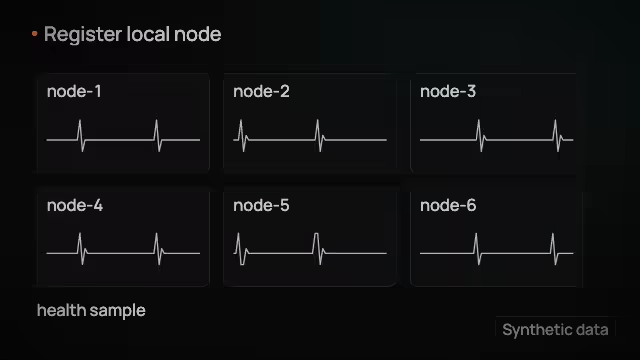
S18 · AI Gateway
Connect and check services
Connecting a new service changes live configuration, and when it fails there is no clear way back.
Register service nodes, check configuration and test requests before accepting integration.
- Register connections
- Prepare request paths
- Send bounded trial requests
- Accept or roll back integrationHuman review
4 steps1 human reviews5 components