Ending "Hallucinated ROI": True Cost Accounting and Value Attribution for Enterprise AI Projects
True ROI accounting for enterprise AI projects must include invocation costs, retries, and human rework, and must be tied to business outcomes verified against controlled baselines; theoretical minutes saved cannot be booked directly as financial returns.


When Theoretical Minutes Saved Become Phantom Financial Returns
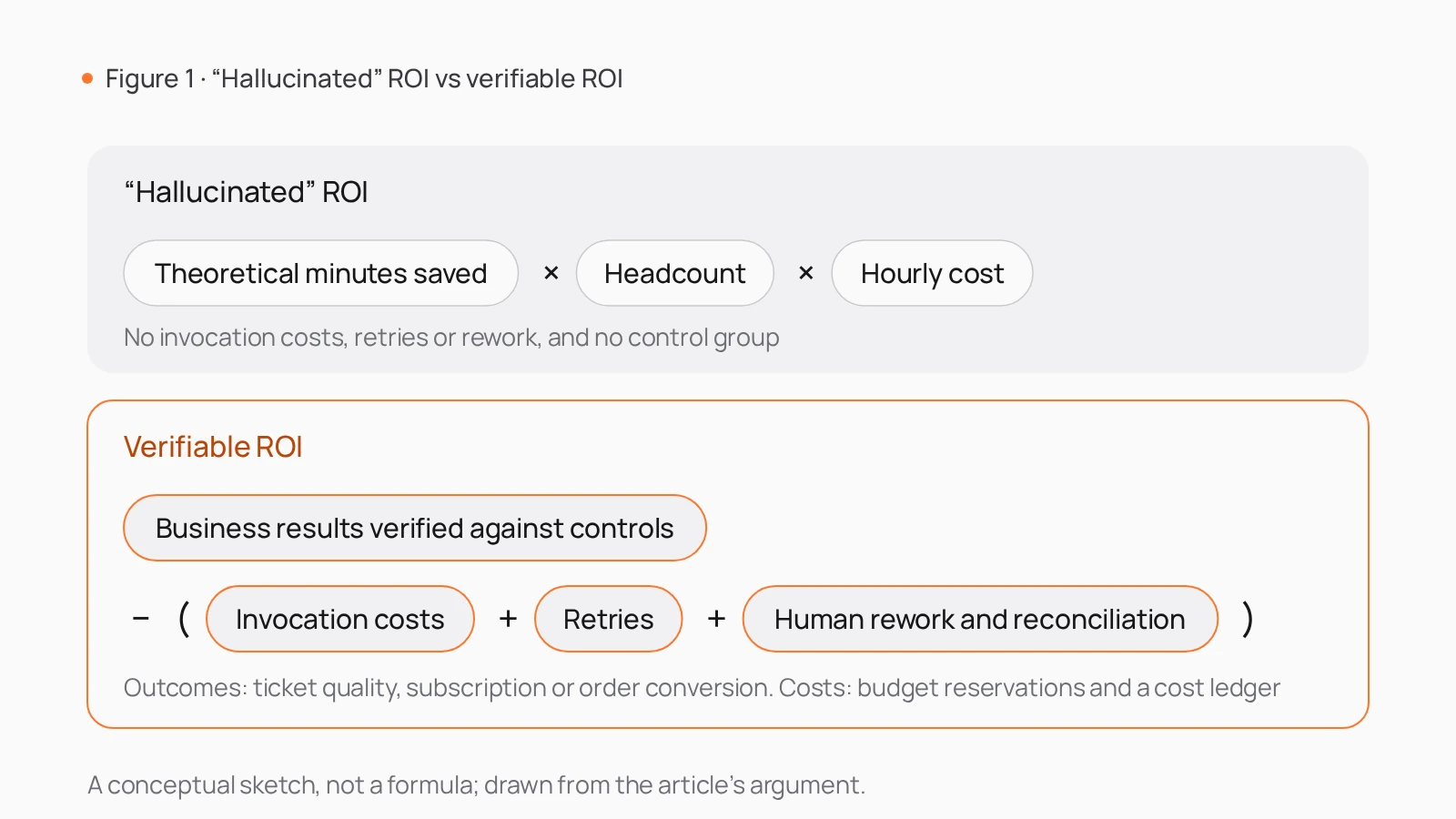
Consider a familiar situation in an enterprise pilot review. A business unit reports that after introducing a generative assistant, employees draft copy and assemble spreadsheets faster in trials. Sponsors multiply those saved minutes by headcount and wage rates to project a large return. Yet when quarterly results arrive, invocation bills have climbed, conversion and retention show no verified improvement, and senior staff spend extra hours inspecting and rewriting flawed upstream drafts.
Treating local drafting speedups as realized profit creates “hallucinated ROI.” Our thesis is simple: AI project ROI must include invocation costs, retries, and human rework, and must be anchored to business outcomes verified through controlled comparison; “theoretical minutes saved” cannot be booked directly as financial return.
From Task Speedups to Aggregate Output: Task Boundaries, Heterogeneity, and Oversight
Why does faster completion of an individual step fail to scale linearly into organizational performance? Macroeconomic theory and workplace studies point to task complexity, worker heterogeneity, and oversight costs.
At the macroeconomic level, Acemoglu (2025) evaluates AI’s aggregate implications using a task-based model working through automation and task complementarities[1]. So long as microeconomic effects stem from task-level cost savings or productivity gains, macroeconomic consequences follow a version of Hulten’s theorem: GDP and aggregate productivity gains can be estimated from the fraction of tasks impacted and average task-level cost savings[1]. Using existing estimates of AI exposure and task-level productivity gains, these macroeconomic effects are non-trivial but modest—no more than a 0.66% increase in total factor productivity (TFP) over 10 years[1]. Even these estimates may be exaggerated because early evidence comes from easy-to-learn tasks, whereas future effects will partly come from hard-to-learn tasks where context-dependent factors shape decisions and no objective outcome measures exist from which to learn successful performance; consequently, predicted TFP gains over the next 10 years are less than 0.53%[1]. Theoretically, even when AI raises low-skill workers’ productivity in certain tasks without creating new tasks, inequality may rise; empirically, while AI impacts are more equally distributed across demographic groups than previous automation technologies, there is no evidence AI will reduce labor income inequality, it is predicted to widen the capital-labor income gap, and some new tasks (such as algorithms for online manipulation) may have negative social value[1].
Inside the firm, task-level gains are equally uneven. Brynjolfsson, Li, and Raymond (2025) studied the staggered introduction of a generative AI conversational assistant across 5,172 customer-support agents[2]. AI assistance raised worker productivity, measured by issues resolved per hour, by 15% on average, with substantial heterogeneity across workers[2]. Less experienced and lower-skilled workers improved both speed and quality, whereas the most experienced and highest-skilled workers saw small speed gains and small quality declines[2]. AI assistance also facilitated worker learning and improved English fluency, particularly among international agents; yielded the largest gains on moderately rare problems where human agents had less baseline experience but the system had adequate training data; and improved work experience as customers were more polite and less likely to ask for a manager[2]. Extrapolating from a narrow pilot without controlling for worker tenure and problem distribution distorts return estimates.
The AI Index 2024 Annual Report (Maslej et al., 2024) reinforces these boundaries[3]. AI has surpassed human performance on several benchmarks (some image classification, visual reasoning, and English understanding) but trails on complex tasks such as competition-level mathematics, visual commonsense reasoning, and planning[3]. While several 2023 studies suggested AI lets workers finish tasks faster, improve quality, and narrow the skill gap, other studies caution that using AI without proper oversight can diminish performance, and robust, standardized evaluations for LLM responsibility are seriously lacking[3].
Engineering Value Attribution: Cost Ledgers, Metric Alignment, and Conversion Feedback
Defensible value attribution requires controls across both costs and outcomes. On rlab.works, this discipline spans the AI Gateway, Intelligence, and Commerce modules through structured skill packs and human review gates.
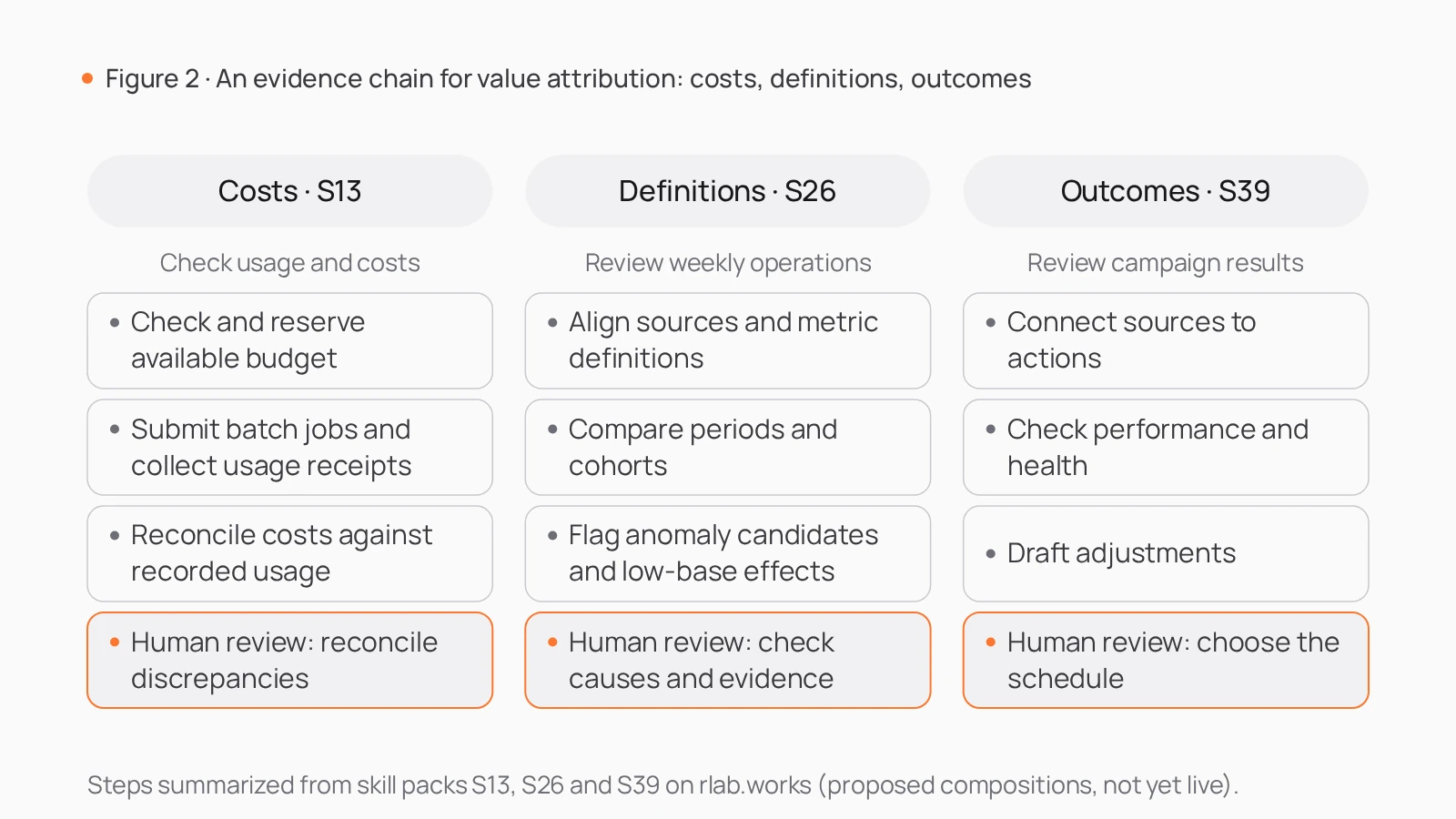
In Intelligence, Review weekly operations (S26) prevents mistaking seasonal noise or shifting definitions for AI gains. Taking authorized business tables, comparison periods, and previous reports as input, it collects and aligns tables (outputting unified data with provenance, definitions, and ownership) and compares periods and segments (outputting cross-period trends and segment comparisons). It then finds exception candidates via Order-to-traffic anomaly diagnostics, drilling down to exact and dashboard-consistent definitions to flag traffic-to-order divergence, partner concentration, geographic mismatch, and low-base effects. At the Check causes and evidence human review gate, a reviewer verifies explanations—rejected outputs return for revision—before assembling the archived weekly report and follow-ups. For travel and hotels, this pack is a source-supported industry—aligning orders, room nights, visits, and channel data while retaining definitions and tracking prior issues—though warehouse permissions and definitions must be verified and holiday overlap does not prove causation. It has no tag for finance, government and public services, or media and content.
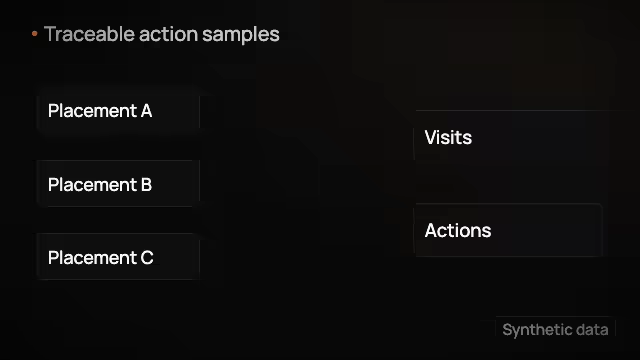
In Commerce, Review campaign results (S39) connects content output to verified actions. Using published content, permitted analytics, and campaign goals as input, it invokes Attribution and conversion feedback to link tracked campaign URLs with external analytics and proprietary registration and order data. It links sources and actions (outputting a traceable visit and action table), checks performance and health (outputting content comparisons, missing data, and runtime anomalies), and drafts next-round adjustments. At the Choose the next plan human review gate, a reviewer must approve the plan—rejected drafts return for revision—before scheduling and retaining execution history and the next baseline. For media and content, this pack is a transferable use, aligning article referral links, reading, and subscription actions to guide topic and channel selection; teams must distinguish reading, subscription, and paid events, and attribution correlation does not prove causal reach. It has no tag for finance, government and public services, or travel and hotels.
Every skill pack on rlab.works is a proposed composition demonstrated with synthetic data and not yet connected to live services. The components above are working code assessed via static source inspection rather than production deployment, and a source-supported industry tag means only that source data has an explicit industry association—making no claims about customers, deployments, or ROI.
Pre-Pilot Checks for Defensible Value Attribution
Before funding or scaling an AI pilot, executives and department heads can apply these checks:
- Does cost accounting include retries, discrepancies, and human rework? Require batch jobs to run against a reservation and reconciliation ledger, and count senior staff time spent reviewing discrepancies and revising rejected drafts.
- Are outcome evaluations anchored to controlled periods and cohorts? Lock metric definitions and baselines up front across worker skill levels and task types to filter out low-base effects, partner concentration, and holiday noise.
- Do attribution workflows gate next-round plans on verified business actions? Reject ROI cases built on theoretical minutes saved; require traceable links from outputs to ticket resolution quality, subscriptions, or orders, with a blocking human review gate before plans advance.
Found it useful? Pass it on.
References
- [1]
Acemoglu, D. (2025). The Simple Macroeconomics of AI. Economic Policy, 40(121), 13–58. doi.org/10.1093/epolic/eiae042
- [2]
Brynjolfsson, E., Li, D., & Raymond, L. R. (2025). Generative AI at Work. The Quarterly Journal of Economics, 140(2), 889–942 (also NBER Working Paper No. 31161, 2023). doi.org/10.1093/qje/qjae044
- [3]
Maslej, N., Fattorini, L., Perrault, R., et al. (2024). The AI Index 2024 Annual Report. Stanford Institute for Human-Centered Artificial Intelligence. hai.stanford.edu ↗
Related capabilities
Platform modules
Skills packs
S13 · AI Gateway
Check usage and costs
The model bill arrives at month end, and nobody can say which requests the overspend went to.
Check the budget before submitting batch jobs, then reconcile costs against recorded usage.
- Check available budget
- Submit and collect results
- Account for request costs
- Review discrepanciesHuman review
4 steps1 human reviews5 components
S26 · Intelligence
Review weekly operations
Most of the weekly report goes into reconciling spreadsheets, and the real anomalies get no attention.
Align table definitions, identify changes worth checking and draft a weekly report with follow-ups.
- Collect and align tables
- Compare periods and segments
- Find exception candidates
- Check causes and evidenceHuman review
- Assemble report and follow-ups
5 steps1 human reviews11 components
S39 · Commerce
Review campaign results
After a campaign only the totals get read, and nobody can say which content or channel did better.
Check visits and action records, compare content results and confirm the next schedule.
- Link sources and actions
- Check performance and health
- Draft adjustments
- Choose the next planHuman review
- Schedule and retain history
5 steps1 human reviews9 components