Distinguishing "Proven" from "Transferable": The Engineering Boundaries of Cross-Industry AI Reuse
Capabilities that share an interaction pattern still require rebuilt data contracts, compliance filters, and human sign-off when moved to a new industry; capability catalogs should distinguish source-supported industries from transferable patterns according to an explicit basis policy.


Why Identical Interaction Patterns Still Stall Across Industry Boundaries
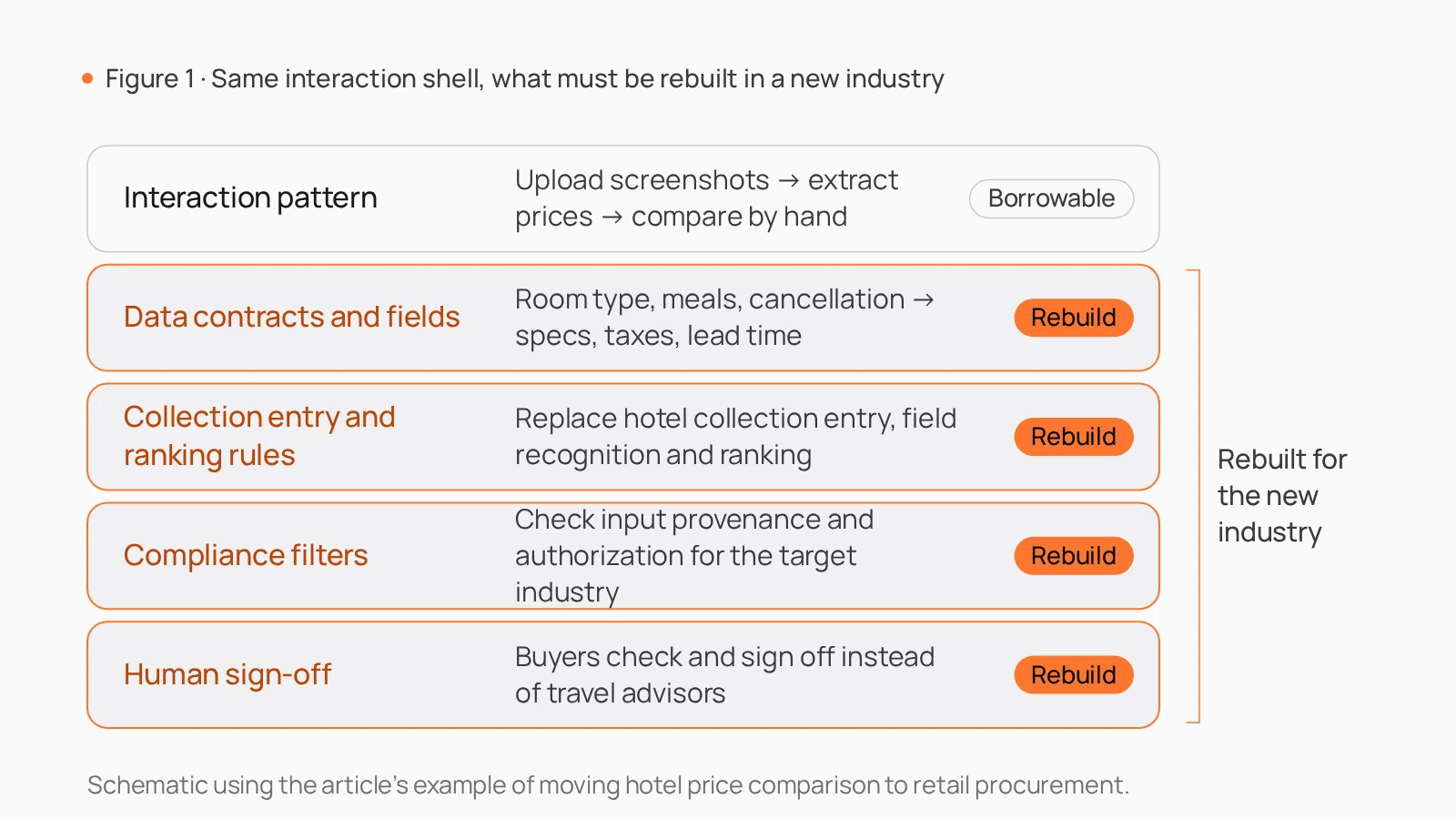
Imagine a common scenario in enterprise planning. A retail procurement team sees a travel workflow that reads hotel rate screenshots and links, aligns comparison terms, and presents a table for an advisor to review tradeoffs. Seeing the same interaction—uploading quote screenshots, extracting prices, and reviewing differences—the procurement lead asks engineering to reuse the workflow for supplier quotes. During integration, however, the team finds that extraction logic, schemas, and ranking rules are built around room types, meal plans, and cancellation conditions. None of those schemas can represent product specifications, taxes, or delivery lead times, and buyer sign-off rules are absent.
This friction stems from mistaking an interaction shell for a portable system. Capabilities that share a workflow pattern still require rebuilt data contracts, compliance filters, and human sign-off when moved to another industry. Rather than treating every workflow as universally plug-and-play, a capability catalog should distinguish source-supported industries from transferable patterns under an explicit basis policy.
Feature Space Shifts, Surrounding Infrastructure, and Data Cascades
Why does a workflow that runs cleanly in one domain encounter friction when moved into another? Research in machine learning, systems engineering, and human-computer interaction explains the mechanisms from three angles.
First is the breakdown of shared feature spaces and distributions. Pan and Yang (2010) note that a major assumption in many machine learning and data mining algorithms is that training and future data must share the same feature space and distribution[2]. In many real-world applications, this assumption fails: an organization may face a classification, regression, or clustering task in one domain of interest while having sufficient training data only in another domain whose data lie in a different feature space or follow a different distribution[2]. While successful knowledge transfer can improve learning performance and avoid expensive data-labeling efforts, it must address domain adaptation, multitask learning, sample selection bias, and covariate shift[2].
Second is the surrounding infrastructure binding a model to its domain. Using the framework of technical debt, Sculley et al. (2015) argue that it is dangerous to view quick wins in machine learning as free, since real-world systems incur massive ongoing maintenance costs[1]. Machine learning code is only a small fraction of a real system; most of it is surrounding infrastructure for data collection, verification, configuration, serving, and monitoring[1]. They identify risk factors including boundary erosion, entanglement, hidden feedback loops, undeclared consumers, data dependencies, configuration issues, changes in the external world, and system-level anti-patterns[1]. Moving a capability to another industry invalidates existing data dependencies, verification rules, and configurations, requiring rebuilt infrastructure even when high-level orchestration looks unchanged.
Third is the downstream compounding of overlooked data issues. Studying high-stakes domains like health, wildlife conservation, and loan allocations, Sambasivan et al. (2021) observe that while data quality carries elevated significance due to its heightened downstream impact, data is paradoxically the most under-valued and de-glamorized aspect of artificial intelligence[3]. From interviews with 53[3] practitioners in India, East and West African countries, and the United States, the authors define and present empirical evidence on “Data Cascades”—compounding events causing negative downstream effects from data issues, triggered by conventional practices that undervalue data quality[3]. Data cascades are pervasive, with 92%[3] prevalence, and are invisible and delayed yet often avoidable when organizations design and incentivize data excellence as a first-class citizen[3].
Defining Engineering Boundaries by Basis Policy: Price Comparison and Video Action Review
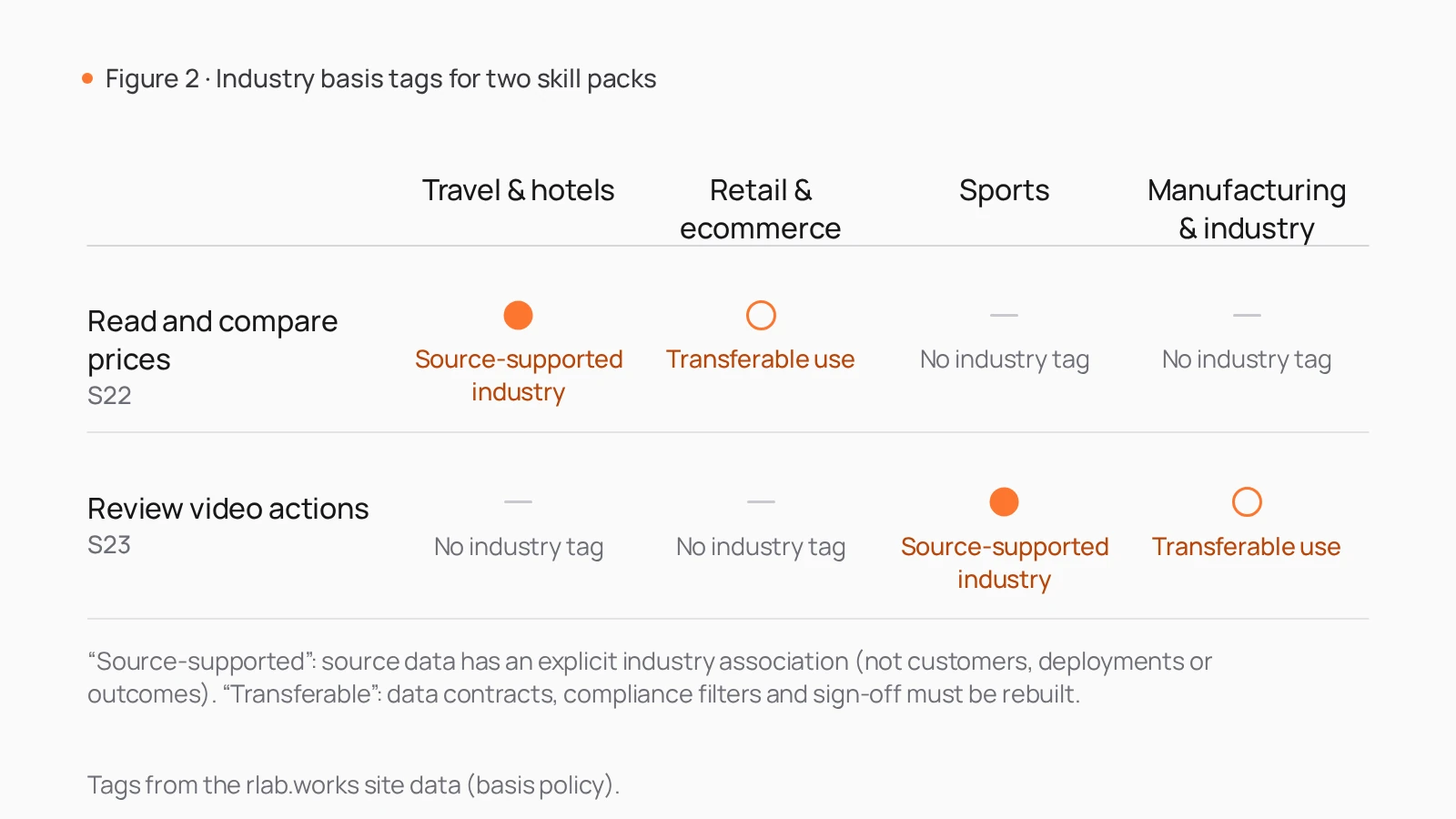
Translating these findings into architecture governance requires candor about what a catalog entry represents. On rlab.works, the basis policy separates industry associations into two categories. A source-supported industry label (Proven) means only that the source data contain an explicit association with that industry; it says nothing about customers, deployments, or outcomes. By contrast, a transferable use label (Transferable) means the workflow pattern could be adapted to another industry, but needs re-done data contracts, compliance filters, and human sign-off.
Two skill packs in the Intelligence module illustrate this boundary.
The first is Read and compare prices (S22), which reads prices from screenshots and links, aligns comparison terms, and reviews differences and tradeoffs. Taking Quote screenshots, links and comparison conditions as initial input, it locates source offers (assisted) to record quote sources; reads key fields (assisted) via components such as Multi-image OTA rate extraction to jointly interpret screenshots and extract hotel and room identifiers, dates, occupancy, breakfast, prices, and promotions as provenance-linked candidates; aligns comparison terms (assisted) into normalized prices, benefits, and commitment states; and pauses at a human review gate (Compare and review) where a designated reviewer or requesting user inspects options. Rejected output returns for revision and does not advance, producing human-verified differences and open items only after sign-off.
In travel and hotels, this pack carries a source-supported industry tag: it reads room types, meal plans, and cancellation conditions from rate screenshots so a consultant can weigh tradeoffs under identical stay conditions, though screenshot records do not represent live bookable inventory and rates must be re-verified through the booking flow before ordering. In retail and ecommerce, it is marked for transferable use: while it can align supplier quote screenshots into a common table so a buyer can verify specifications, taxes, and delivery lead times before choosing, engineers must replace hotel collection entry points, field extraction, and ranking rules rather than comparing merchandise with room or meal fields. In sports and manufacturing, the pack has no industry tag and serves at most as a general pattern.
The second is Review video actions (S23), which preserves footage sources, proposes motion candidates, and creates evidence-linked replays after human correction. Starting from Authorized footage, venue information and review goal, it enforces two human review gates. First, Confirm footage sources (human review) uses Media provenance and declared-use review to bind source identity, archival evidence, and declared scope of use to media, blocking reuse when provenance is unconfirmed or evidence changes; rejected inputs return for revision. It then normalizes timing and frames (assisted) and proposes motion candidates (assisted) before pausing at Review against requirements (human review), where Court calibration and reviewed trajectory reconstruction receives court and ball annotations, audits revisions, and reconstructs trajectories within bounded gaps so only human-accepted trajectories, annotations, and events advance. Assisted steps then summarize confirmed events with limitations, build annotated replays with source mappings, and hand over a review pack.
In sports, this pack carries a source-supported industry tag: all member components have sports source labels, letting analysts correct ball-track candidates from match footage and generate conditional statistics and annotated replays, bounded by specified court geometry and calibration conditions for speed readings. In manufacturing and industry, it is marked for transferable use—such as adapting footage review to a workstation to flag questionable motions, let a team lead confirm them against standard operating procedures, and hand over a shift review pack. Doing so requires redoing workstation calibration, motion candidates, and process statistics; existing components do not automatically recognize standard operating procedures or judge violations, and shift report templates need adaptation. In travel and retail, this pack has no industry tag.
Pre-Pilot Checks Before Reusing a Capability Across Industries
Before funding a cross-industry pilot, an executive or architect can apply three checks:
- Verify the catalog basis tag and industry scope: Check whether the capability is source-supported in the target industry, marked for transferable adaptation, or untagged, and never treat a source-data industry tag as evidence of customer deployments or outcomes.
- Scope the schema and infrastructure rewrite: Map the differences between source and target domains across collection entry points, field definitions, normalization rules, and ranking criteria before committing schedules.
- Wire domain compliance filters and blocking human gates: Define valid input provenance and assign human review owners in the target domain, ensuring unaccepted candidates return for revision and cannot advance automatically.
Found it useful? Pass it on.
References
- [1]
Sculley, D., Holt, G., Golovin, D., Davydov, E., Phillips, T., Ebner, D., Chaudhary, V., Young, M., Crespo, J.-F., & Dennison, D. (2015). Hidden Technical Debt in Machine Learning Systems. Advances in Neural Information Processing Systems (NeurIPS), 28, 2503–2511. papers.nips.cc ↗
- [2]
Pan, S. J., & Yang, Q. (2010). A Survey on Transfer Learning. IEEE Transactions on Knowledge and Data Engineering, 22(10), 1345–1359. doi.org/10.1109/TKDE.2009.191
- [3]
Sambasivan, N., Kapania, S., Highfill, H., Akrong, D., Paritosh, P., & Aroyo, L. M. (2021). "Everyone wants to do the model work, not the data work": Data Cascades in High-Stakes AI. Proceedings of the 2021 CHI Conference on Human Factors in Computing Systems, Article 39. doi.org/10.1145/3411764.3445518
Related capabilities
Skills packs
S22 · Intelligence
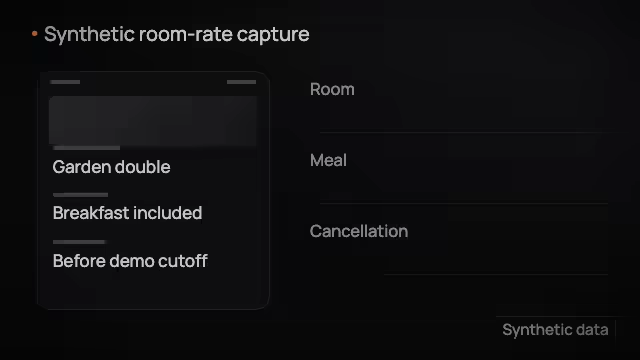
Read and compare prices
Quote screenshots differ in format, tax and inclusions, so manual comparisons often compare unlike with unlike.
Read prices from screenshots and links, align comparison terms and review differences and tradeoffs.
- Locate source offers
- Read key fields
- Align comparison terms
- Compare and reviewHuman review
4 steps1 human reviews7 components
S23 · Intelligence
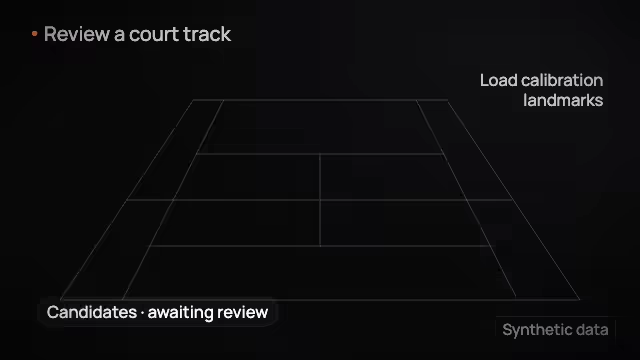
Review video actions
Finding key moments frame by frame is slow and tiring, and the conclusions are hard to check later.
Preserve footage sources, propose motion candidates and create evidence-linked replays after human correction.
- Confirm footage sourcesHuman review
- Normalize timing and frames
- Propose motion candidates
- Review against requirementsHuman review
- Summarize confirmed events
- Build annotated replays
- Hand over the review pack
7 steps2 human reviews8 components