The Strong Model Need Not Author Every Step: Review at the Boundary That Changes the Environment
Tool-using agents waste high-end model capacity when the strong model autoregressively decodes every routine lookup. Separating reversible reads from state-changing writes—letting a weak model execute read-only calls while holding the first write for single-pass semantic verification by the strong model—preserves most strong-model quality while sharply cutting memory-bandwidth traffic, latency, or remote output tokens.

Why Having the Strong Model Author Every Lookup Drags Down Tool Agents
When engineering teams deploy multi-step tool-using agents in customer service, workflows, or document operations, they often default to a single-actor assignment: because a bad state change is costly, the strongest and most expensive model writes every step. Yet real agent traces show a clear asymmetry. Most turns are reversible, side-effect-free lookups—checking an order, listing folders, retrieving rules, or inspecting schema fields. Only a few turns mutate external state, such as modifying a booking, issuing a refund, updating a database, or sending an external notice.
Having the strong model autoregressively decode every lookup imposes a steep tax. Token-by-token generation repeatedly reads large model weights from high-bandwidth memory, driving up wall-clock latency, memory traffic, and remote output-token spend. Conversely, handing the whole task to a weak model sacrifices reliability where complex rule synthesis and irreversible writes occur.
Resolving this tension requires separating drafting a trajectory from committing environmental changes: classify actions into reversible reads versus irreversible writes, let a weak model execute read-only exploration in bounded chunks, and place strong-model verification at the write boundary.
From Token Speculation to Trajectory-Level Semantic Verification
Two research traditions address inference cost and latency, yet neither maps directly onto multi-step tool trajectories alone.
The first is speculative decoding. In Leviathan, Kalman, and Matias (2023), a small model drafts tokens while the large model verifies them in parallel in one forward pass, preserving the large model’s exact distribution[2]. In multi-step tool use, however, an agent interacts with an external environment between steps, and different lookup orders or phrasings can validly satisfy the same goal. Requiring exact-match tokens or actions rejects valid exploration. The second is query-level routing and cascading, as in FrugalGPT (Chen, Zaharia, & Zou, 2024), which picks one model per query to reduce cost while keeping performance[3]. Yet a single trajectory mixes easy lookups with high-stakes writes across turns, so a single per-query model choice cannot split work inside a trajectory.
Wang et al. (2026) introduce SpecAgent, a protocol for trajectory-level speculation with semantic verification[1]:
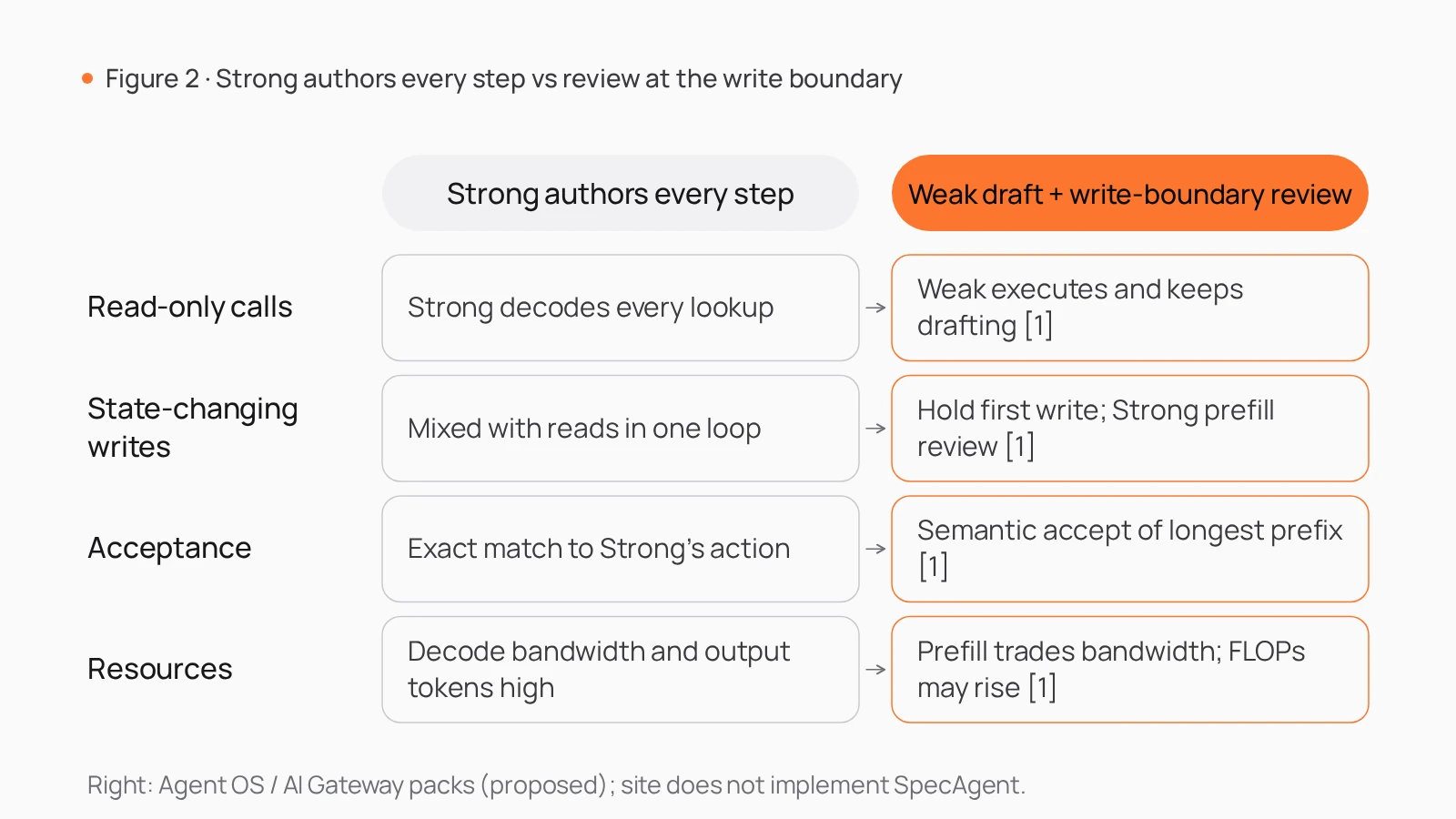
- Drafting reads and holding writes: A weak model drafts bounded chunks of up to K steps (K=6 on τ² and VitaBench; K=8 on AutomationBench), executes read-only tool calls immediately as it drafts, and holds the first state-changing action without executing it[1].
- Single-pass prefill verification and local repair: The strong model verifies the grounded chunk in one prefill pass, returning (j, reason, optional replacement) to commit the longest prefix judged semantically valid, and repairs only the first rejected step via fused repair when possible or one strong repair turn otherwise[1].
Replacing step-by-step strong decoding with parallel prefill shifts work from memory bandwidth to compute. Across customer-service, workflow, and edge–cloud benchmarks, Wang et al. (2026) report the following Pass@1 and estimated resources under their serving assumptions[1]:
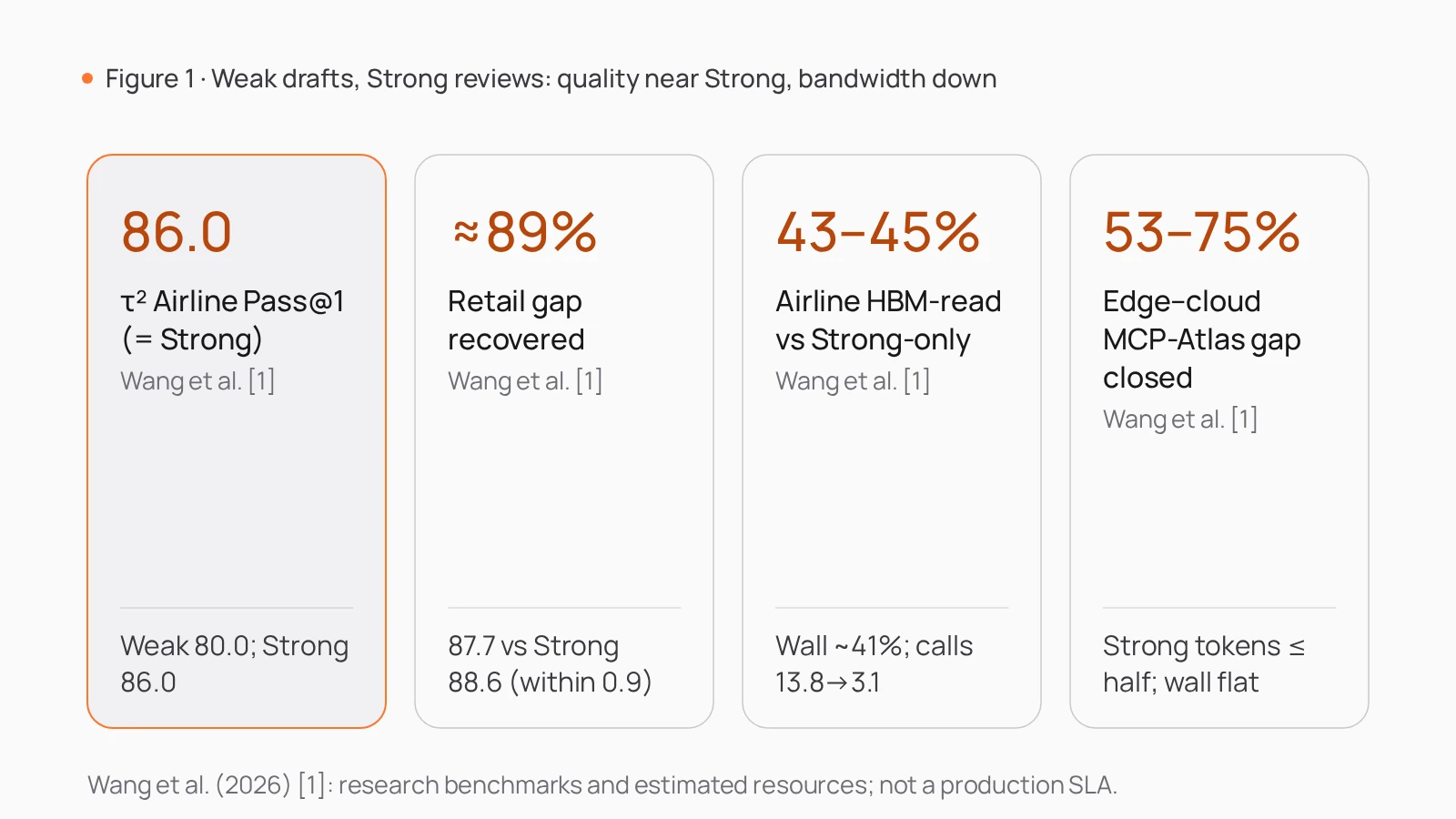
- Task quality (Pass@1): On τ² Airline, SpecAgent achieves 86.0, matching Strong-only (86.0) vs. Weak-only (80.0). On τ² Retail, SpecAgent reaches 87.7 vs. Strong-only 88.6 (Weak-only 80.4)—within 0.9 points and recovering ~89% of the Weak–Strong gap. On AutomationBench (SpecAgent 10.5 between Weak 6.8 and Strong 15.2) and VitaBench Delivery (SpecAgent 44.5 between Weak 34.0 and Strong 48.0), it recovers 44% and 75% of the gap[1].
- Memory traffic and wall time vs. FLOPs: On τ², strong calls per trajectory fall sharply (e.g., Airline 13.8 to 3.1). Relative to Strong-only, estimated high-bandwidth memory reads (HBM-read) and wall time drop to 43–45% and ~41% (126.2 vs. 305.2 s) on Airline, and to 53–57% and ~54% (87.5 vs. 162.4 s) on Retail. On AutomationBench, HBM-read drops to 78–84% and wall time to ~57%; on VitaBench, HBM-read drops to 59–65% and wall time to ~69%. Crucially, estimated FLOPs rise by 30%, 38%, 38%, and 87% across the four blocks—confirming that the saving comes from decode and memory bandwidth, not arithmetic[1].
- Edge–cloud MCP-Atlas deployment: Across 101 public tasks on real MCP servers and three strong-model backends, SpecAgent closes 53–75% of the Weak–Strong quality gap while the strong model generates at most half of Strong-only output tokens (36–50%), cutting API cost to 59–81%. Wall time does not fall in this deployment because local weak latency is similar to remote strong latency[1].
Retail ablations clarify why both boundary placement and semantic acceptance are essential. Reviewing every chunk including reads, or also holding user replies, more than triples strong calls and can raise HBM-read past Strong-only; similarly, collaboration baselines that keep the strong model as the primary actor or escalate more often can use more strong calls than Strong-only[1]. Meanwhile, exact-match acceptance (keeping only what the strong model would have done) lowers Retail Pass@1 to 82.5 and raises FLOPs by ~70%—semantic acceptance is what retains weak-model progress[1]. Scope boundaries must also be stated: these findings reflect research benchmarks with simulated users or MCP servers and estimated resources under the paper’s serving assumptions, not production SLA guarantees[1].
Engineering Mapping on rlab.works: Read–Write Classification, Hold Gates, and Operating-Point Evaluation
In our engineering view, these findings translate into five architectural rules: inventory tools as reversible reads versus irreversible writes; allow the weak model to run reversible reads; require strong-model (or human) commitment before irreversible writes; prefer semantic acceptance over regenerating every step; and score policies jointly on quality and strong-token or latency operating points.
Across Agent OS and AI Gateway on rlab.works, three proposed skill packs and three components illustrate how these controls map onto enterprise workflows:
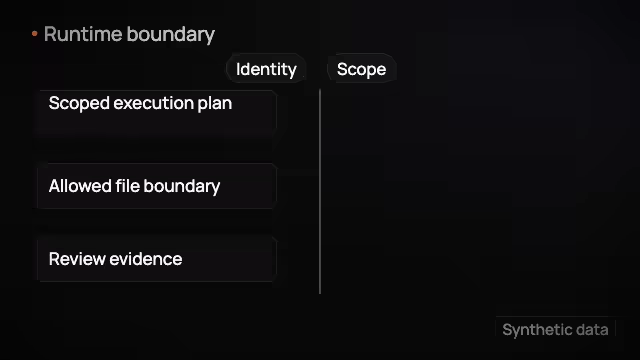
- Holding state-changing actions until reviewed: In Agent OS, Approve computer actions (S03) runs check readiness → approve the action list (human gate) → act and retain evidence → check the changes (human gate). This maps directly to holding state-changing actions until reviewed. In legal services, it is transferable: reads and writes are restricted to scoped folders, and outbound submission is excluded from default permissions.
- Separating scoped execution from delivery sign-off: In Agent OS, Plan and deliver work (S01) runs plan the steps → approve the scope (human gate) → run and collect → review and hand over (human gate). Its runtime layer pairs Durable governed agent execution (a governed execution loop) with Sandboxed agent jobs and artifacts (running jobs in a sandbox before production effects). In manufacturing, this pack is transferable: software orchestrates planning, lookups, and human records, while physical equipment work stays with qualified personnel under configured permits and checkpoints.
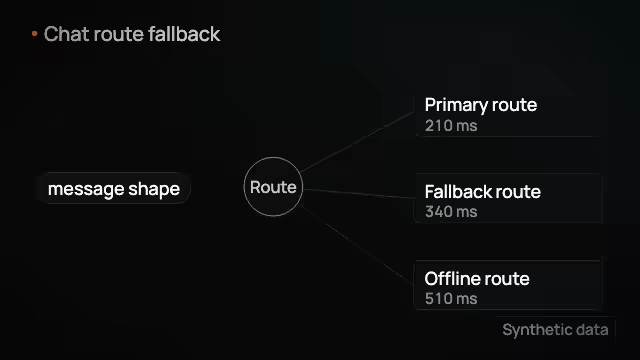
- Comparing Weak/Strong operating points with real samples: In AI Gateway, Compare and switch models (S12) runs check candidate services → compare sample results → review switch proposals (human gate) → configure primary and fallback → recheck samples (human gate), backed by Task-aware model routing and structured evaluation to compare routing and structured fixtures across operating points. Transferable in enterprise settings, it verifies candidates on real samples with shadow evidence rather than promising automatic optimal-model selection.
Adaptation boundaries must be stated candidly. None of the site’s skill packs or components implement SpecAgent. All three skill packs are proposed compositions not yet integrated with live services and demonstrated on synthetic data. Among the components, Durable governed agent execution and Task-aware model routing and structured evaluation are rated working from static source inspection only, while Sandboxed agent jobs and artifacts is a prototype.
Three Pre-Deployment Checks for Write-Boundary Review
Before scaling multi-step tool agents, engineering leaders should apply three checks:
- Inventory every tool as a reversible read or irreversible write: Separate side-effect-free lookups from state-mutating calls so the runtime can automatically hold the first write action in any draft chunk.
- Place expensive review at the write boundary rather than on every step: Let lightweight models execute bounded read-only gathering, triggering strong-model prefill review or human gates only before state changes or at chunk limits.
- Evaluate semantic validity alongside token, bandwidth, and latency operating points: Accept valid intermediate trajectories without requiring verbatim agreement, and measure quality alongside strong-model output tokens, memory bandwidth, and wall-clock latency.
Found it useful? Pass it on.
References
- [1]
Wang, Z., Liu, Y., Chen, C., Liu, Q., & Guo, Z. (2026). Trajectory-level speculation with semantic verification for tool-using agents (arXiv:2610.21463). arxiv.org ↗
- [2]
Leviathan, Y., Kalman, M., & Matias, Y. (2023). Fast inference from transformers via speculative decoding. In *ICML 2023*. arxiv.org ↗
- [3]
Chen, L., Zaharia, M., & Zou, J. (2024). FrugalGPT: How to use large language models while reducing cost and improving performance. *TMLR*. arxiv.org ↗
Related capabilities
Platform modules
Skills packs
S01 · Agent OS
Plan and deliver work
Hand AI a big job and it often stops halfway or drifts, and nobody can tell how far it got.
Break a goal into dependent tasks, confirm execution and deliver reviewable results.
- Plan the steps
- Approve the scopeHuman review
- Run and collect
- Review and hand overHuman review
4 steps2 human reviews7 components
S03 · Agent OS
Approve computer actions
Back-office entry, forms and file edits are repetitive computer work you would hand to AI, if you trusted it not to click and change the wrong things.
Check identity and action scope, run approved actions and retain page and file changes.
- Check readiness
- Approve the action listHuman review
- Act and retain evidence
- Check the changesHuman review
4 steps2 human reviews8 components
S12 · AI Gateway
Compare and switch models
New models keep arriving: switching may make results worse, not switching may leave you behind.
Compare available services on shared samples, then review differences and adjust primary and fallback choices.
- Check candidate services
- Compare sample results
- Review switch proposalsHuman review
- Configure primary and fallback
- Recheck samplesHuman review
5 steps2 human reviews7 components