Put Compliance in the Claim Library, Not the Prompt: A Data Architecture for Regulated Content Generation
In regulated content generation, piling compliance and audience rules into ever-longer prompts is brittle and expensive. Production evidence and retrieval research show that constraints belong on claim-level records as retrieval-gated metadata while serving verbatim approved text to the generator—separating by-construction filter metrics from judged quality and preserving human medical, legal, and regulatory review before publication.


Why Ever-Longer Prompt Rules Fail to Govern Regulated Copy
In regulated content workflows—such as pharmaceutical promotional copy or medical communications—every claim must match an approved indication, target audience, and reference while avoiding prohibited phrasing. A common approach in drafting assistants is to keep adding rules to a long prompt: each time a draft misses a constraint, engineers append another citation rule or verbatim-claim instruction to a product-level template.
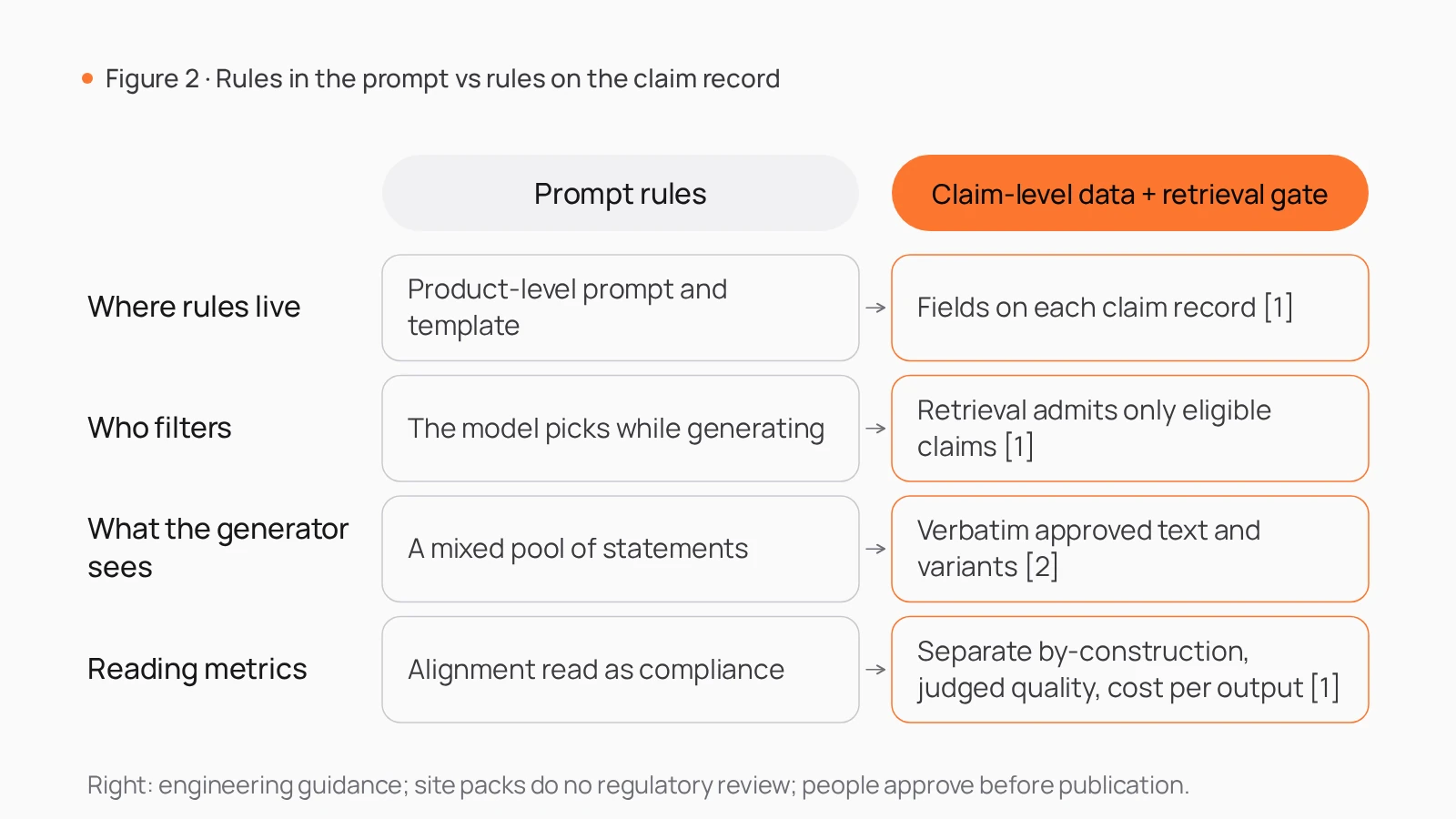
As products and channels grow, static prompt rules become hard to maintain. In the production case discussed below, the rule-based baseline often failed to produce outputs fitted to audience and context, with audience mismatches, low relevance, and overuse of inactive or general claims[1]. Eligibility and compliance constraints are properties of individual approved records, not global style advice. In our view, relocating them onto a claim-level data model, gating admission at retrieval, and serving verbatim approved text to the generator scales better—but the evidence for that needs careful reading.
From Prompt Rules to a Claim-Level Data Model: Retrieval Gates, Raw Evidence, and Cost Realities
Grounding generation in external records builds on retrieval-augmented generation (Lewis et al., 2020), pairing a parametric generator with a non-parametric retrieved index so outputs draw on external documents at inference time[3]. In regulated settings, the harder questions are how the indexed unit is modeled, whether raw wording is preserved, and how post-deployment metrics are interpreted.
Mishra et al. (2026) examine this shift in a production case study of a deployed internal claims-generation tool[1]. Their data model spans 1,867 approved pharmaceutical claims across four US-market products and 11 claim categories; 98% link to references (2% have none), and 72% are used in materials[1]. Whereas the baseline relied on rule-based prompting and strict templates with citation rules and verbatim-claim constraints, the new pipeline does not eliminate rules—it relocates them from static product-level prompt text to claim-level, retrieval-gated metadata[1]. Each record stores approved match text, lifecycle state (Approved, Archived, Draft), reference IDs and texts, indication, content type, target audience, claim-specific guardrails, prohibited words and negative constraints, and a six-dimension quality score (“6C”: clarity, completeness, consistency, connectivity, compliance, context)[1]. Duplicates, near-duplicates, and contradictions are clustered; a graph links claims, references, and materials; and an audience filter ranks, merges, suppresses, or flags candidates[1].
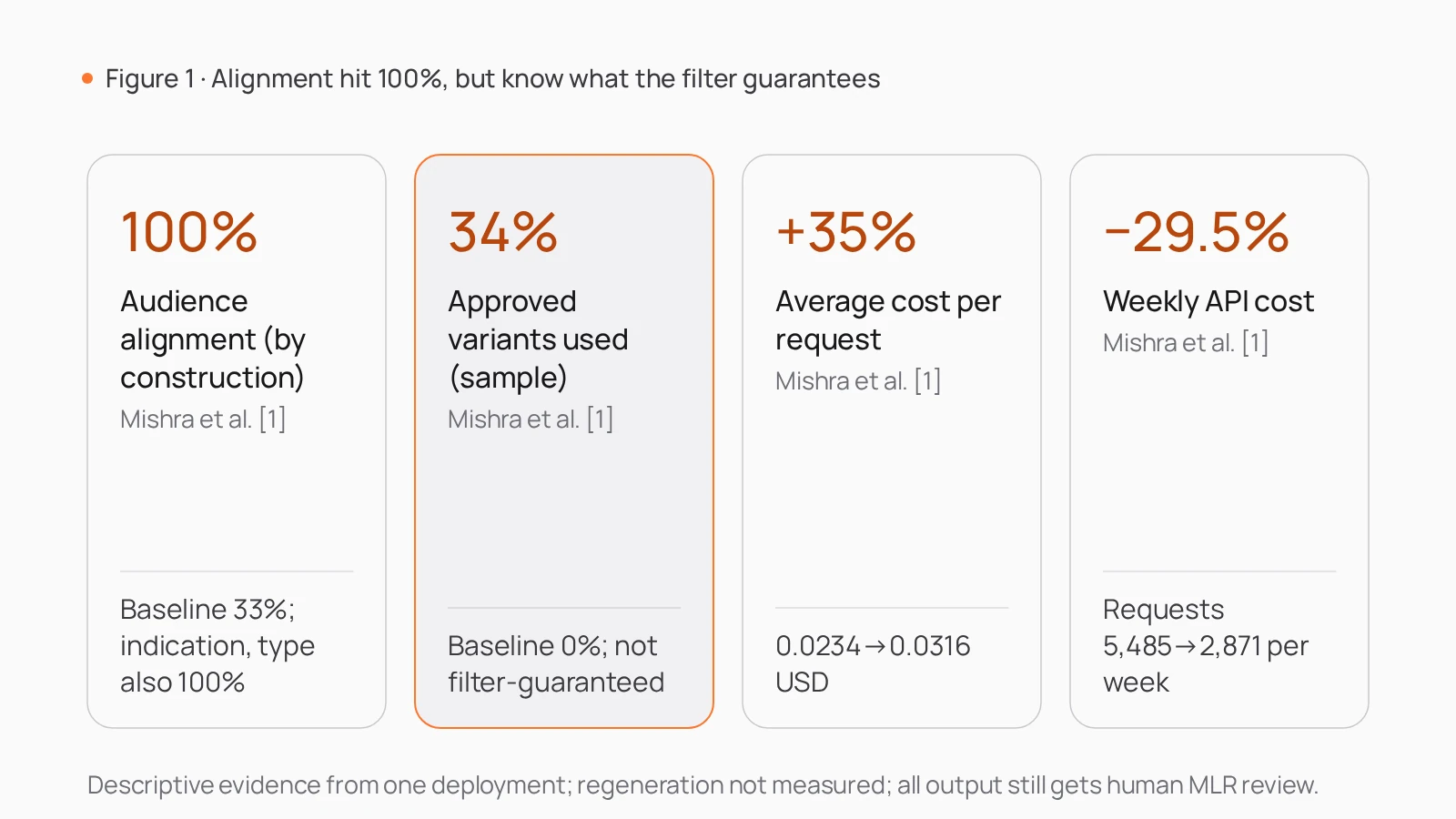
Across six product–audience segments evaluated on a small sample of a few claims per segment—judged by internal medical-content writers uninvolved in development and blinded to the pipeline—metrics jumped pre to post: approved claims used rose from 71% to 100%, indication alignment from 71% to 100%, content-type alignment from 38% to 100%, and target-audience alignment from 33% to 100%[1]. Crucially, as the authors state, these 100% alignment figures and approved-claim rates are structurally guaranteed by construction: because the pipeline retrieves only approved claims already matching the requested indication, content type, and audience, 100% reflects filter design rather than intrinsic model compliance[1]. The metrics that actually test whether structured context helps are claim-variant reuse and 6C quality of selected claims: utilization of approved alternative wordings rose from 0% to 34% in the evaluation sample (repository-wide, 42.69% of claims had variants, but variants were actually used in materials for only about 17.6% of claims), and average 6C scores of selected claims were higher post-deployment in most segments[1].
Production logs using the same model in both settings expose a sharp cost nuance[1]. Per-request resource use grew: tokens per request rose from 5,714 to 9,126, and average cost per request rose 35% (0.0234 to 0.0316 USD)[1]. Yet weekly API cost fell 29.5% (128.70 to 90.69 USD) because weekly requests dropped from 5,485 to 2,871 and weekly response tokens fell 65.4%, while success rate moved from 99.2% to 100% and P50 latency from 2,100 to 1,956 ms[1]. At equal volume, total cost would rise ~35%; the authors hypothesize fewer regenerations, but because regeneration rate, active users, and campaign mix were not measured, this is descriptive deployment evidence of an association rather than causal proof[1]. The study is bounded to one company, four products, and one market with an unreleased dataset—and all generated content still passes through human medical, legal, and regulatory review before reaching end users, with provenance and approval status preserved when records are reconciled[1].
Engineering Mapping on rlab.works: Record Normalization, Filtered Retrieval, and Pre-Publication Gates
In our engineering view, regulated pipelines should model constraints as fields on approved records (status, audience, indication, channel, prohibited phrases, references), enforce eligibility at retrieval, pass verbatim approved text and allowed variants to the generator, report by-construction metrics separately from judged quality and human-review outcomes, measure cost per accepted output (requests × cost per request) rather than cost per call, and preserve approval status, provenance, and human sign-off before publication.
Across Intelligence, AI Gateway, and Commerce on rlab.works, three proposed skill packs and three components illustrate this structure and its adaptation boundaries:
- Deduplicating claims while retaining conflicts and provenance: In Intelligence, Unify and enrich records (S28) runs Ingest and stage sources → Normalize and resolve entities → Classify and locate gaps → Investigate and accept facts (human gate). Proven only for travel catalogs (field contracts per source, retained conflicts and provenance, catalog wiring pending), it offers an analogy for deduplicating approved claims, keeping contradictions visible, and flagging the 2% of claims lacking references.
- Metadata-filtered retrieval with explicit source checks: In AI Gateway, Connect information search (S17) runs Collect permitted material → Build retrieval candidates → Prepare the summary → Check the sources (human gate), pairing with Vector storage, embedding and rerank for filtered vector writes and queries. Transferable for legal workflows (connecting document permissions and locations, preserving retrieval references explicitly, with summary output alone not constituting legal advice), it gates candidates by metadata before human source checks.
- Grounded variant generation and gated publishing: In Commerce, Publish in several languages (S38) runs Prepare content candidates → Translate and check versions → Review facts and wording (human gate) → Publish pages and messages → Complete discovery and sharing, supported by Multilingual marketing copy variants (audience/channel variants with retained factual grounding) and Editorial review and A/B test management (persisting draft queues and review decisions). It is transferable for media (adapting hotel-specific translation fields to general articles, every destination referencing the same approved version) and public-sector communications (retaining human approval before publication).
No site pack is proven in pharmaceutical promotion, and no pack or component performs regulatory review (healthcare tags cover administrative service only). All three packs are proposed, unintegrated compositions demonstrated on synthetic data; while the three components carry “working” static-inspection ratings, production use requires domain contract wiring and human regulatory sign-off.
Three Pre-Deployment Checks for Regulated Content Pipelines
- Verify that constraints live on claim records, not only in prompts: Store lifecycle state, audience, indication, prohibited phrases, and references as retrieval-gated fields, and pass verbatim approved text and variants to the generator.
- Separate by-construction metrics from judged quality and cost per accepted output: Do not conflate 100% filter alignment with model compliance; track variant reuse, blinded quality scores, and cost per accepted output (requests × cost per request).
- Preserve provenance through merges and keep human approval before publication: Retain approval status and references without hiding contradictions, and require human medical, legal, and regulatory sign-off before publication.
Found it useful? Pass it on.
References
- [1]
Mishra, S., Li, Q., Adak, S., Phogat, U., Patil, S., & Pati, S. (2026). From prompt rules to golden data model: Production-scale generation of personalized, compliant pharmaceutical claims (arXiv:2610.31519). arxiv.org ↗
- [2]
Bao, Z., Zhang, S., Zhang, H., Lou, S., Wen, M., & Luo, M. (2026). Is complex agentic memory always needed? Naive RAG is stronger than we thought (arXiv:2610.30755). arxiv.org ↗
- [3]
Lewis, P., Perez, E., Piktus, A., Petroni, F., Karpukhin, V., Goyal, N., Küttler, H., Lewis, M., Yih, W., Rocktäschel, T., Riedel, S., & Kiela, D. (2020). Retrieval-augmented generation for knowledge-intensive NLP tasks. In *NeurIPS 2020*. arxiv.org ↗
Related capabilities
Platform modules
Skills packs

S38 · Commerce
Publish in several languages
One piece of content in several languages across web and social channels quickly ends up with mismatched versions.
Prepare grounded copy, translate and review it, then publish to selected pages and channels.
- Prepare content candidates
- Translate and check versions
- Review facts and wordingHuman review
- Publish pages and messages
- Complete discovery and sharing
5 steps1 human reviews8 components
S28 · Intelligence
Unify and enrich records
The same item exists in several systems under different names with missing fields, and it gets messier over time.
Merge source records into one catalog, identify gaps and have reviewers accept additional facts.
- Ingest and stage sources
- Normalize and resolve entities
- Classify and locate gaps
- Investigate and accept factsHuman review
4 steps1 human reviews10 components

S17 · AI Gateway
Connect information search
AI answers sound convincing, but without sources nobody dares to use them.
Connect information sources, retrieve relevant passages and check summary sources and access scope.
- Collect permitted material
- Build retrieval candidates
- Prepare the summary
- Check the sourcesHuman review
4 steps1 human reviews5 components