[Manufacturing & Industry] Software Orchestration Does Not Turn a Wrench: Boundaries of Video Action Review, Spare-Part Visual Search, and Batch Traceability on the Shop Floor
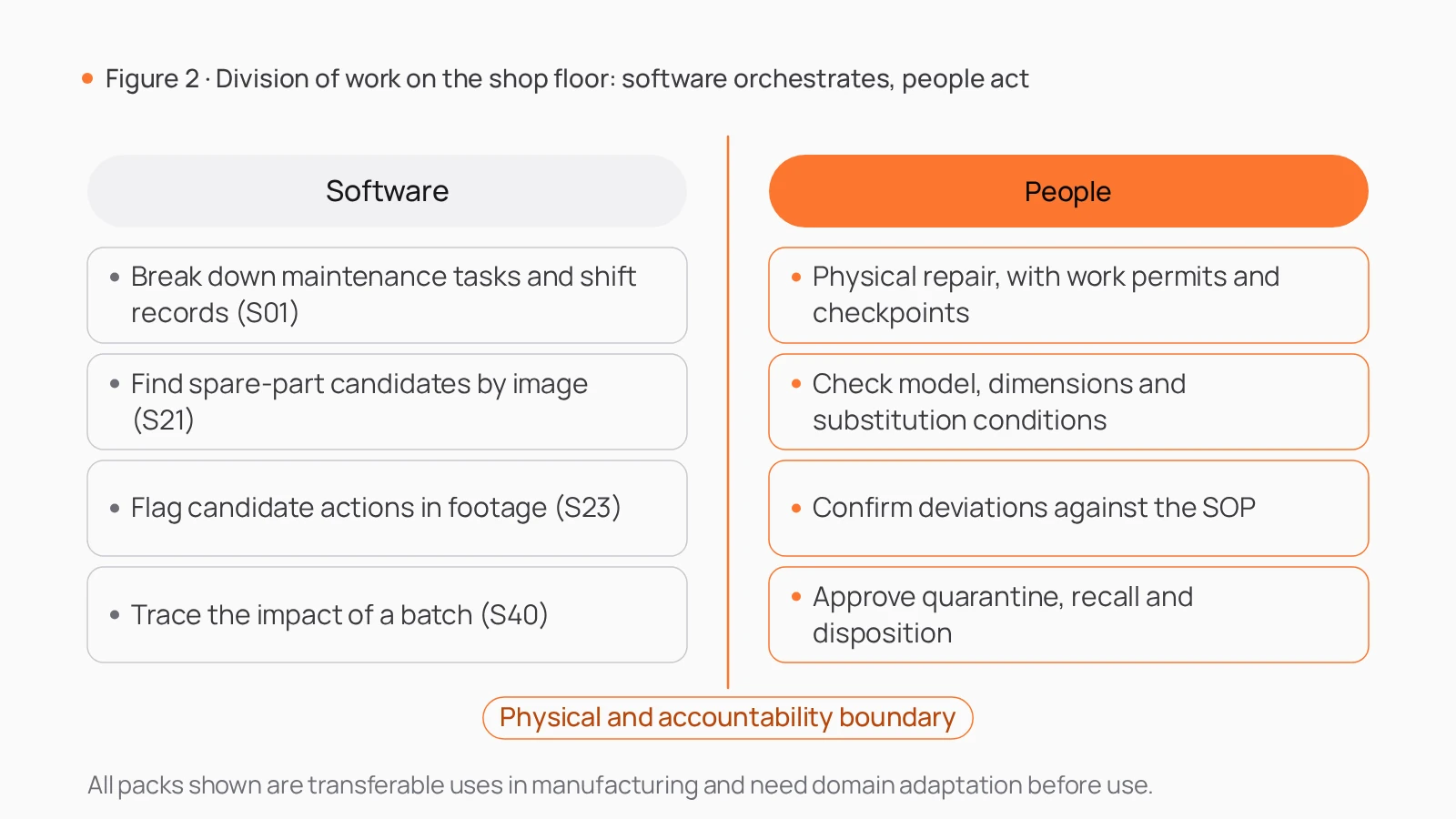
On the factory floor, software is responsible for breaking down maintenance tasks, retrieving spare-part candidates by image, flagging questionable motions in video footage, and tracing batch exposure; physical repair, mechanical verification, and safety interlocks remain human responsibilities. All four skill packs examined here are transferable applications in manufacturing.

Why a Completed Digital Work Order Cannot Close a Physical Valve
Imagine a night-shift maintenance response on an assembly line. A machine halts after an abnormal vibration; the technician photographs a worn component to look up a replacement, pulls workstation video to check whether an operating step went wrong, and logs the affected work-in-process batch alongside a repair schedule. If the plant treats a software suggestion as a completed physical action—letting a vision model rule an operator in violation, issuing a spare part solely because its photo looks similar, or resetting a safety interlock when a digital ticket updates—the result is mechanical mismatch, disputed rework, or a shop-floor hazard.
Manufacturing environments enforce strict physical and accountability boundaries. On the shop floor, software breaks maintenance objectives into structured tasks, retrieves spare-part candidates by image, flags candidate motion segments in video footage, and traces batch quality exposure. Physical repairs, dimensional verification, quarantine execution, and safety interlocks remain with qualified personnel. Just as importantly, none of the skill packs discussed here carries a source-supported industry basis in Manufacturing & industry; all are transferable uses requiring domain adaptation before deployment.
Work Specification, Cyber-Physical Layering, and Scaling Enablers
Why must industrial software respect explicit human checkpoints and architectural separation rather than acting directly on equipment? Research on lean production, Industry 4.0 architecture, and industrial adoption highlights the underlying mechanisms.
First, reliable shop-floor execution depends on explicit specification and built-in verification. Based on a multi-year study of Toyota and its suppliers, Spear and Bowen (1999) argue that the tacit knowledge behind the Toyota Production System can be expressed as four rules[1]: all work is highly specified in content, sequence, timing, and outcome; every customer-supplier connection is direct, with an unambiguous yes-or-no way to send requests and receive responses; the pathway for every product and service is simple and direct; and any improvement is made in accordance with the scientific method, under a teacher’s guidance, at the lowest possible level in the organization[1]. These rules build in tests that signal problems immediately[1]. In digital shop-floor tooling, software adds value not by bypassing work rules inside an opaque black box, but by making timing, sequence, and potential anomalies visible so team leaders and technicians can make unambiguous yes-or-no verification decisions against standard operating procedures.
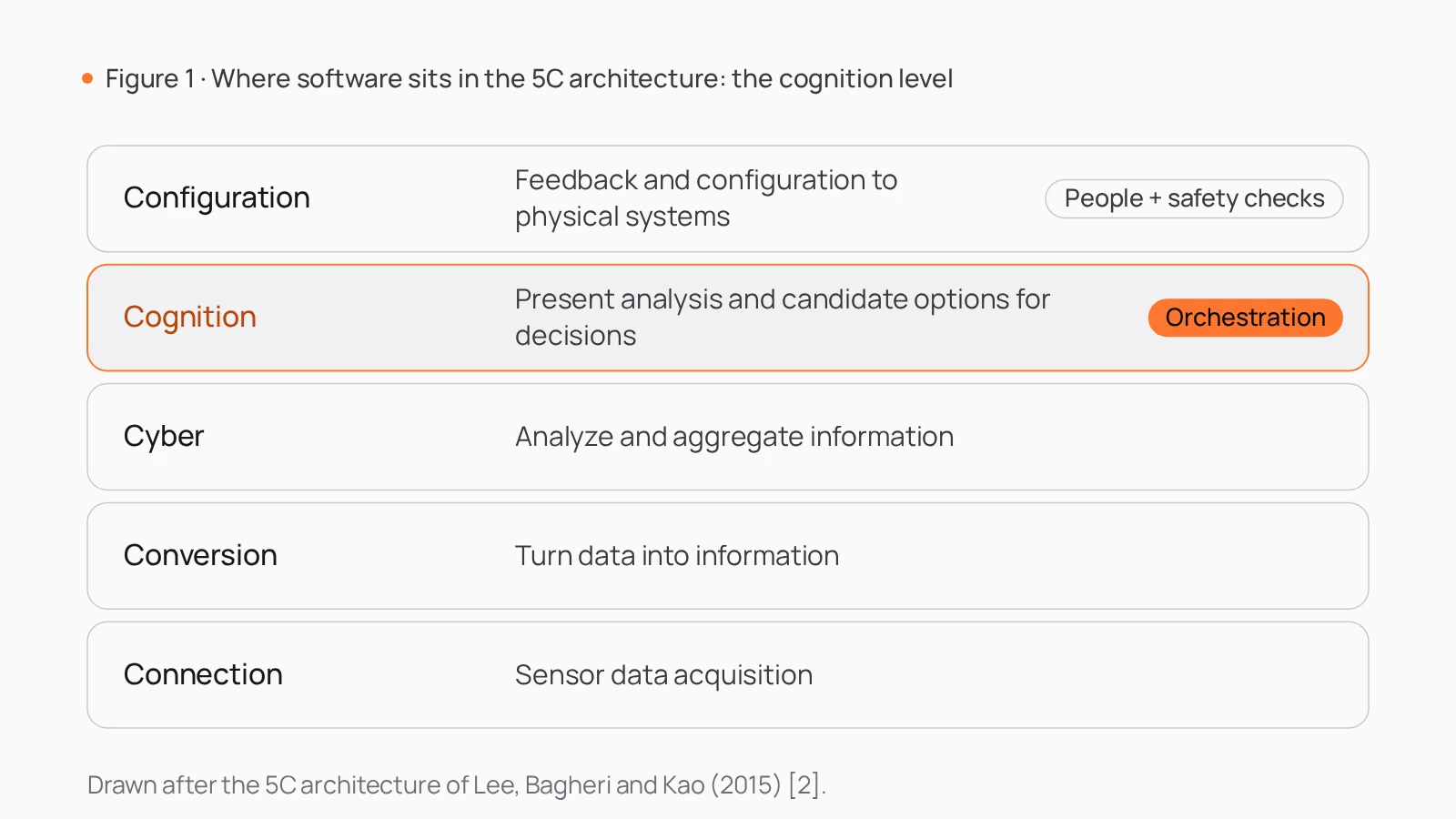
Second, industrial engineering separates analytical cognition from physical actuation. Lee, Bagheri, and Kao (2015) propose a unified five-level architecture—the “5C” architecture of connection, conversion, cyber, cognition, and configuration—as a guideline for building cyber-physical systems in Industry 4.0 manufacturing[2]. Their framework moves from sensor data acquisition and data-to-information conversion through analytics and decision support, before reaching feedback and configuration of the physical system[2]. Information-understanding and workflow-orchestration software sits in the analytical and decision-support layers: it organizes candidate findings and task plans for operators, neither replacing sensor instrumentation nor bypassing safety validation to reconfigure machinery directly.
Engineering Mapping: Input Contracts, Human Gates, and Transferable Boundaries
Turning these principles into software requires explicit input contracts, mandatory human review gates, retained evidence bundles, and domain adaptation boundaries. Across the Intelligence, Commerce, and Agent OS modules of the catalog, the following skill packs illustrate how shop-floor assistance is structured:
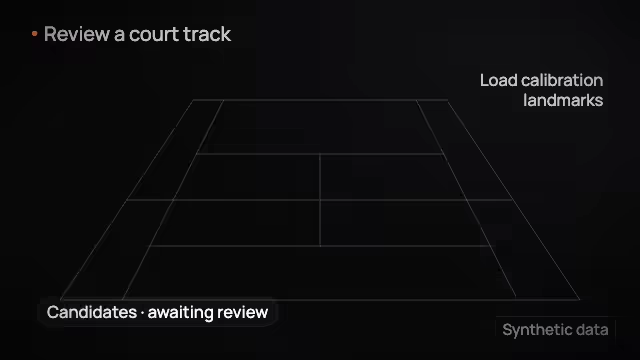
- Workstation footage review via Review video actions (S23): Starting from Authorized footage, venue information and review goal, the workflow opens with a human review gate to confirm footage sources (any rejected output returns for revision and does not advance). It then normalizes timing and frames and uses the camera registration and ball-track proposals component to propose motion candidates with time positions. Execution pauses at a second human gate (Review against requirements), where a reviewer inspects and corrects candidate trajectories and events before summary statistics, annotated replays, and review-pack handover are generated. In manufacturing, this pack is a transferable use (its source-supported basis is sports court tracking): a plant can adapt the pattern to flag questionable workstation motions for a team leader to verify against standard operating procedures (SOPs) before handing over a shift review pack. However, engineers must redo workstation calibration, motion candidates, and operation statistics; existing components do not automatically recognize SOPs or judge violations, and shift-report templates require adaptation.
- Replacement part lookup via Find similar by image (S21): Taking Catalog records, images and search requirements as input, the workflow places a human gate at the first step (Validate source records) so only confirmed catalog records are imported. It then builds a versioned, attribute-linked image index and retrieves similarity-tiered candidates. The final step (Check specifications and select) is another human gate producing accepted candidates and mismatch notes. In manufacturing, this transferable use lets a technician photograph an old part to find visual candidates in a spare-parts catalog, then manually verify model numbers, dimensions, and substitution conditions. Material fields and image domains require adaptation, and visual similarity only aids lookup—never certifying mechanical compatibility or safety.
- Quality containment via Trace batches and resolve issues (S40): From Batch origins, inspection records and movement events, the workflow links batch and inspection records to work orders, collects scan and movement receipts, and uses the batch traceability, recall tasks and distribution risk audits component to trace affected inventory, orders, and resolution candidates. Reviewers govern outcomes through consecutive human gates—first Approve resolution (authorizing quarantine, recall, or replacement tasks) and then Verify resolution to record resolution evidence and open items. Because its components originate from retail source data, this pack is conservatively tagged as a transferable use in manufacturing: teams must unify batch and work-order models and implement live equipment connections separately, and a scan record never implies physical interception has occurred.
- Maintenance task orchestration via Plan and deliver work (S01): From Goal, scope and delivery requirements, the pack breaks a maintenance goal into dependent tasks and pauses at Approve the scope via the auditable workflows, human confirmation and decision review component. After human approval, it runs bounded software steps, collects evidence, and pauses at Review and hand over to deliver an accepted package and reuse record. As a transferable use in manufacturing, it structures inspection, material preparation, and review tasks across shifts—but orchestrates software tasks and human records only. Mechanical repair is performed by personnel under configured work permits and checkpoints.
An explicit statement of current limits is essential. Manufacturing has no skill pack with a source-supported industry basis; all packs above are transferable uses only. Furthermore, every skill pack on the site is a proposed composition demonstrated with synthetic data and not yet connected to live services. Component maturity reflects static source inspection rather than production deployment—and the auditable workflows, human confirmation and decision review component is a prototype whose tool steps act as placeholders and records rather than autonomous execution.
Pre-Pilot Checks for Manufacturing Leaders
Before funding a shop-floor pilot, a plant manager or CDO can apply three checks:
- Does the design separate decision support from physical actuation? Confirm that software is restricted to candidate retrieval, motion flagging, impact tracing, and task documentation. Any proposal that issues spare parts without dimensional verification or alters machine interlocks without human sign-off should be stopped.
- Do human review gates enforce blocking authority and audit trails? Verify that team-leader SOP reviews, technician specification checks, quarantine approvals, and maintenance scope sign-offs are wired into the state machine so unaccepted outputs cannot advance.
- Is cross-domain adaptation scoped and budgeted? Ensure the project budgets for workstation camera recalibration, bill-of-materials alignment, unified work-order and batch schemas, and integration with physical work-permit procedures.
Found it useful? Pass it on.
References
- [1]
Spear, S., & Bowen, H. K. (1999). Decoding the DNA of the Toyota Production System. Harvard Business Review, 77(5), 96–106. hbr.org ↗
- [2]
Lee, J., Bagheri, B., & Kao, H.-A. (2015). A Cyber-Physical Systems architecture for Industry 4.0-based manufacturing systems. Manufacturing Letters, 3, 18–23. doi.org/10.1016/j.mfglet.2014.12.001
- [3]
World Economic Forum, in collaboration with McKinsey & Company. (2023, December). Global Lighthouse Network: Adopting AI at Speed and Scale [White paper]. www3.weforum.org ↗
Related capabilities
Platform modules
Skills packs
S23 · Intelligence
Review video actions
Finding key moments frame by frame is slow and tiring, and the conclusions are hard to check later.
Preserve footage sources, propose motion candidates and create evidence-linked replays after human correction.
- Confirm footage sourcesHuman review
- Normalize timing and frames
- Propose motion candidates
- Review against requirementsHuman review
- Summarize confirmed events
- Build annotated replays
- Hand over the review pack
7 steps2 human reviews8 components
S21 · Intelligence
Find similar by image
A customer sends a photo and asks if you have it; matching it against the catalog by hand is slow and misses things.
Import a catalog, retrieve candidates by image or text and review specifications and availability.
- Validate source recordsHuman review
- Build the image index
- Find similar candidates
- Check specifications and selectHuman review
4 steps2 human reviews3 components
S40 · Commerce
Trace batches and resolve issues
When a batch has a quality problem and nobody can trace which warehouses and orders it reached, the recall has to be broad.
Record batch and quality events, trace the impact and have reviewers decide and verify resolution.
- Record batches and inspections
- Collect movement events
- Trace the impact
- Approve resolutionHuman review
- Verify resolutionHuman review
5 steps2 human reviews6 components
S01 · Agent OS
Plan and deliver work
Hand AI a big job and it often stops halfway or drifts, and nobody can tell how far it got.
Break a goal into dependent tasks, confirm execution and deliver reviewable results.
- Plan the steps
- Approve the scopeHuman review
- Run and collect
- Review and hand overHuman review
4 steps2 human reviews7 components