[Retail & Ecommerce] From Competitor Screenshot Price Comparison to Multi-Warehouse Fulfillment Promises: Why Retail AI Must Stop Before the Human Red Line of Price Locking and Stock Counting
Screenshot price extraction and product normalization can organize competitor price gaps, but locking prices, reallocating stock, and verifying inventory require operational approval and physical checks; in retail, quote confirmation and order fulfillment are source-supported while screenshot comparison and service offer matching are transferable.


Fast Price Scraping and Order Routing, Fragile Margins and Broken Promises
Imagine a common scenario ahead of a major retail promotion. Operations teams feed competitor screenshots and promotional links into a vision-and-language workflow to assemble a normalized price-gap table, while the order system reads book inventory across regional warehouses and dispatches picking waves automatically. Once live traffic hits, failures cascade: several scraped discounts turn out to be broken-size clearance items or conditional bundles, so matching them automatically erodes category margins. Meanwhile, pickers discover that book stock cannot ship as promised because key sizes are missing or damaged on the shelf, triggering split shipments and breached delivery promises.
This failure mode defines a core boundary for retail automation: screenshot price comparison and item normalization can organize competitor price gaps, but locking prices, reallocating inventory, and verifying physical stock must retain operational approval and physical checks. In the retail capability catalog, quote confirmation (S33) and order fulfillment and delivery (S35) carry a source-supported industry association, whereas screenshot price comparison (S22) and service offer matching rehearsal (S42) represent transferable uses requiring domain-specific adaptation.
Dynamic Pricing, Omnichannel Transparency, and Network Allocation: What the Research Shows
Why is it risky to wire scraped competitor prices and book inventory figures directly into autonomous pricing and fulfillment commitments? Empirical research in operations management and information systems explains the mechanisms governing price responses, channel integration, and store-network distribution.
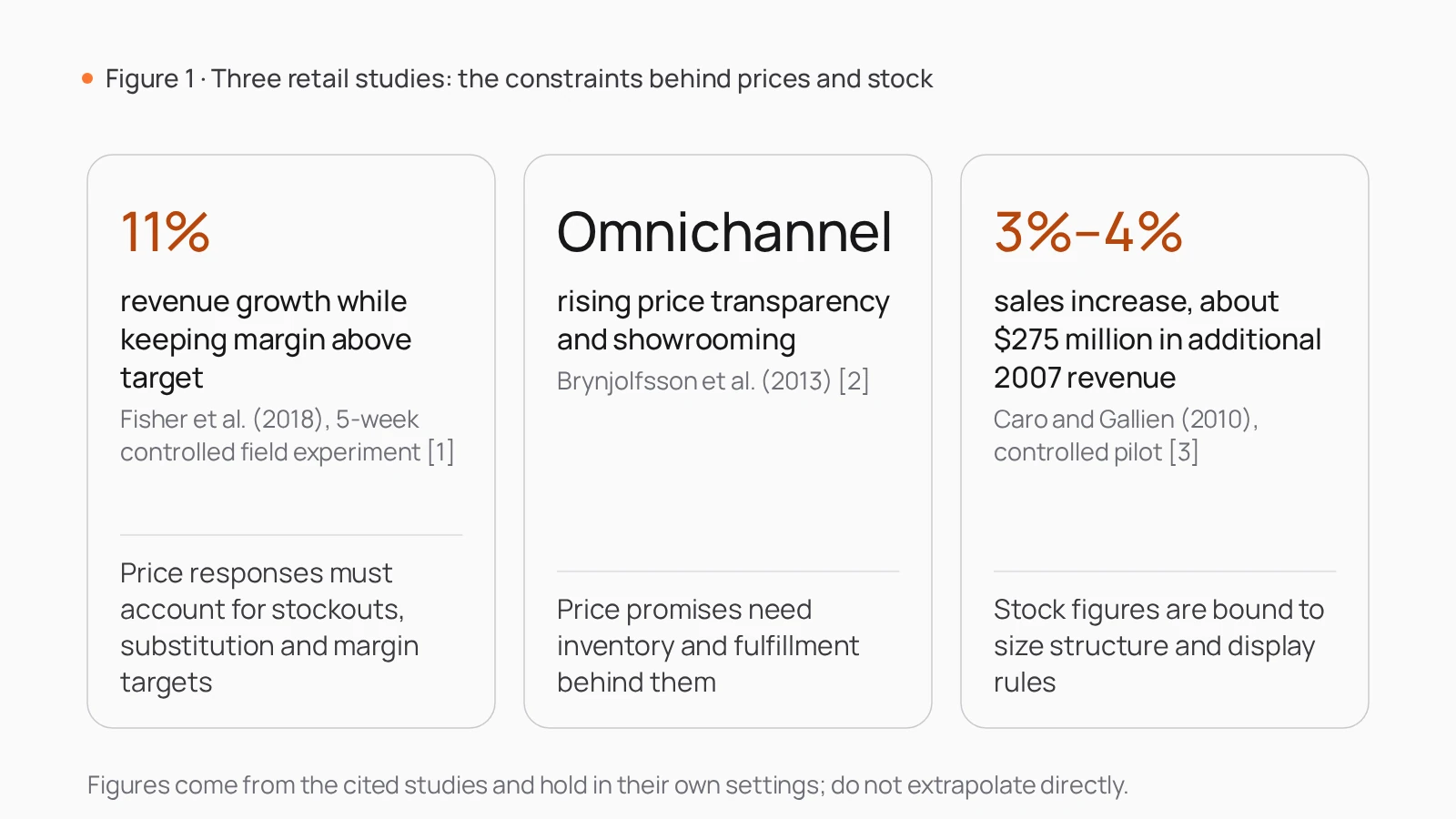
In competition-based dynamic pricing, Fisher, Gallino, and Li (2018) examined online retailers that track competitors’ price changes and must answer four questions[1]: whether to respond, to whom, by how much, and on which products[1]. Answering them requires unbiased estimates of price elasticity, competitor significance, and consumer price comparison across retailers[1]. Yet empirical estimation faces two key challenges[1]: endogeneity in observational data—where prices correlate with demand shocks observable to pricing managers but not to researchers—and the absence of competitor sales information needed to estimate a full consumer-choice model[1]. The authors addressed endogeneity through a randomized-price field experiment, and resolved missing competitor sales data by exploiting the retailer’s own and competitors’ stockouts, alongside competitor price changes, as variation in the consumer choice set among substitutable products across retailers[1]. Tested in a controlled live experiment lasting five weeks[1], their best-response pricing strategy documented an 11% revenue increase while maintaining a margin above a retailer-specified target[1]. Profitable price responses depend on joint estimation of stockout states, substitution behavior, and margin targets rather than matching raw price screenshots in isolation.
At the channel level, Brynjolfsson, Hu, and Rahman (2013) argued that as technology blurs the distinction between physical and online retailing, firms must compete in an omnichannel environment[2]. Customers use mobile devices and engage in showrooming, raising price transparency[2]. Retailers need curated and exclusive assortments, competition beyond price, effective use of customer data, and channel integration such as inventory visibility and fulfillment across stores and online[2]. When front-end pricing operates without reliable fulfillment visibility, commercial promises outrun physical capacity.
At the store-network level, Caro and Gallien (2010) collaborated with a Spain-based fast-fashion retailer to study how to distribute limited inventory over time across stores in a fast-fashion network[3]. The environment features very short product life cycles and a store policy whereby an article is removed from display whenever one of its key sizes stocks out[3]. The authors formulated a stochastic model predicting single-store sales during a replenishment period as a function of demand forecasts, initial inventory of each size, and the display-removal policy, then embedded a piecewise-linear approximation of that model into a network-wide mixed-integer program to compute shipment quantities maximizing overall predicted sales subject to inventory availability and other constraints[3]. In a controlled pilot experiment comparing the new allocation process with the prior weekly shipment procedure, the model increased sales by 3% to 4%[3], equivalent to $275 M in additional revenues for 2007[3], while reducing transshipments and increasing the proportion of time products spend on display within their life cycle[3]. Aggregate inventory counts hide size-level stockouts and display rules; allocation decisions require operational constraints and physical verification.
Engineering Mapping: Input Contracts, Human Gates, and Adaptation Boundaries
Translating these findings into software architecture requires separating upstream data normalization from downstream commercial commitments, and placing blocking human review gates before price locking, replenishment splits, and delivery exception handling. On rlab.works, the Intelligence and Commerce modules express these workflows through skill packs and underlying components:
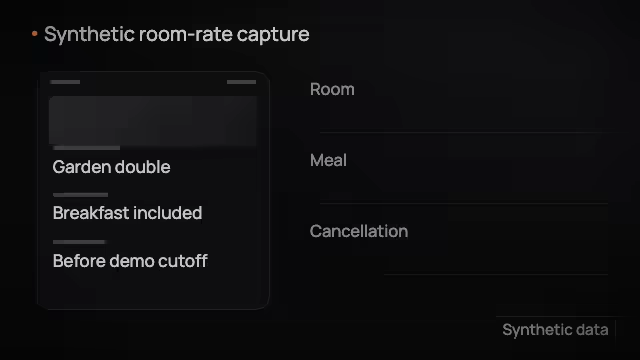
- Read and compare prices (S22): Taking Quote screenshots, links and comparison conditions as input, S22 runs assisted steps to Locate source offers, Read key fields, and Align comparison terms—producing provenance-tagged price candidates and aligned terms, benefits, and commitment states—before halting at the human review gate Compare and review, where rejected output returns for revision and does not advance. While S22 is source-supported in travel, it is a transferable use in retail: because its extractors were built around hotel rate screenshots, retail adoption requires replacing hotel collection entry points, field extractors, and ranking rules rather than reusing room or meal fields to compare merchandise.
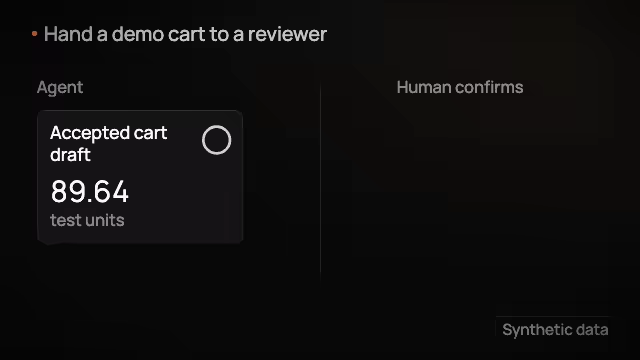
- Quote and confirm (S33): Source-supported in retail, S33 takes Customer requirements, available items and quantities as input and executes assisted steps to Check eligibility and prices, Assemble supplier quotes, and Prepare confirmation details—consolidating supplier costs, promotions, and the customer cart into a confirmation summary—before pausing at the human gate Hand over for confirmation. Underneath, Customer-specific catalogs, pricing, promotions and credit determines visible items by segment and context, calculates quotes, reserves promotional budgets, checks credit, and supports explicit human overrides, while Signed agent-to-human checkout handoff converts intent into a time-bounded, signed browser or mobile handoff that validates context and fills missing options. Wiring the cart to the signed checkout intent must still be completed for each deployment, and no quote locks without human confirmation.
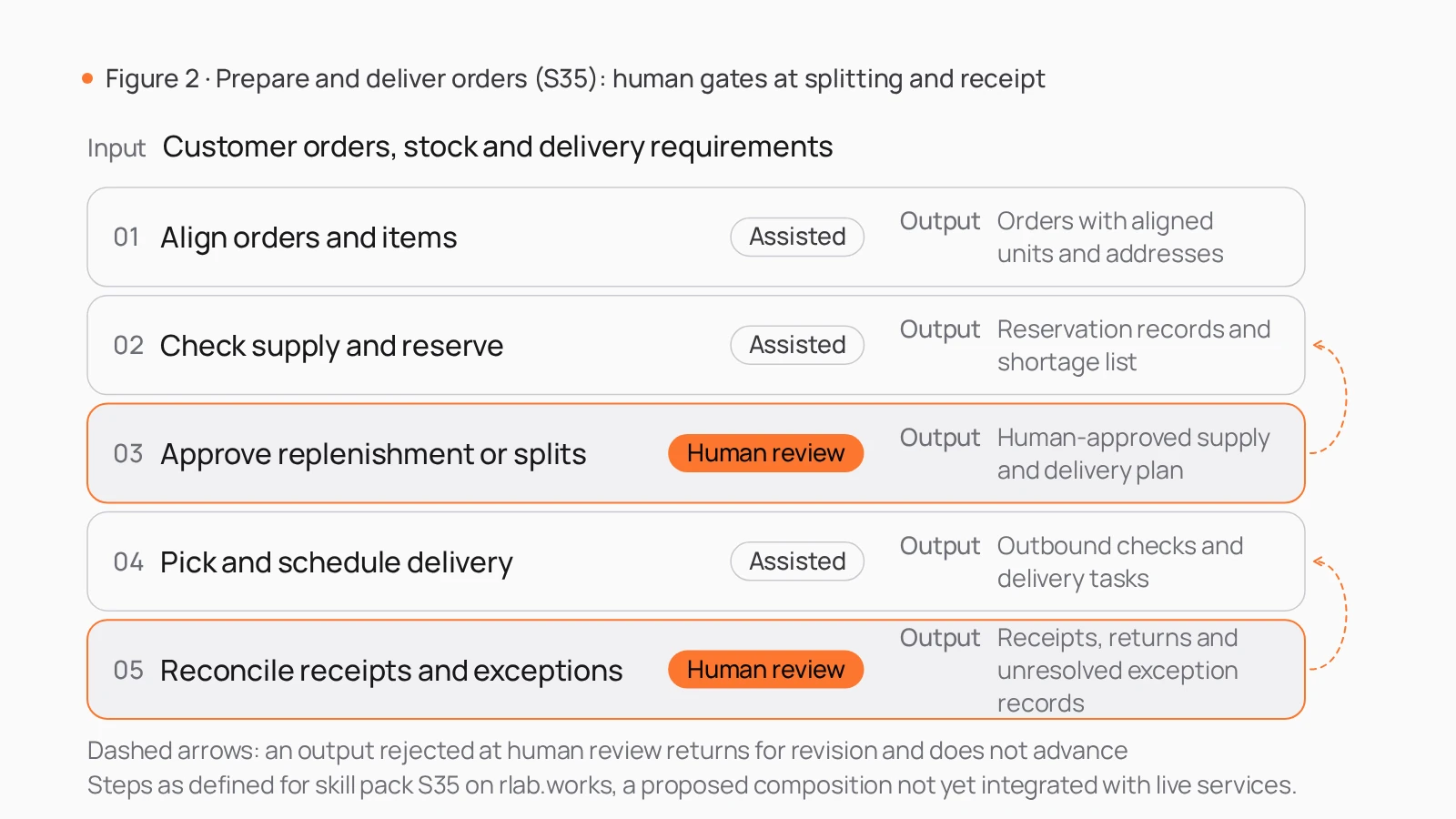
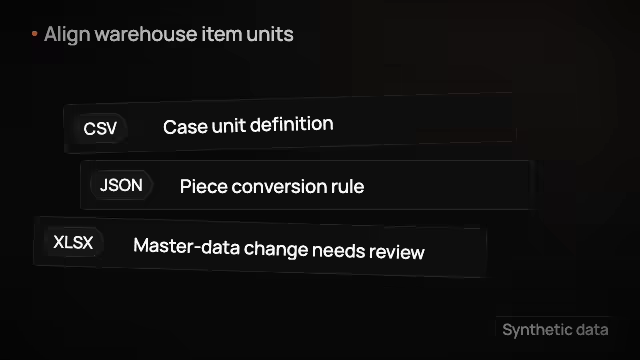
- Prepare and deliver orders (S35): Also source-supported in retail, S35 takes Customer orders, stock and delivery requirements as input and assists operators to Align orders and items and Check supply and reserve, producing reservation records and shortage lists. It pauses at the human gate Approve replenishment or splits—backed by Order approval, inventory reservation and delivery promises, which creates order snapshots, enforces blocking review checks, reserves stock, and plans shortages or split shipments. After human approval, the workflow runs the assisted step Pick and schedule delivery and concludes at the human gate Reconcile receipts and exceptions to verify receipts, returns, and exceptions. Deployment requires connecting inventory, procurement, outbound, and delivery identifiers; vehicle routes remain advisory, and refunds require separate authorization.
- Rehearse offer matching (S42): A transferable use in retail, S42 takes Supplier listings, service requirements and opt-in subscriptions as input and sequences Review service listings (human review), Match demand and explain (assisted), Confirm and rehearse handoff (human review), and Summarize feedback and adjust (assisted) to produce simulated requests, non-payable records, and de-identified feedback. It only rehearses software service integration and never replaces vendor qualification or creates real procurement orders.
Pre-Pilot Checks for Retail and Supply Chain Leaders
Before funding a retail pricing or fulfillment pilot, leaders can apply the following checks:
- Does price comparison incorporate stockouts and margin floors? Ensure scraped competitor prices are never wired directly to automated repricing; recommendations must account for stockout states, substitutability, and margin targets before human review.
- Do price locking, order splitting, and exception handling enforce blocking human gates? Confirm that checkout confirmation, shortage split approvals, and delivery exceptions halt for an assigned human reviewer, and that rejected proposals return for revision without triggering autonomous charges, picks, or refunds.
- Have transferable workflows been re-contracted for retail master data? When adapting screenshot comparison or service-matching packs, verify that hospitality schemas have been replaced with SKU barcodes, size curves, unit conversions, and warehouse bin locations.
Found it useful? Pass it on.
References
- [1]
Fisher, M., Gallino, S., & Li, J. (2018). Competition-Based Dynamic Pricing in Online Retailing: A Methodology Validated with Field Experiments. Management Science, 64(6), 2496–2514. doi.org/10.1287/mnsc.2017.2753
- [2]
Brynjolfsson, E., Hu, Y. J., & Rahman, M. S. (2013). Competing in the Age of Omnichannel Retailing. MIT Sloan Management Review, 54(4), 23–29. sloanreview.mit.edu ↗
- [3]
Caro, F., & Gallien, J. (2010). Inventory Management of a Fast-Fashion Retail Network. Operations Research, 58(2), 257–273. doi.org/10.1287/opre.1090.0698
Related capabilities
Platform modules
Skills packs
S33 · Commerce
Quote and confirm
For each quote, sales checks prices, asks several suppliers and totals it by hand, and the back-and-forth is slow.
Prepare quotes and line items from requirements, then hand them to the customer for confirmation.
- Check eligibility and prices
- Assemble supplier quotes
- Prepare confirmation details
- Hand over for confirmationHuman review
4 steps1 human reviews4 components
S35 · Commerce
Prepare and deliver orders
With many orders, shortages, split shipments and delivery problems are tracked by hand, and nobody can tell customers where their order is.
Check orders and stock, approve shortage handling, then pick, deliver and reconcile exceptions.
- Align orders and items
- Check supply and reserve
- Approve replenishment or splitsHuman review
- Pick and schedule delivery
- Reconcile receipts and exceptionsHuman review
5 steps2 human reviews9 components
S22 · Intelligence
Read and compare prices
Quote screenshots differ in format, tax and inclusions, so manual comparisons often compare unlike with unlike.
Read prices from screenshots and links, align comparison terms and review differences and tradeoffs.
- Locate source offers
- Read key fields
- Align comparison terms
- Compare and reviewHuman review
4 steps1 human reviews7 components
S42 · Commerce
Rehearse offer matching
You want to match supply and demand, but going live directly risks unclear qualifications and failed transactions.
Review service listings and subscription criteria, explain matches and rehearse handoff before summarizing feedback.
- Review service listingsHuman review
- Match demand and explain
- Confirm and rehearse handoffHuman review
- Summarize feedback and adjust
4 steps2 human reviews5 components