E34 SeriesE · Organisation & people
Passing the Baton Across Shifts and Time Zones: How Interruption Recovery, State Traceability, and Field Collaboration Eliminate Organizational Friction
Handoff loss across shifts and time zones can be reduced through session migration, state snapshots, and structured handoff records; hospital handoff research and distributed cognition theory offer analogous evidence and design mechanisms.


When the Baton Drops Between Shifts and Time Zones
Consider a common operational scenario. A daytime field operator or service specialist handles an incoming customer issue and, just before shift change, drops a voice note and unorganized screenshots into a chat channel. When a colleague on the night shift or in another time zone takes over, the record does not show whether account permissions were verified, which data access requests were approved, or which statements are confirmed facts versus tentative guesses. The incoming operator either repeats intake from scratch or acts on incomplete assumptions, causing delays and errors.
This friction happens when organizations rely on unstructured chat logs and individual memory to carry work across shifts and time zones. Unlike low-level software checkpoints that reconnect a dropped network stream, human handoffs across shifts involve transferring accountability, re-verifying permissions, and confirming open tasks. Handoff loss across shifts and time zones can be reduced through session migration, state snapshots, and structured handoff protocols; multicenter research on hospital handoffs provides analogous evidence[1].
Coordination Dependencies, Distributed Cognition, and the Hospital Handoff Analogy
Why does operational context degrade when work crosses a shift or time-zone boundary? Research in coordination theory and cognitive science shows that a handoff is not merely message passing; it is the management of activity dependencies through shared external representations.
In their interdisciplinary survey of coordination theory, Malone and Crowston (1994) define coordination as managing dependencies among activities[2]. Analyzing processes across computer science, organization theory, operations research, economics, linguistics, and psychology, they highlight recurring dependencies—shared resources, producer/consumer relationships, simultaneity constraints, and task/subtask dependencies—and show how characterizing them guides the design of cooperative work tools[2]. Work spanning shifts or time zones creates a producer/consumer dependency: the outgoing shift produces an intermediate state that the incoming shift must consume to continue execution. If the upstream activity emits an unstructured note rather than a verified state artifact that satisfies downstream prerequisites, coordination breaks down.
Preserving state across personnel changes requires shifting the burden of memory from individual minds to shared institutional artifacts. Based on an ethnographic study of navigation teams aboard a US Navy ship, Hutchins (1995) argues in Cognition in the Wild that cognition is distributed across people, tools, and representations[3]. Navigating the vessel is accomplished by a socio-technical system rather than any single mind; much of the “thinking” lives in shared artifacts, procedures, and role coordination[3]. When watch teams rotate, continuity depends on structured charts, instruments, and handoff procedures that hold task state across operators[3].
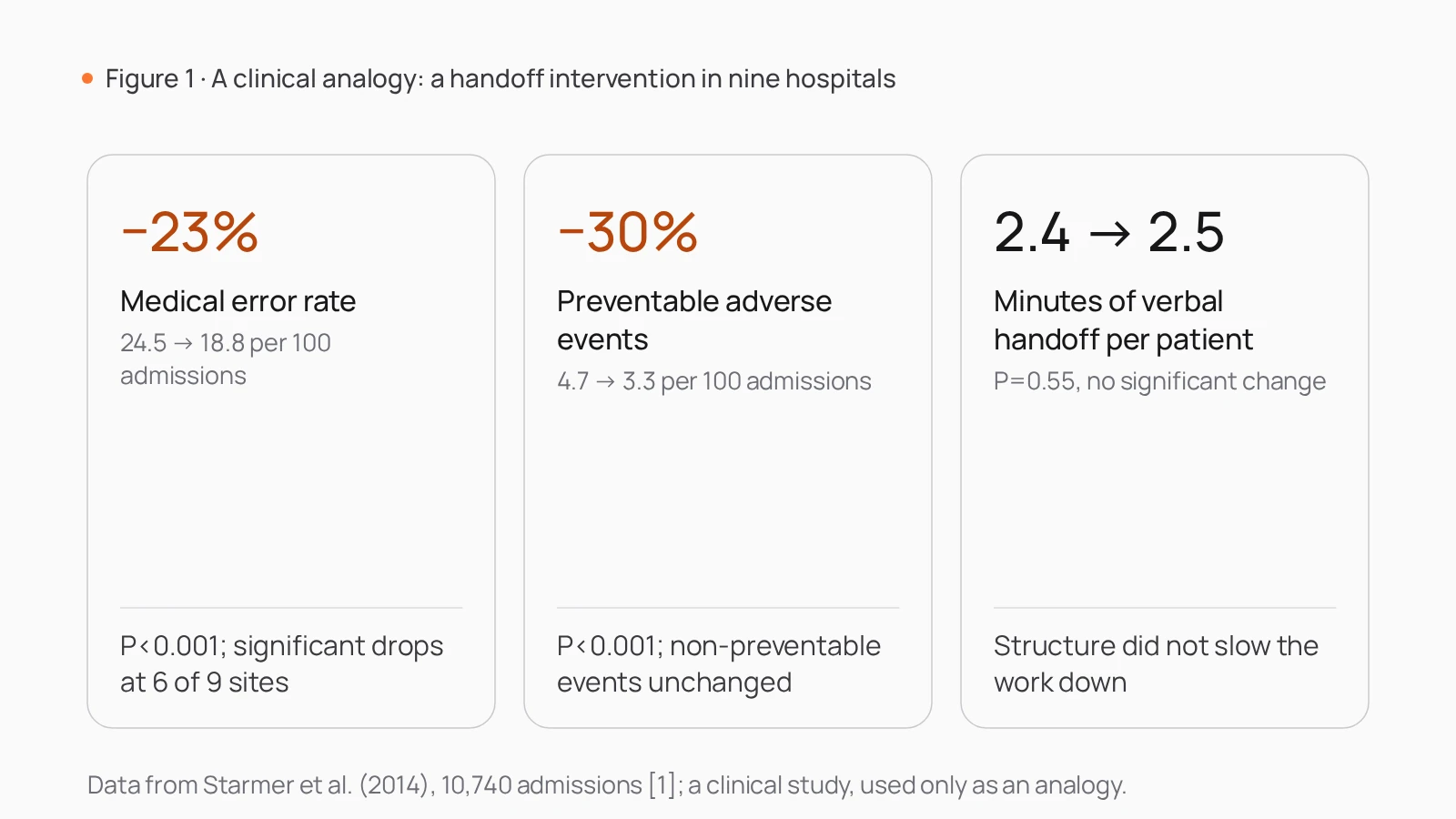
Empirical research on clinical handoffs offers a real-world analogy for formalizing these shared artifacts and procedures. Starmer et al. (2014) conducted a prospective intervention study of a resident handoff-improvement program across nine hospitals, measuring medical errors, preventable adverse events, miscommunications, and resident workflow[1]. The intervention bundled a mnemonic to standardize oral and written handoffs, communication training, a faculty development and observation program, and a sustainability campaign[1]. Across 10,740 patient admissions, the medical-error rate decreased by 23% from the preintervention period to the postintervention period (24.5 vs. 18.8 per 100 admissions, P<0.001), and preventable adverse events decreased by 30% (4.7 vs. 3.3 events per 100 admissions, P<0.001), while nonpreventable adverse events did not change significantly (3.0 and 2.8 events per 100 admissions, P=0.79)[1]. Significant error reductions occurred at six of nine sites[1]. Inclusion of all prespecified key elements rose significantly in written documents and oral communication (nine written and five oral elements; P<0.001 for all 14 comparisons)[1]. Crucially, standardizing handoffs did not slow workflow: oral handoff duration did not change significantly (2.4 and 2.5 minutes per patient pre- and postintervention, respectively; P=0.55), nor did patient-family contact or computer time[1].
Engineering Mapping: Turning Handoff Protocols into Contracts and Human Gates
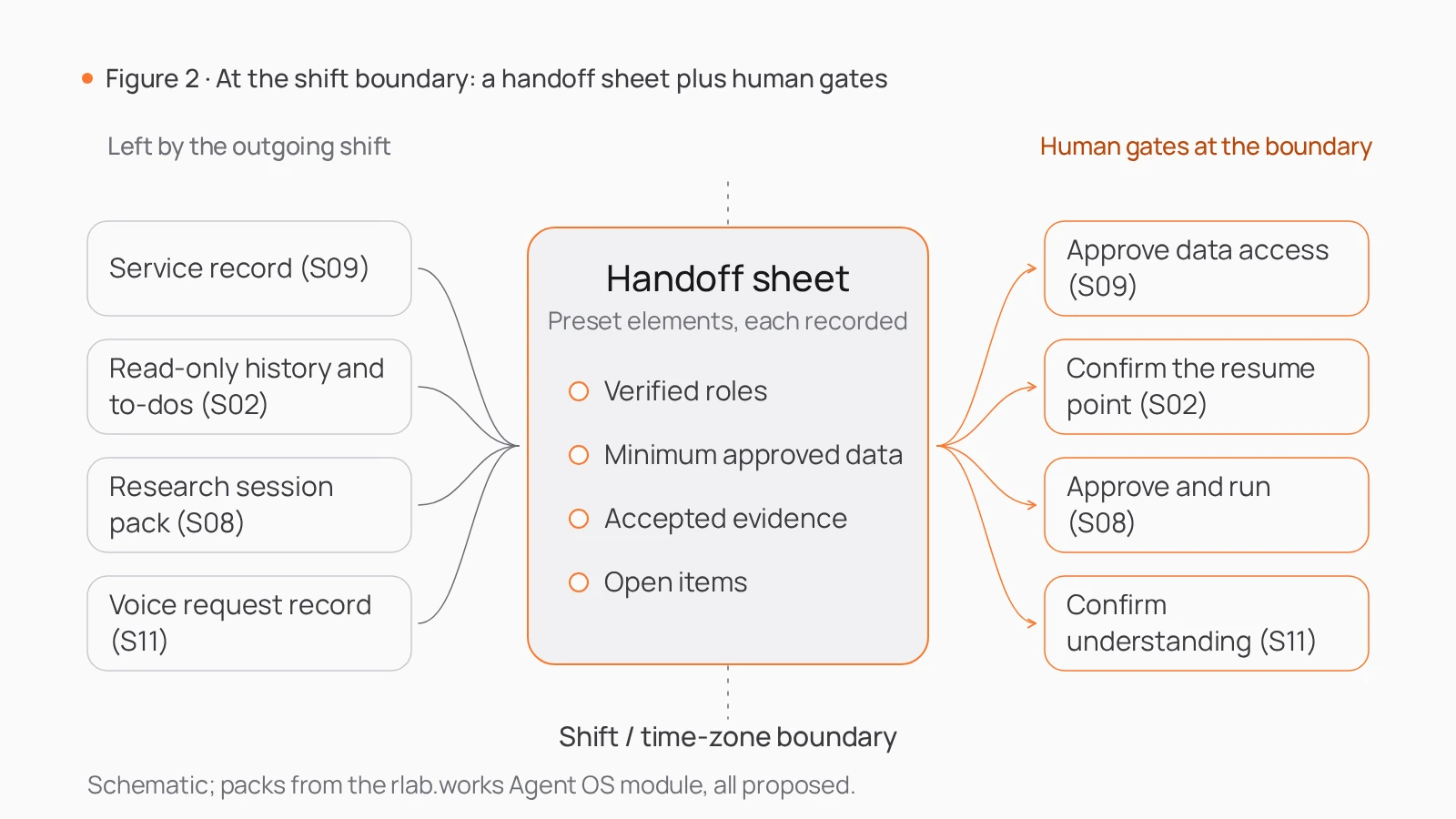
Translating coordination theory[2], distributed cognition[3], and the clinical handoff analogy[1] into software architecture means refusing to treat unverified large language model summaries as valid handoffs. Instead, permission verification, read-only state snapshots, and recipient sign-off must be wired into explicit workflow contracts. Within the Agent OS module on rlab.works, structured skill packs and components illustrate this design:
- Service intake and role-verified handoff: Intake and handoff (S09) takes a service request, identity assertions, and assignment rules as input, running through Confirm account and role → Create the service record → Approve data access (human review) → Hand over and record. At the human review gate, an assigned reviewer or requesting user approves the minimum data package allowed to cross the boundary; rejected outputs return for revision and do not advance. The final step uses collaborative delivery, approvals and evidence gates to coordinate queues, artifact versions, and evidence-based handoffs, producing an owner receipt record and follow-up status.
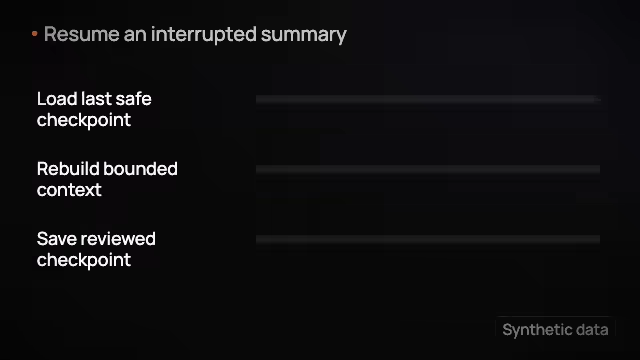
- Resuming interrupted work across shifts: When a session pauses or disconnects, Resume interrupted work (S02) takes the interrupted session and backup, using the verified legacy agent-session migration component to validate backups, isolate invalid content, and import read-only history and pending positions. Human review gates at Confirm the resume point and Inspect the result require explicit human confirmation before execution resumes and before results and open items are accepted.
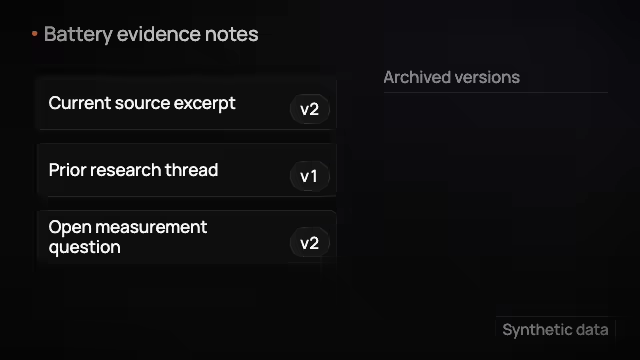
- Cross-time-zone research continuity: Continue research (S08) relies on the persistent research workspace and memory component to retain universes, sessions, observations, decisions, and session bundles. Through Load research context → Plan follow-up research → Approve and run (human review) → Review the changes (human review), it hands over accepted evidence, open questions, and a continuation bundle.
- Spoken request capture for field handoffs: Take spoken requests (S11) records user-initiated audio with permitted context, drafts the request, and pauses at a Confirm understanding human review gate before retaining replies and redacted error clues.
Across the industries linked to this article—manufacturing and industry, healthcare, lifestyle and consumer apps, and finance—none of these skill packs carries a source-supported industry tag; they represent transferable use in specific domains or general patterns:
- In healthcare, only Intake and handoff (S09) is tagged for transferable use, letting an appointment desk verify permissions, collect minimum necessary data, and hand records to administrative staff. It requires hospital identity and ticketing integration and supports administrative services only—never automated symptom triage.
- In lifestyle and consumer apps, only Resume interrupted work (S02) is tagged for transferable use. Imported history remains strictly read-only and must never trigger automatic execution or billing without a native checkpoint or explicit confirmation of a new task.
- In finance, only Continue research (S08) is tagged for transferable use to carry multi-week research evidence forward; search and completion queues still require integration, and the pack is not a native financial workflow.
- Take spoken requests (S11) is tagged for transferable use only in general enterprise settings (requiring transcription endpoints and retention policies, without automatically modifying calendars or sending messages). In manufacturing and industry, none of the packs carries an industry tag; they serve only as general software patterns and do not perform physical shop-floor handoffs.
Every skill pack on the site is a proposed composition demonstrated with synthetic data and not yet connected to live services. Component maturity ratings (the components above are working code) come from static source inspection rather than production deployment.
Pre-Pilot Checks for Engineering and Operations Leaders
Before funding a cross-shift or cross-time-zone handoff pilot, leaders can apply concrete checks:
- Does the handoff artifact enforce prespecified structural elements? Verify that the workflow requires explicit fields—verified role, approved minimum data package, accepted evidence, and open items—much like standardized clinical handoff elements[1], rather than raw chat logs.
- Do human review gates hold blocking authority at boundary crossings? Confirm that data access approval, resume-point confirmation, and spoken-request interpretation pause execution until an assigned reviewer accepts them, returning rejected drafts for revision.
- Is historical state isolated from automatic execution? Ensure that importing a prior shift’s session or voice note creates a read-only record first, preventing unconfirmed context from triggering downstream actions or billing.
Found it useful? Pass it on.
References
- [1]
Starmer, A. J., Spector, N. D., Srivastava, R., West, D. C., Rosenbluth, G., Allen, A. D., Noble, E. L., Tse, L. L., Dalal, A. K., Keohane, C. A., Lipsitz, S. R., Rothschild, J. M., Wien, M. F., Yoon, C. S., Zigmont, K. R., Wilson, K. M., O'Toole, J. K., Solan, L. G., Aylor, M., ... Landrigan, C. P. (2014). Changes in Medical Errors after Implementation of a Handoff Program. New England Journal of Medicine, 371(19), 1803–1812. doi.org/10.1056/NEJMsa1405556
- [2]
Malone, T. W., & Crowston, K. (1994). The Interdisciplinary Study of Coordination. ACM Computing Surveys, 26(1), 87–119. doi.org/10.1145/174666.174668
- [3]
Hutchins, E. (1995). Cognition in the Wild. MIT Press. mitpress.mit.edu ↗
Related capabilities
Platform modules
Skills packs
S02 · Agent OS
Resume interrupted work
A long job drops halfway through on a disconnect, timeout or restart, and usually starts over.
Check history and runtime readiness, resume unfinished work and review the result.
- Recover the history
- Confirm the resume pointHuman review
- Resume execution
- Inspect the resultHuman review
4 steps2 human reviews6 components

S09 · Agent OS
Intake and handoff
Support has to verify the customer, look up records and find an owner, and the case changes hands several times before anyone takes it.
Verify operator access, collect service issues and hand records to the appropriate person.
- Confirm account and role
- Create the service record
- Approve data accessHuman review
- Hand over and record
4 steps1 human reviews10 components
S08 · Agent OS
Continue research
When research changes hands or pauses for weeks, nobody can find what was checked or why a conclusion was reached.
Save research scope and evidence, investigate in bounded batches and confirm follow-up work.
- Load research context
- Plan follow-up research
- Approve and runHuman review
- Review the changesHuman review
4 steps2 human reviews6 components
S11 · Agent OS
Take spoken requests
Typing is impractical on the move or on site, and voice messages get misheard or lost.
Record spoken requests with consent, confirm the interpretation and retain replies and handling records.
- Capture the request
- Add relevant context
- Confirm understandingHuman review
- Respond and record
4 steps1 human reviews6 components