E35 SeriesE · Organisation & people
Overcoming Frontline Surveillance Anxiety: Socio-Technical Change Management Where Audit Trails Serve Review and Protect Compliant Workers
When video review, voice transcription, and work-order logs operate as micro-surveillance tools, frontline staff work around them; designed on socio-technical principles, workflows first reduce paperwork burdens and use clear human decision records to provide verifiable operating evidence for compliant workers.


When Shift Handover Logs Look Like Electronic Policing, Frontline Data Degrades
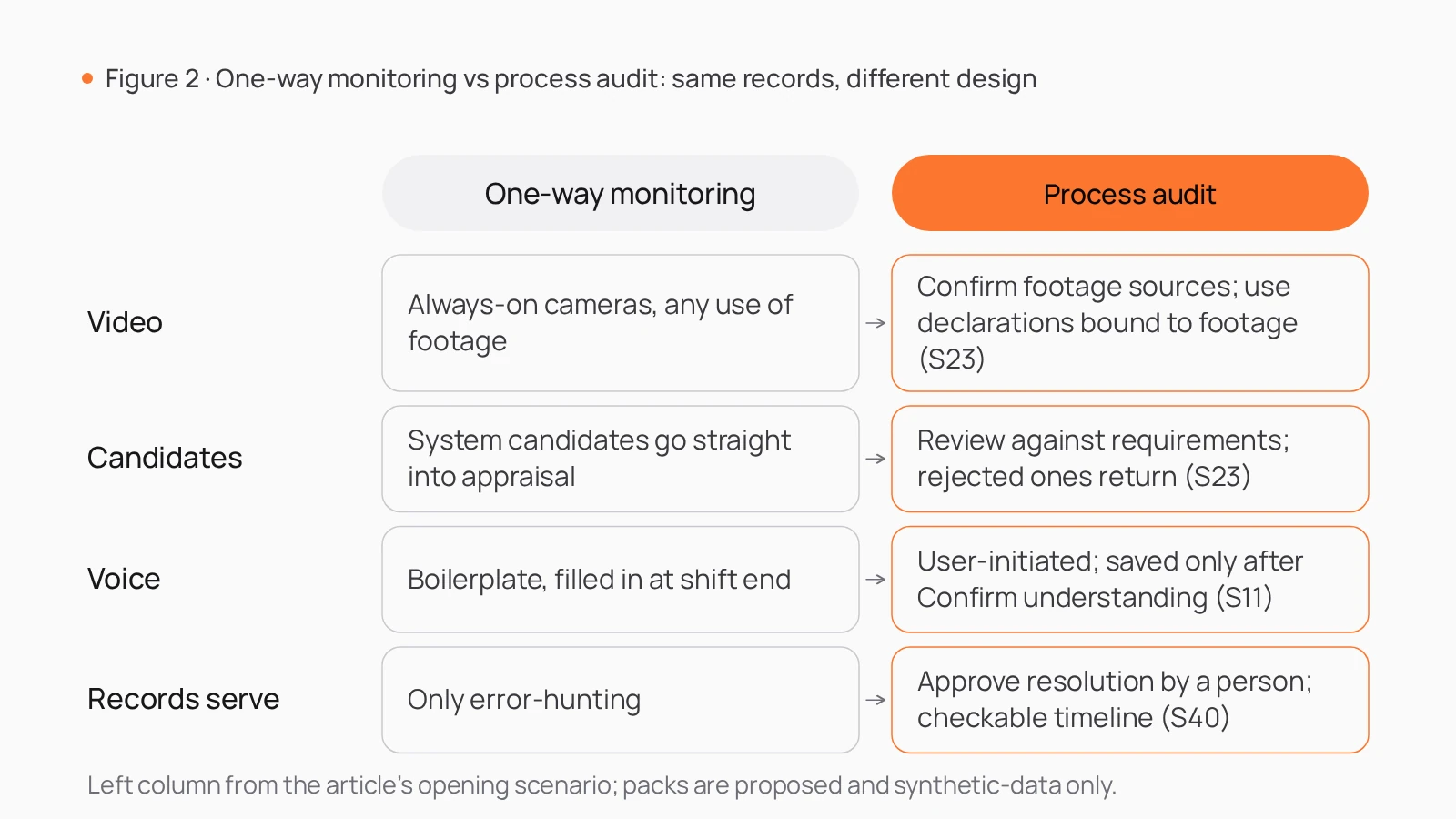
Imagine a familiar situation on a factory floor or in a distribution warehouse. To reduce missed steps during shift handovers and speed up quality investigations, management installs overhead cameras for action analysis, issues voice-transcription terminals to team leads, and adds granular status checkpoints to digital work orders. Soon after rollout, cameras are blocked by stacked totes, voice logs shrink to boilerplate phrases, and batch exception entries are held back until the end of the shift. Instead of capturing context for root-cause review, the new logging stack is experienced by operators as fault-finding surveillance.
In our view, this resistance arises when system design conflates operational auditability with one-way disciplinary monitoring. When video review, voice transcription, and work-order auditing operate as micro-surveillance instruments, workers are likely to bypass them. Designed according to socio-technical systems principles, an effective workflow first reduces frontline paperwork and then uses clear human decision records to provide verifiable operating evidence that protects compliant workers.
From Mechanized Coal Mining to Workplace Algorithms: Control, Enactment, and Resistance
Why do capable logging systems so often provoke defensive workarounds? Organization theory and research on algorithmic labor processes explain the underlying dynamics.
Studying the introduction of the mechanized longwall method in British coal mines, Trist and Bamforth (1951) found that the new technology broke up small, self-regulating, multi-skilled work groups into a large, specialized, shift-based production cycle[1]. Disrupting the work group’s social structure produced isolation, stress, absenteeism, and defensive behaviors[1]. The study founded socio-technical systems thinking: technical and social systems must be jointly optimized[1]. Tightening technical tracking while ignoring the social structure of frontline teams erodes operational resilience.
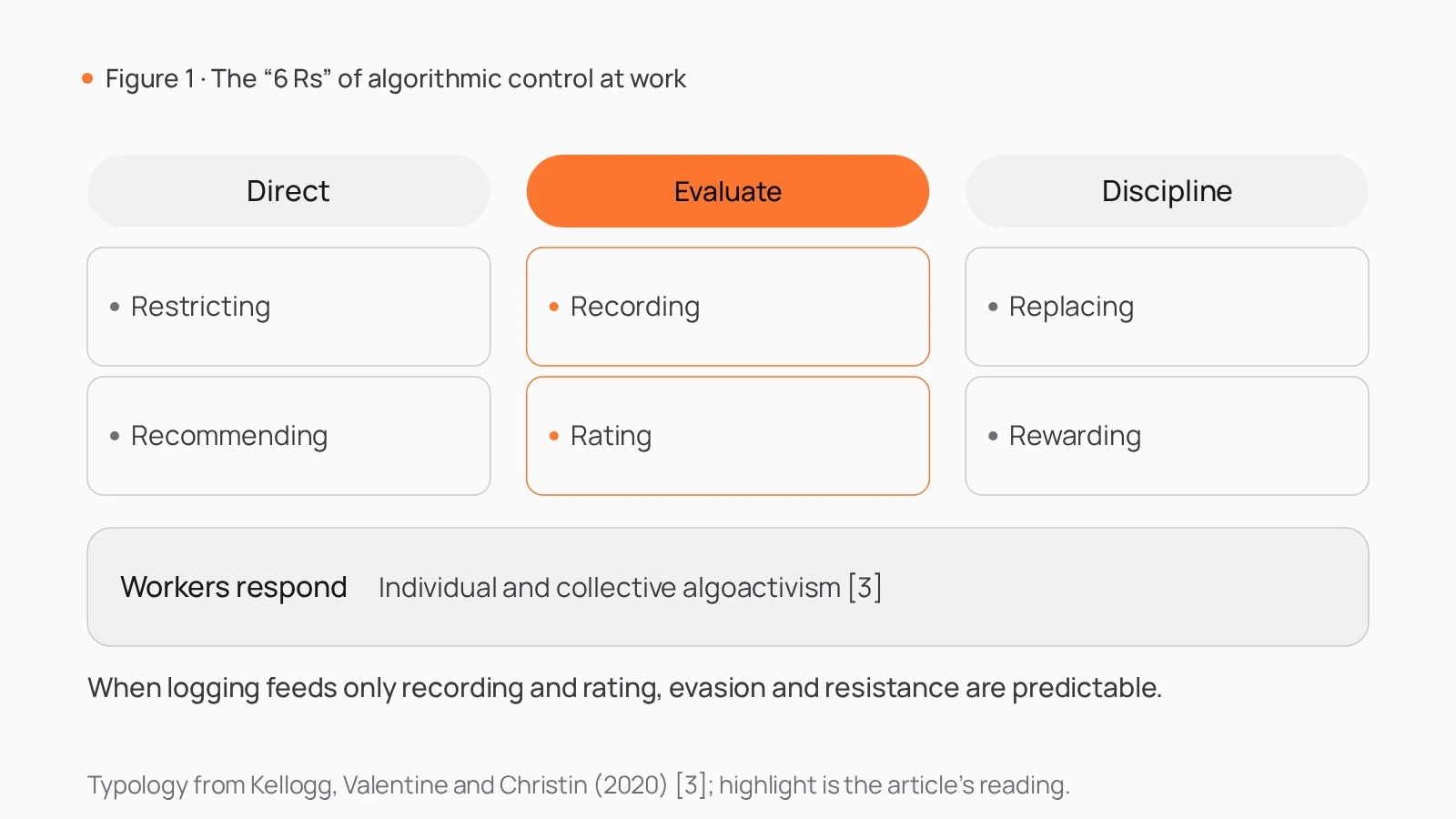
As algorithmic tools enter the workplace, this tension sharpens. Kellogg, Valentine, and Christin (2020) use Edwards’ (1979) perspective of “contested terrain”—wherein managers implement production technologies to maximize the value of labor and workers resist—to synthesize interdisciplinary research on algorithms at work[3]. They find that algorithmic control in the workplace operates through six main mechanisms, which they call the “6 Rs”: employers can use algorithms to direct workers by restricting and recommending, evaluate workers by recording and rating, and discipline workers by replacing and rewarding[3]. Their synthesis highlights several key insights: labor process theory helps highlight potential problems with the largely positive view of algorithms at work; the technical capabilities of algorithmic systems facilitate a form of rational control distinct from the technical and bureaucratic control used by employers for the past century; employers’ use of algorithms is sparking the development of new algorithmic occupations; and workers are individually and collectively resisting algorithmic control through emerging tactics called algoactivism[3]. When a frontline logging system feeds directly into opaque recording and rating pipelines, evasive tactics are a predictable response.
Wiring Socio-Technical Principles into Workflows: Scoped Consent, Human Gates, and Verifiable Evidence
Translating socio-technical optimization into software architecture requires explicit boundaries around data capture, mandatory human review gates before tentative outputs become official records, and audit trails that document approved actions. Across the Intelligence, Agent OS, and Commerce modules on rlab.works, skill packs and components illustrate this structure.
For visual review in Intelligence, Review video actions (S23) starts from authorized footage, venue information, and a review goal rather than open background surveillance. Its opening step is a human review gate backed by Media provenance and declared-use review, which binds source identity, archive evidence, and declared-use scope to media assets, blocking reuse when provenance is unconfirmed or evidence changes. Only after sources are confirmed does the workflow normalize frames and propose motion candidates. At Review against requirements, a reviewer inspects the candidates; rejected output returns for revision and does not advance to summaries or annotated replays. For manufacturing, this pack is a transferable use: proposing motion candidates for human correction can be adapted so a team lead reviews flagged workstation actions against standard operating procedures (SOPs) before handing over a shift review pack. However, existing components do not automatically recognize SOPs or judge violations; workstation calibration, action candidates, process statistics, and report templates must be rebuilt. (Its source-supported industry tag in sports means only that source data has an explicit sports association; for logistics, retail, and enterprise services, it is a general pattern only.)
For spoken updates and task coordination in Agent OS, Take spoken requests (S11) starts from a user-initiated recording and permitted context. After capturing the request and adding authorized context, it pauses at Confirm understanding (human review): rejected drafts return for revision, and only confirmed requests advance to retain replies and privacy-filtered error clues, cutting hands-busy paperwork. In enterprise services, this pack is a transferable use requiring a live transcription endpoint and retention settings, without automatically altering calendars or sending messages; in manufacturing, logistics, and retail, it is a general pattern only. Alongside it, Plan and deliver work (S01) runs through Plan the steps → Approve the scope (human review) → Run and collect → Review and hand over (human review), using Auditable workflows, human confirmation and decision review to persist versioned workflows, check permissions, pause for human decisions, and log review outcomes. In manufacturing, S01 is a transferable use—breaking equipment maintenance into inspection, kitting, and review tasks with shift-handover evidence—while orchestrating software tasks and human records only; physical repairs are performed by personnel with configured work permits and checkpoints (and in logistics, retail, and enterprise services, S01 is a general pattern only).
In the Commerce module, Trace batches and resolve issues (S40) takes batch origins, inspection records, and movement events, using Batch traceability, recall tasks and distribution risk audits to collect scan receipts, trace affected inventory and orders, and export audit timelines. Human review gates at Approve resolution and Verify resolution ensure reviewers approve isolation, recall, or replacement tasks and verify completion, giving compliant operators verifiable operating evidence that inspections and escalations were completed. S40 is a transferable use in manufacturing (requiring unified batch and work-order models and live equipment integration) and logistics (adapting product packaging to containers and cargo events, where scan registration does not mean physical interception has occurred), and a general pattern in retail and enterprise contexts.
Pre-Pilot Checks for Executive and Operations Leaders
Before funding a frontline logging or review pilot, a CEO, CDO, or department head can apply concrete checks to ensure socio-technical alignment:
- Verify explicit provenance and declared-use boundaries at ingestion: Check whether video and audio inputs require user initiation or explicit venue and scope declarations enforced by software gates, preventing process-review footage from drifting into undeclared attendance policing.
- Confirm that the workflow reduces administrative friction before adding tracking: Evaluate whether voice capture and task templates eliminate manual logbooks, and verify that unaccepted machine drafts or motion candidates are held at human review gates rather than fed into automated worker ratings.
- Inspect whether the audit trail protects compliant operators: Ensure that workflow logs record verified inspection records, escalations, and supervisor approvals completed by frontline staff—providing verifiable operating evidence when incidents are reviewed.
Found it useful? Pass it on.
References
- [1]
Trist, E. L., & Bamforth, K. W. (1951). Some Social and Psychological Consequences of the Longwall Method of Coal-Getting: An Examination of the Psychological Situation and Defences of a Work Group in Relation to the Social Structure and Technological Content of the Work System. Human Relations, 4(1), 3–38. doi.org/10.1177/001872675100400101
- [2]
Orlikowski, W. J. (2000). Using Technology and Constituting Structures: A Practice Lens for Studying Technology in Organizations. Organization Science, 11(4), 404–428. doi.org/10.1287/orsc.11.4.404.14600
- [3]
Kellogg, K. C., Valentine, M. A., & Christin, A. (2020). Algorithms at Work: The New Contested Terrain of Control. Academy of Management Annals, 14(1), 366–410. doi.org/10.5465/annals.2018.0174
Related capabilities
Platform modules
Skills packs
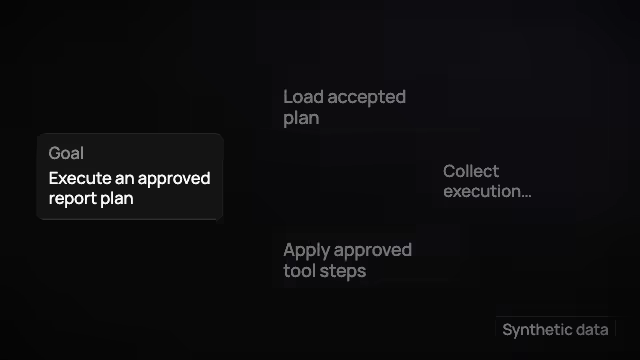
S01 · Agent OS
Plan and deliver work
Hand AI a big job and it often stops halfway or drifts, and nobody can tell how far it got.
Break a goal into dependent tasks, confirm execution and deliver reviewable results.
- Plan the steps
- Approve the scopeHuman review
- Run and collect
- Review and hand overHuman review
4 steps2 human reviews7 components
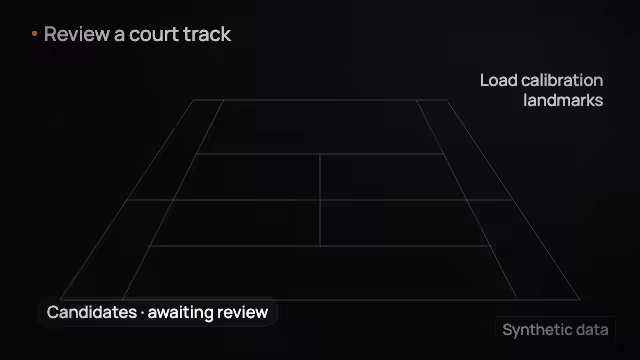
S23 · Intelligence
Review video actions
Finding key moments frame by frame is slow and tiring, and the conclusions are hard to check later.
Preserve footage sources, propose motion candidates and create evidence-linked replays after human correction.
- Confirm footage sourcesHuman review
- Normalize timing and frames
- Propose motion candidates
- Review against requirementsHuman review
- Summarize confirmed events
- Build annotated replays
- Hand over the review pack
7 steps2 human reviews8 components

S11 · Agent OS
Take spoken requests
Typing is impractical on the move or on site, and voice messages get misheard or lost.
Record spoken requests with consent, confirm the interpretation and retain replies and handling records.
- Capture the request
- Add relevant context
- Confirm understandingHuman review
- Respond and record
4 steps1 human reviews6 components
S40 · Commerce
Trace batches and resolve issues
When a batch has a quality problem and nobody can trace which warehouses and orders it reached, the recall has to be broad.
Record batch and quality events, trace the impact and have reviewers decide and verify resolution.
- Record batches and inspections
- Collect movement events
- Trace the impact
- Approve resolutionHuman review
- Verify resolutionHuman review
5 steps2 human reviews6 components