[Finance II] Backtest Overfitting and Model Risk Governance: Rule-Scenario Sandboxes and Invocation Ledger Auditing in Financial Institutions
Parameter optimization without out-of-sample testing manufactures illusory Sharpe ratios; scenario replay and model risk management (SR 11-7) belong inside a governed sandbox, and research strategies must never connect directly to live trading.


The Illusion of Historical Curves: Why Parameter Sweeps Must Not Feed Live Trading
Consider a familiar situation on a quantitative research or risk modeling desk. After adopting large language models and automated workflow tools, analysts can translate natural-language trading hypotheses into structured candidate rules far faster than before. Within a short period, a team sweeps through combinations of entry thresholds, holding horizons, and rebalancing frequencies across the same historical window until a smooth equity curve emerges. Yet as soon as the selected rule faces unseen market regimes or realistic transaction costs, its apparent advantage vanishes.
Accelerating candidate generation without tightening validation boundaries does not improve forecasting skill; it merely speeds up the fitting of historical noise. In our view, parameter optimization conducted without out-of-sample testing manufactures illusory Sharpe ratios; scenario replay and model risk management under SR 11-7 belong inside a governed sandbox, and strategy outputs must never connect directly to live execution.
Backtest Overfitting, Effective Challenge, and Risk Data Aggregation
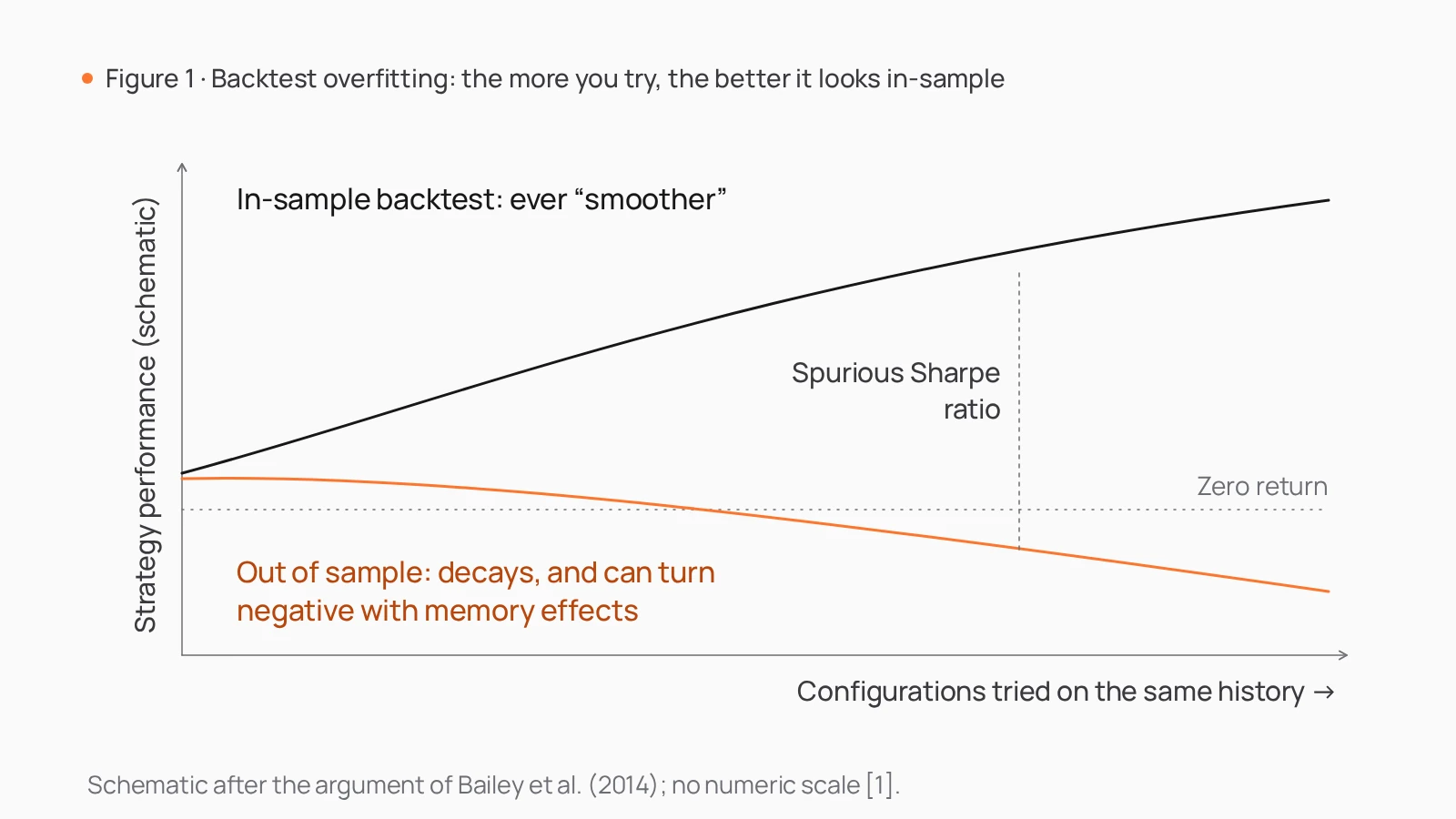
Why does unconstrained historical parameter search so reliably produce disappointing live performance? In their paper Pseudo-Mathematics and Financial Charlatanism: The Effects of Backtest Overfitting on Out-of-Sample Performance, Bailey, Borwein, López de Prado, and Zhu (2014) examine how backtest overfitting degrades out-of-sample performance[1]. Their abstract states that high simulated performance is easily achievable after backtesting a relatively small number of alternative strategy configurations, a practice they call “backtest overfitting”; the more configurations tried, the greater the probability that the backtest is overfit, and because analysts rarely report how many configurations they tried, investors cannot evaluate the degree of overfitting[1]. Under memory effects, the authors add, backtest overfitting leads to negative expected out-of-sample returns rather than zero performance[1]. In our engineering interpretation, when a strategy idea remains loosely specified and the procedure for calculating returns, turnover, and fee drag is left flexible during experimentation, repeated parameter sweeps over finite historical records inevitably mistake random fluctuations for durable structure.
Effective validation also depends on the integrity of the underlying data and reporting pipeline. In January 2013, the Basel Committee on Banking Supervision published Principles for effective risk data aggregation and risk reporting (BCBS 239), a framework initially aimed at global systemically important banks[3]. BCBS 239 establishes principles spanning overarching governance and infrastructure, risk data aggregation capabilities, risk reporting practices, and supervisory review[3]. Specifically, risk data aggregation capabilities must satisfy requirements for accuracy and integrity, completeness, timeliness, and adaptability, while risk reporting practices must demonstrate accuracy, comprehensiveness, clarity and usefulness, appropriate frequency, and sound distribution[3]. Taken together, these academic and supervisory foundations point to a clear architectural requirement: financial institutions must lock down explicit hypotheses before running replays, separate in-sample parameter sweeps from out-of-sample validation on accurate and complete records, and route every scenario comparison through a human gate capable of exercising effective challenge.
Engineering the Rule-Scenario Sandbox: Explicit Assumptions, Out-of-Sample Separation, and Human Gates
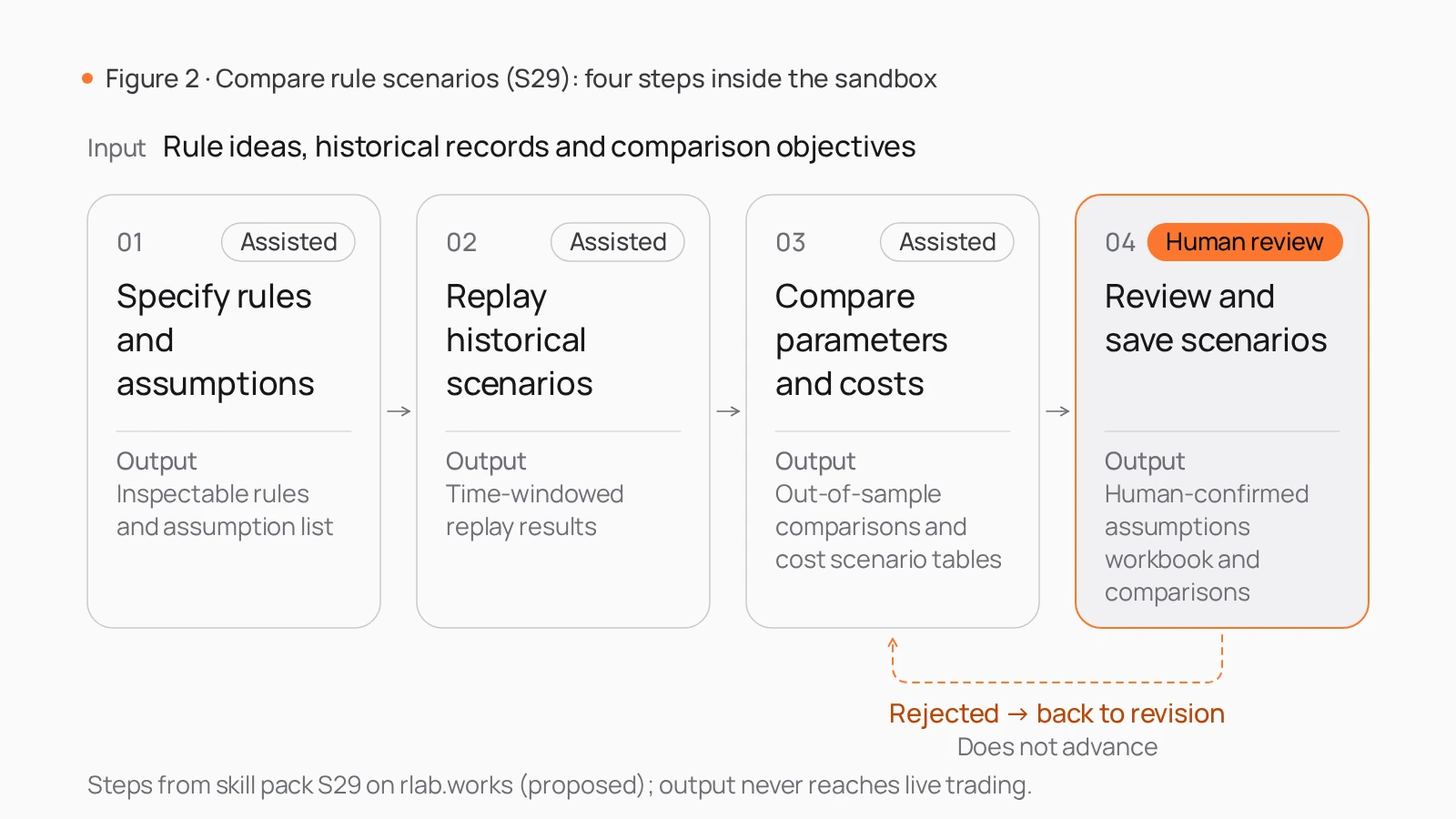
Translating model risk governance into software architecture requires replacing ad-hoc script execution with an auditable research sandbox. Within the Intelligence module on rlab.works, the Compare rule scenarios (S29) skill pack structures quantitative and policy experimentation as an explicit sequence of assisted steps and mandatory human review:
- Specify rules and assumptions: Starting from an initial input contract of rule ideas, historical records and comparison objectives, the workflow uses Natural-language strategies and templates to turn investment ideas or reusable templates into structured, inspectable strategy rules and documentation. Rather than leaving calculation procedures indefinite, this step emits an explicit checklist of inspectable rules and assumptions before any historical replay begins.
- Replay historical scenarios: Next, Explainable portfolio backtest and replay backtests and replays the structured strategy over historical windows, covering portfolio construction, market target weights, turnover, hit rates, and attribution relative to the benchmark universe. The output is a time-windowed replay record that preserves attribution details for subsequent inspection.
- Compare parameters and costs: To guard against naive curve-fitting, Strategy sweeps and walk-forward validation compares template replay results, sweeps parameters under feasibility constraints, and performs out-of-sample validation on selected parameters. It produces an out-of-sample comparison and cost-scenario table so reviewers can see how parameter choices behave outside the fitting window and how turnover and fee assumptions affect net outcomes.
- Review and save scenarios (human review gate): Execution pauses at a mandatory human review step assigned to a designated reviewer or the requesting user. Here, institutional effective challenge takes operational form: the reviewer examines the human-confirmed assumption table and comparison notes, and any rejected output is returned for revision and does not advance. Where research teams run batch model tasks and need to keep tool operating expenses accountable, the Check usage and costs (S13) skill pack in the AI Gateway module can check available budgets prior to batch submission and reconcile recorded usage afterward for internal research tool administration, without touching financial trade settlement.
Pre-Pilot Governance Checks for Financial Leaders
Before funding an AI-assisted strategy research or risk-scenario pilot, a chief risk officer, head of quantitative research, or technology executive can apply several concrete governance checks:
- Verify that rule definitions and cost assumptions are frozen before replay: Require every experiment to begin by emitting a versioned checklist of rules, constraints, and fee assumptions. If analysts can silently alter how consequences are computed after viewing historical curves, the workflow invites backtest overfitting.
- Enforce strict separation between parameter sweeps and out-of-sample validation: Confirm that the sandbox architecture distinguishes in-sample parameter scanning from walk-forward out-of-sample validation, and that time-windowed attribution records meet organizational standards for data accuracy, completeness, and auditability.
- Mandate a blocking human review gate and air-gap the research sandbox from execution: Ensure that scenario comparisons pause for review by an objective, informed party with the authority to reject and return unvalidated outputs, and verify at the infrastructure level that the scenario sandbox has no credentials or interfaces capable of triggering live trades.
Found it useful? Pass it on.
References
- [1]
Bailey, D. H., Borwein, J. M., López de Prado, M., & Zhu, Q. J. (2014). Pseudo-Mathematics and Financial Charlatanism: The Effects of Backtest Overfitting on Out-of-Sample Performance. Notices of the American Mathematical Society, 61(5), 458–471. doi.org/10.1090/noti1105
- [2]
Board of Governors of the Federal Reserve System. (2011, April 4). SR 11-7: Guidance on Model Risk Management (jointly issued with OCC as Bulletin 2011-12). federalreserve.gov ↗
- [3]
Basel Committee on Banking Supervision (BCBS). (2013). Principles for effective risk data aggregation and risk reporting (BCBS 239). Bank for International Settlements. bis.org ↗
Related capabilities
Platform modules
Skills packs
S29 · Intelligence
Compare rule scenarios
A new pricing or investment rule is too risky to launch untested, and intuition will not convince anyone.
Express ideas as explicit rules, compare historical replays and parameters and review assumptions.
- Specify rules and assumptions
- Replay historical scenarios
- Compare parameters and costs
- Review and save scenariosHuman review
4 steps1 human reviews6 components
S13 · AI Gateway
Check usage and costs
The model bill arrives at month end, and nobody can say which requests the overspend went to.
Check the budget before submitting batch jobs, then reconcile costs against recorded usage.
- Check available budget
- Submit and collect results
- Account for request costs
- Review discrepanciesHuman review
4 steps1 human reviews5 components