Is AI the Cause of Layoffs, or the Cover Story? Six Judgements on AI and Organisational Change
Since 2023, US layoff announcements have mentioned AI more and more often. Put the experiments, layoff statistics, employer surveys and company statements side by side, and AI’s task-level gains are real, but most layoffs made in its name look more like anticipatory cuts or narrative framing; real substitution is concentrated in a few roles and happens mainly through hiring fewer people. This long read offers six judgements with confidence levels and counter-evidence, plus preparation checklists for individuals and smaller companies.


Since 2023, large US companies have announced a new round of layoffs every few months, and one word has appeared in those announcements more and more often: AI. That raises a question people keep asking. Are these companies cutting jobs because AI has arrived, or did they want to cut anyway and simply borrow AI as the reason?
The question deserves a careful answer, because it decides how companies and individuals should prepare. If the layoff wave is mainly AI substitution, the priority is redeployment and self-protection. If AI is mostly an expectation and a story, the priority is telling signal from noise and not being carried along by a fashionable narrative. This article puts the public experiments, statistics, employer surveys and company announcements side by side, offers six judgements, and states the counter-evidence and our own judgement in every part.
Six judgements
Confidence levels: high = several high-quality studies point the same way; medium = good evidence, but with important counter-examples or measurement problems; low = rests mainly on forecasts, individual cases or the author’s inference.
- AI’s productivity gains at the task level are real, but at the organisational level they are far from realised. (Confidence: high for tasks, medium for organisations.) In experiments, novice customer-support agents became 34% more productive [1], yet similar experiments show that using AI outside its capability frontier lowers accuracy [2]; in a survey, only 39% of respondents reported any impact of AI on EBIT (earnings before interest and taxes) [3].
- The 2023–2026 US layoff wave was mainly not produced by AI “replacing” people; AI is more an expectation and a story. (Confidence: medium.) In 2025, layoffs for which employers cited AI made up only about 4.5% of the total [4]; in a New York Fed survey, only 1% of AI-using service firms had laid off workers because of AI [5]; in an executive survey, only 2% had made large cuts because of AI actually being implemented, while more than half had cut in anticipation of AI [6]. By 2026, however, AI had become the reason employers cited most often [7], so this judgement needs continuous updating.
- AI’s impact on employment shows up first at the entry point, not among existing staff. (Confidence: medium.) Macro data show no clear AI footprint on employment yet [8], but employment of young workers in AI-exposed occupations has fallen in relative terms, mainly through fewer hires [9][10].
- Merging R&D with product and flattening organisations have a real economic logic, but there is a practical limit. (Confidence: medium.) AI lowers the cost of coordination and of acquiring knowledge [11], and an experiment shows individuals using AI can match the performance of teams [12]; but after Meta pushed manager ratios as high as 1:50, within three months it planned to cap direct reports at about 20 [13][14].
- The biggest organisational risk is not people being replaced but people not developing. (Confidence: medium.) Junior engineers who learned with AI scored lower on a quiz [15], and AI can also intensify work [16]; cut junior roles and middle-management mentoring at the same time, and the talent pipeline may break [17].
- Macro forecasts for the next decade differ by an order of magnitude; smaller companies should plan for a “structural reorganisation” scenario rather than bet on rapid automation. (Confidence: low; this is essentially a planning judgement.) Published estimates of the annual productivity boost range from about 0.07 percentage points (converting Acemoglu’s ten-year total of no more than 0.66%) [18] to about 1.5 percentage points [19].
How to read this article: strength of evidence
The sources cited here fall roughly into four grades, which differ in strength and in how they can be used:
| Grade | Type | How it is used |
|---|---|---|
| A | Peer-reviewed experiments, quasi-experiments, historical and survey data, and peer-reviewed theory and ethnography | Can serve as causal or strong descriptive evidence, within the limits of extrapolation |
| B | Working papers, preprints and research updates from research organisations | Peer review not yet complete; some samples are small |
| C | Surveys, statistics and estimates from consultancies, vendors, international bodies, central banks and industry organisations | Reflect intentions, stated reasons or model assumptions, not actual outcomes; some organisations have an interest in AI adoption |
| D | CEO memos, company announcements, media reports and executive interviews | Show only what companies say and do; cannot prove that a practice works or that a claim is true |
In addition, interest-rate decisions and tax documents are used only to confirm policy facts, not to show any causal effect on layoffs.
Cross-checking rule: when a company’s claim (grade D) is corroborated by grade A or B evidence, it can be treated as a fairly firm trend; when claims are inconsistent, lack grade A or B support, or have already been reversed, more caution is needed. The analysis of “AI layoffs” below applies this rule. Anything labelled “our judgement” is the author’s inference from the evidence, not a conclusion of the sources.
1. AI changes tasks first, not the organisation's accounts
Position: Generative AI brings real productivity gains on well-defined tasks with clear right answers, and it helps novices most; but the gains have limits, and they have not yet translated at scale into financial returns for organisations.
Key evidence
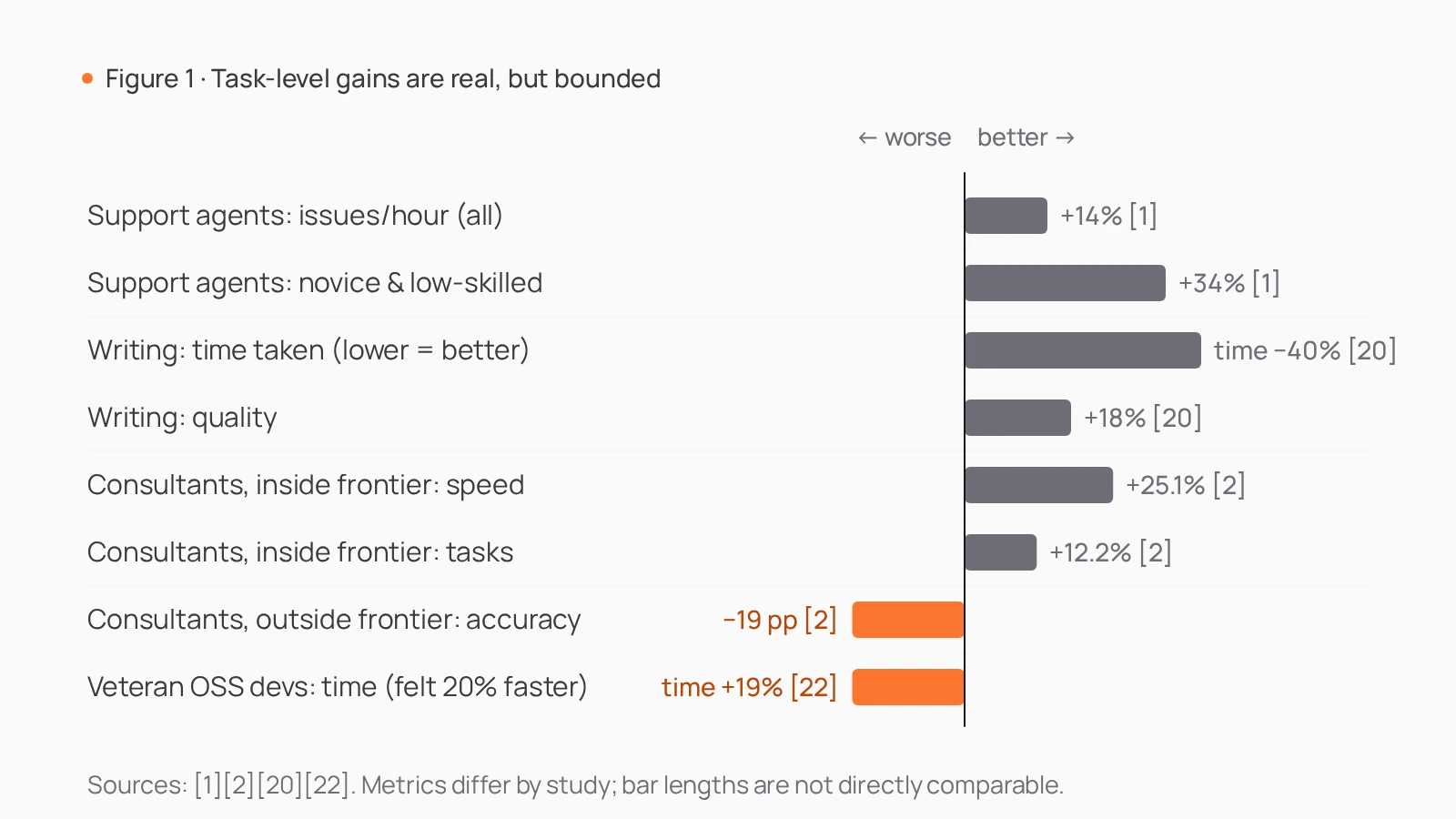
- Novices gain most. In a quasi-experiment covering 5,179 customer-support agents, an AI assistant raised issues resolved per hour by 14% on average and by 34% for novice and low-skilled workers, with little effect on experienced staff [1]. In a writing experiment with 453 professionals, time taken fell by 40% and quality rose by 18% [20].
- There are limits. In an experiment with 758 BCG consultants, those using AI on tasks “inside the frontier” of AI capability completed 12.2% more tasks, worked 25.1% faster and produced higher quality; on a task “outside the frontier”, their accuracy was 19 percentage points lower [2].
- Not yet realised at the organisational level. In McKinsey’s 2025 survey, 88% of organisations used AI in at least one function, but only 39% reported any impact of AI on EBIT [3].
Counter-arguments and limits
- Experienced people do not necessarily benefit. In METR’s randomised experiment in early 2025, 16 experienced open-source developers took 19% longer when using AI, while believing they had become 20% faster [22]; but in a 2026 update METR said its newer data suffer from selection bias and that there is now “likely” a speed-up, though the evidence remains weak [23]. Conclusions change quickly as tools change.
- Exposure is not replacement. The McKinsey Global Institute estimates that about 57% of US work hours are technically automatable, but states explicitly that this is not a job-loss forecast [24]. Task exposure is only the share of tasks that could be affected.
- Experiments are not organisations. Most experiments measure individual tasks; organisational effects also depend on process, collaboration and quality control. McKinsey found that one of the factors most strongly associated with EBIT impact is fundamental redesign of workflows [3].
Our judgement
Why does individual speed-up not automatically become organisational return? There are at least three gates. The first is bottleneck shift: once code is written faster, review, testing and customer sign-off become the new bottleneck. The second is the cost of quality: errors made outside the frontier have to be found and reworked [2]. The third is demand: time saved becomes output only if there is more work worth doing.
What AI changes first is how much one person can do in an hour, not how many people a company needs. Between the two lie process redesign, quality control and whether demand grows. That is the starting point of the next part: if organisational returns have not yet broadly materialised [3], then many of the layoffs made in AI’s name can hardly all be explained by “AI has already replaced these people”.
It also means that whether AI is “useful” cannot be judged by whether employees use it, but by whether end-to-end delivery time and quality improve.
2. Is AI the cause of layoffs, or the cover story?
Position: On the US evidence for 2023–2026, AI is the fastest-growing reason given for layoffs; but most layoffs made in AI’s name are either “anticipatory cuts” that bet on the future, or other causes given a better-sounding name. Job losses genuinely caused by AI substitution do exist, but they are concentrated in a few task-intensive roles and mostly take the form of not backfilling and hiring fewer people. (Confidence: medium.)
Start with the numbers: how much weight AI carries among layoff reasons
Each month Challenger, Gray & Christmas counts the layoff plans announced by US employers and the reasons employers give for them:
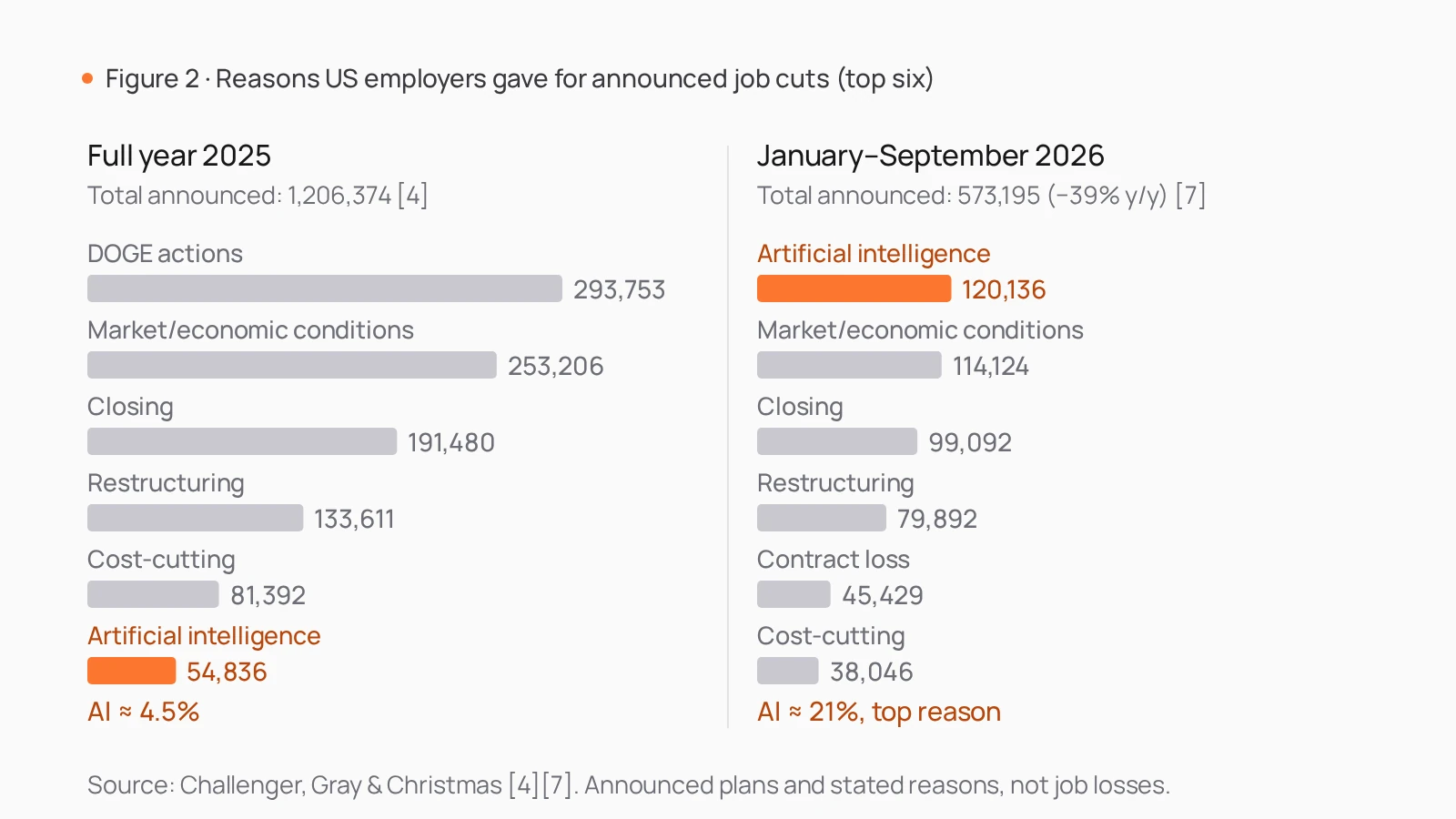
- 2025: announced job cuts totalled 1,206,374 for the year, of which employers cited AI for 54,836, about 4.5% (author’s calculation from [4]). Ahead of AI came actions by the Department of Government Efficiency (DOGE), market or economic conditions, closings of stores or units, restructuring and cost-cutting [4].
- January–September 2026: total announced cuts fell to 573,195, 39% fewer than in the same period a year earlier; but AI was cited for 120,136 of them, about 21%, making it the leading reason so far this year [7]. Technology accounted for 29% of all cuts [7].
Employer surveys: little real substitution, many anticipatory cuts
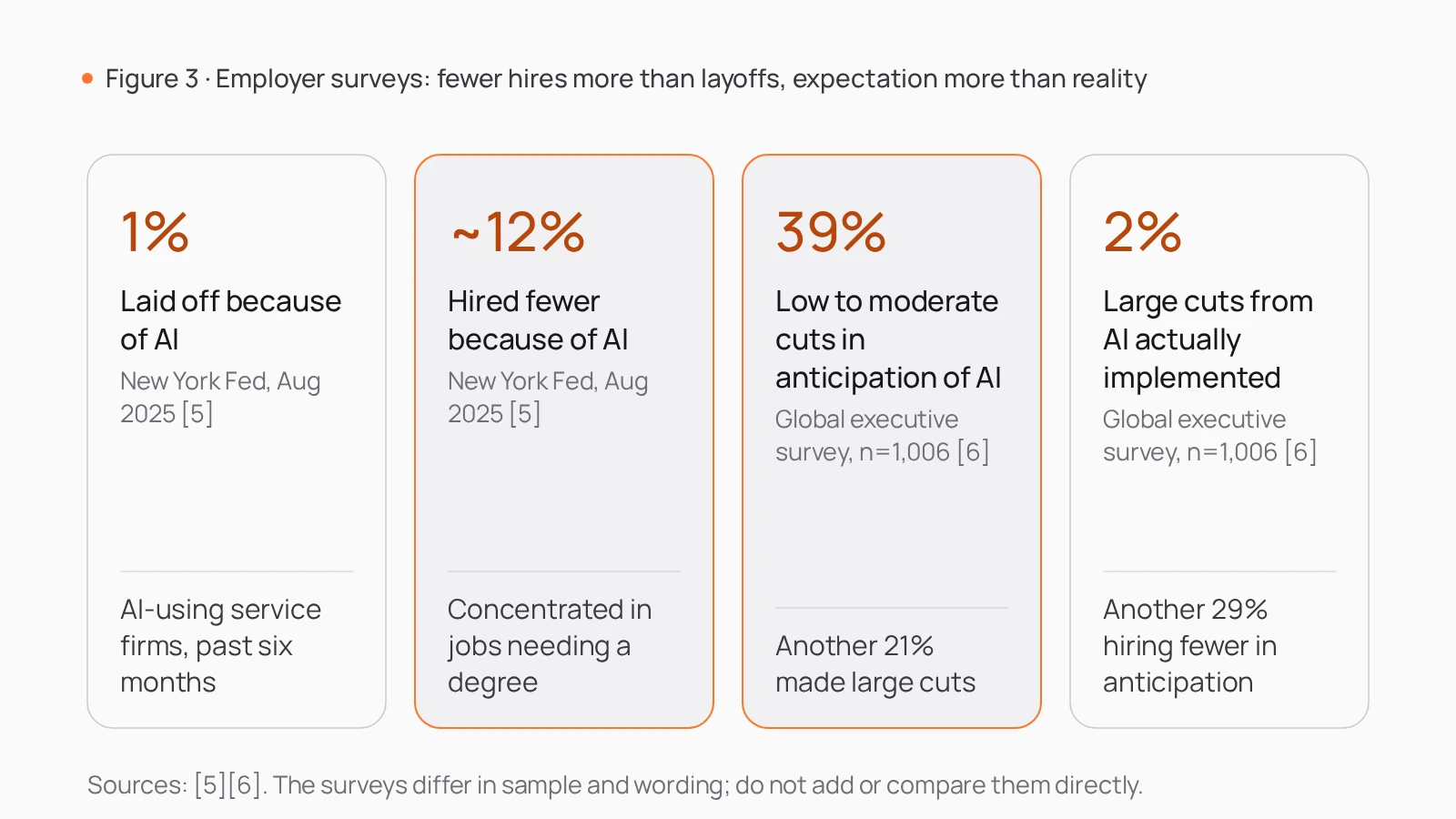
- New York Fed (August 2025): among service firms using AI, only 1% had laid off workers because of AI in the previous six months; about 12% had hired fewer people because of AI, concentrated in jobs requiring a college degree; just over a third had retrained staff. The authors conclude that for current workers, AI is “more likely to result in retraining than job loss” [5].
- Global executive survey (December 2025, 1,006 respondents): 39% of organisations had made low-to-moderate layoffs in anticipation of AI, 21% had made large cuts, and another 29% were hiring fewer people in anticipation of AI; only 2% had made large cuts because of AI actually being implemented [6].
- Oxford Economics (January 2026): firms “don’t appear to be replacing workers with AI on a significant scale”; if AI were replacing labour at scale, productivity growth should be accelerating, and overall it is not [26]. The firm also suspects some companies want to dress layoffs up as good news, because attributing them to AI sends investors a more positive message than admitting past over-hiring [27].
Other explanations: what else was happening at the same time
If not AI, layoffs can come from several other forces. They overlap in time with the AI narrative, which makes them especially easy to confuse with it.
- Pandemic over-expansion and its correction. When Meta cut about 13% of its staff, more than 11,000 people, in November 2022, Zuckerberg explained that he, like many others, had expected the pandemic boost to online activity to last and had therefore decided to “significantly increase our investments”, and that “I got this wrong” [28]. The 2023 “year of efficiency” planned a further reduction of about 10,000 people, closed about 5,000 open roles not yet filled, and flattened the organisation by removing several layers of management [29]. The stated reasons for both rounds were revenue below expectations and organisational efficiency, not AI substitution. Challenger likewise attributes the technology layoff wave to the AI pivot combined with “over-hiring over the last decade” [4].
- Higher cost of capital. The Federal Reserve raised the target range for the federal funds rate to 1/4 to 1/2 percent in March 2022 [30] and to 5-1/4 to 5-1/2 percent by July 2023 [31]. Our judgement: more expensive money forces technology companies that depend on financing and valuation to switch from “growth first” to “profit first”. That has nothing to do with AI, yet it can easily appear alongside AI in the same layoff announcement.
- Changes in the tax treatment of R&D. Under amendments to Section 174 of the US tax code, from 2022 domestic research and experimental expenditures had to be amortised over 5 years and foreign ones over 15 years; legislation in July 2025 restored immediate expensing of domestic R&D for tax years beginning after 2024, with foreign R&D still amortised over 15 years [32]. A press report argued that the change raised the tax cost of employing R&D staff and helped drive technology layoffs [33], but that causal link has not been tested academically.
- Budgets shifting from people to compute. Microsoft planned to invest about $80 billion in AI data centres in fiscal 2025 [34]. In his memo to employees after layoffs, Nadella wrote that the company was “thriving”, was “investing more in CapEx than ever before” and that overall headcount was “relatively unchanged”, even as it cut jobs, something he called “the enigma of success” [35]. IBM’s CEO said AI had replaced the work of “a couple hundred” HR employees, but total employment had risen because the savings were invested in software engineering and sales [36].
- Government and macro shocks. The leading layoff reason in 2025 was DOGE actions, with 293,753 cuts [4]. By September 2026, the concerns Challenger listed for companies were high energy costs, an uncertain war in Iran, a rate hike that could make hiring more expensive, and rising healthcare costs, saying firms were in a “wait-and-see period” [7]. None of these has anything to do with AI, yet all of them squeeze hiring and headcount.
The gap between what companies say and what the evidence shows
The table below puts together several US companies that are often cited, comparing their public statements with other evidence. The last column applies the four-type framework below and is our judgement, not what these companies say.
| Company | Public statement | Other evidence | Closest type (our judgement) |
|---|---|---|---|
| Amazon | June 2025: generative AI will reduce the company’s corporate workforce [37]; October: about 14,000 cuts, emphasising fewer layers and calling AI the most transformative technology [38] | The CEO later said the cuts were “not really financially driven, and it’s not even really AI-driven… it’s culture” [39]; in January 2026 a further ~16,000 cuts, with no mention of AI in the announcement [40] | Mainly culture and layer reduction (c), plus expectations about future AI (d) |
| Salesforce | CEO: support headcount down from about 9,000 to about 5,000 “because I need less heads” [41] | Company said support case volumes fell and it no longer needed to backfill [41]; later said hundreds of support engineers were redeployed to other parts of the business [42] | Real substitution (a), mainly via not backfilling and redeployment |
| IBM | AI replaced the work of several hundred HR employees [36] | Total employment rose; resources moved to engineering and sales [36] | Real substitution (a) + budget reallocation (b) |
| Klarna | Once said AI could do much of its customer-service work; headcount down 40% in 2022–2024 [6] | CEO acknowledged that a cost-led approach led to “lower quality” and began hiring human agents again [43] | Anticipatory cuts that went too far (d), later reversed |
| Duolingo | “AI-first”; gradually stopping use of contractors for work AI can do [44] | CEO said the company had “never laid off any full-time employees” and that contractor numbers always varied with need [45] | Partial substitution at the contractor level (a), amplified by outsiders into an “AI layoff” |
| Meta | 2022–2023 cuts attributed to over-investment and efficiency [28][29]; 2026 flattening in the name of AI [13] | Three months later the CTO admitted the rollout was “atrocious” and manager spans were pulled back [14] | First an expansion correction (c), later a bet on an AI-era organisational form (d) |
| Microsoft | Company “thriving”, record capital spending [35] | About $80 billion of AI data-centre investment [34] | Budget reallocation (b) |
A framework: four kinds of "AI layoff"
| Type | Mechanism | Typical signals |
|---|---|---|
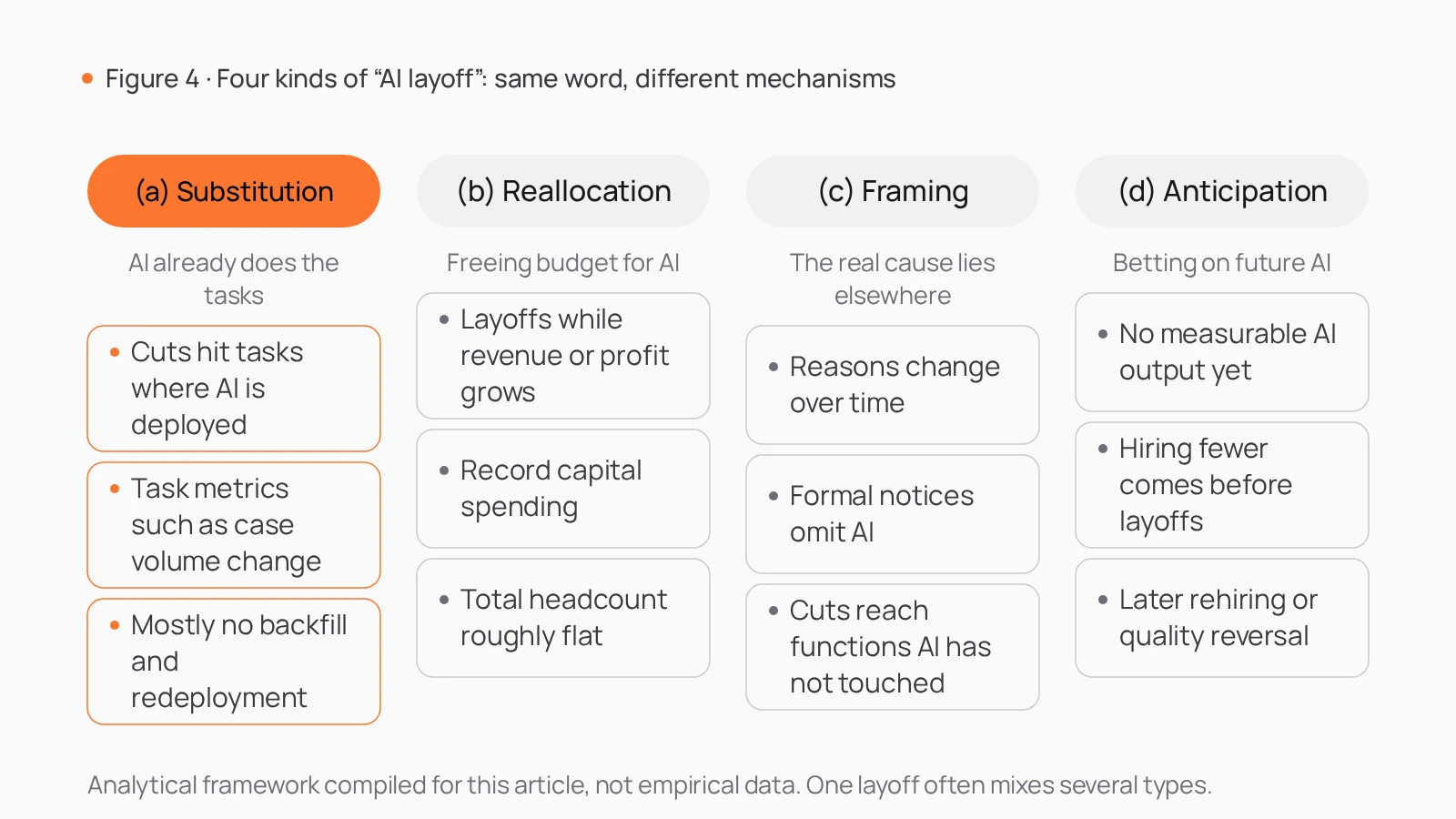
| (a) Real substitution | AI already does these tasks, so demand for the role falls | The cuts hit exactly the tasks where AI is deployed; task metrics such as case volume change; mostly via not backfilling and redeployment [5][41][42] |
| (b) Budget reallocation | Cutting other roles to free budget for AI (compute, platforms, AI talent) | Layoffs alongside revenue or profit growth; record capital spending; total headcount roughly flat [34]–[36] |
| (c) Narrative framing | The real cause is over-hiring, demand, interest rates, tax or culture; AI is the easier story to tell | Reasons change over time; formal announcements do not mention AI; cuts cover functions AI has not touched [27][37]–[40] |
| (d) Anticipatory cuts | Betting that AI will be able to substitute later, cutting or hiring less first | No measurable AI output yet; “hiring fewer” precedes “laying off”; rehiring or quality reversals afterwards [6][43] |
Why companies like to say "it's AI"
Attributing layoffs to AI has several advantages for a company (our judgement; the evidence is cited sentence by sentence):
- For investors: AI is a forward-looking reason. Oxford Economics argues that it conveys a more positive message than admitting weak demand or past over-hiring [27]; Challenger also observes that the market appears to reward companies that mention AI [25]. The authors of the executive survey say bluntly that another possibility is that AI is simply “a sexier reason to announce layoffs than simply needing to cut costs” [6].
- For peers: in uncertain environments, organisations tend to imitate peers seen as successful in order to gain legitimacy [46]; when several large companies describe restructuring as “AI-first”, not saying so starts to look behind the times [37][44][47].
- Internally: the AI narrative can turn a cost adjustment into a “transformation”.
But this story has costs. The employees who remain worry that they will be next and become reluctant to explore how AI could improve their work; wrongly attributing layoffs to AI also breeds cynicism about AI among employees [6]. Klarna’s step back from “AI replacement” to human agents is an example of a claim running ahead of capability [43].
Counter-arguments and limits
- AI’s role may also be underestimated. Challenger has a separate category, “Technological Update (possibly AI)”, which counted 20,219 cuts in 2025 [4]; Amazon first stressed AI and later said the cuts were “not even really AI-driven” [37][39], which shows that stated reasons themselves shift and can exaggerate or play down AI.
- The change in 2026 deserves attention. AI’s share rose from about 4.5% in 2025 to about 21% in January–September 2026 [4][7]. Our judgement: part of the reason is that other reasons (especially government cuts) fell sharply and the total declined; but it may also be an early sign that real substitution is starting to spread, and it should be tracked quarter by quarter.
- The data have limits. Challenger counts announced plans and stated reasons, not actual job losses [4]; the New York Fed covers only New York and northern New Jersey [5]; the executive survey was sponsored by a methodology company and is global [6]; the full Oxford Economics report is not public, and some of its statements come via press reports [27].
- Substitution is happening. Employment of young workers in AI-exposed occupations has fallen in relative terms, mainly through fewer hires [9][10]; the New York Fed also found that reduced hiring was concentrated in jobs requiring a college degree [5]. This does not contradict the “it’s just an excuse” view: the impact is real, but it is happening at the hiring gate rather than in large layoff announcements.
Our judgement: how to tell the difference
So far, the claim that “AI caused the layoff wave” overstates AI’s direct role. It is more accurate to say that AI is changing companies’ expectations, budgets and public explanations, while real substitution occurs mainly in customer service, back-office and junior roles, and mostly as reduced hiring. Institutional theory helps explain why companies like to call layoffs “AI”: in uncertain environments, organisations tend to imitate peers to gain legitimacy [46], and the market appears to reward this story [25].
To judge which type an “AI layoff” belongs to, ask seven questions:
- Are the roles being cut exactly the tasks AI is already doing? Is there a task metric (such as case volume) to support it? [41]
- Was there a controlled pilot and measurement before the cuts? [6]
- Is the company shrinking total headcount, or cutting while increasing hiring or capital spending? [35][36]
- Are the reasons consistent over time? Do later announcements still mention AI? [37]–[40]
- Is it layoffs, or not backfilling, hiring fewer and redeploying? [5][42]
- Did the company expand too fast in recent years, or is it facing pressure from demand, interest rates or tax? [28][30]–[32]
- Were there rehirings or quality reversals afterwards? [43]
What would make us change this judgement? AI’s direct substitution role should be considered to be rising if: independent employment data begin to show a clear AI footprint [8]; the share of firms “expecting AI layoffs” repeatedly turns into actual layoffs [5]; the share “cutting because AI was implemented” clearly exceeds the share “cutting in anticipation” [6]; and AI’s share of reasons keeps rising even when total layoffs are not falling [4][7]. Until those signals appear, it is safer to treat “AI layoffs” as a claim to be tested case by case than as an established fact.
3. Reorganisation: the real logic of merging R&D with product, and of flattening
Position: US companies that merge product, design and engineering into end-to-end squads and remove management layers are following a real economic logic: AI lowers the cost of coordination and of acquiring expertise. But flattening has a practical limit, and copying the slogans is riskier than copying the mechanisms. (Confidence: medium.)
Key evidence
- Theory: Garicano’s knowledge-hierarchy model shows that lower communication costs and lower costs of acquiring knowledge widen spans of control, let front-line workers solve more problems themselves and make organisations flatter [11]. Generative AI lowers both kinds of cost.
- Experiments: in a 776-person experiment at Procter & Gamble, individuals using AI matched the performance of teams without AI, and the solutions of people with R&D and commercial backgrounds became more balanced [12]. In a natural experiment on an AI coding assistant covering 187,489 developers, the share of project-management work fell by 10 percentage points, which the authors suggest may flatten organisational hierarchies [48].
- Company practice: LinkedIn turned its associate product manager programme into an associate product builder programme and is adopting a full-stack builder model [49]; Expedia reorganised into “small end-to-end squads with clear ownership”, concluding that “A lot of speed blockers are structural” [50]; Wix redefined its engineers as end-to-end owners, “xEngineers” [51].
Counter-arguments and limits
- Flattening has a limit. In March 2026 Meta set up an applied AI engineering organisation with manager ratios as high as 1:50 [13]; three months later the CTO admitted the rollout had been “atrocious” and planned to cap direct reports at about 20 [14]. Gartner also warns that cutting middle management overloads managers and interrupts mentoring paths [17].
- “Getting rid of product managers” is not a consensus. Andrew Ng argues that when a prototype can be built in a day, product management becomes the bottleneck [49].
- The evidence grade is low. Organisation-level practices come almost entirely from memos and media reports (grade D), with no rigorous evaluation of their effects; Wix itself acknowledges that “many details are still being worked out” [51].
- There is an element of imitation. Institutional theory holds that organisations in uncertain environments tend to imitate peers, and that convergence does not necessarily improve efficiency [46]; in an IBM survey, 64% of CEOs acknowledged investing in AI before understanding its value, so as not to fall behind [43].
Our judgement
US companies’ practices can be grouped into three layers: norms (AI use becomes a default expectation and enters performance reviews and headcount approval [44][47]), structure (end-to-end squads with fewer hand-offs and layers [49]–[51]) and platform (centralised data, AI and agent platforms [50]). The evidence most supports the structural move to fewer hand-offs, and least supports any particular degree of flattening.
For the merger of R&D and product specifically, the gains and losses are clear. The gains are fewer hand-offs, a faster idea → prototype → customer feedback loop, and a single point of responsibility for customer outcomes [12][50]. The possible loss is depth: when everyone has to be “full-stack”, capabilities that take years to build, such as architecture, algorithms and domain knowledge, are the easiest to dilute. So the unit of fusion should be the team, not necessarily the individual: the team owns the outcome, while individuals can still have clear specialisms. The previous part is a reminder that in a single restructuring announcement, the logic of organisational efficiency and the logic of storytelling are often mixed together [29][39].
4. The labour market: the impact is at the entry point, not among existing staff
Position: By autumn 2026, overall US employment showed no clear AI shock; but in highly AI-exposed occupations, employment of young workers has fallen in relative terms, mainly through reduced hiring. What AI changes first is who gets in the door, not who is shown out. (Confidence: medium.)
Key evidence
- Macro calm. As of October 2026, the Budget Lab at Yale still found no clear AI footprint on employment [8]; Danish administrative data show that two years after generative AI chat tools were launched, effects on earnings and hours were close to zero, ruling out effects larger than 2% [52].
- The entry point is shrinking. ADP payroll data show that employment of 22- to 25-year-olds in AI-exposed occupations is 19% below the counterfactual, mainly through reduced hiring rather than layoffs; it fell in occupations where AI is applied in substituting ways and was flat or rising where it is applied in complementary ways [9]. Résumé data covering 62 million workers show that in firms adopting generative AI, junior employment fell by 7.7% in relative terms after six quarters, with no break for senior staff [10].
- Employer accounts agree. In the New York Fed survey, the share of firms “hiring fewer” because of AI (about 12%) was far higher than the share “laying off” (1%) [5].
Counter-arguments and limits
- Causality is not established. [9] is descriptive evidence; the effect weakens after controlling for education, and some occupations show pre-trends; [9] and [10] are both working papers.
- Other explanations. Rising interest rates and the post-pandemic hiring correction in the same period (see part 2) would also hit junior hiring first; Oxford Economics also notes that graduate unemployment has risen most in the economies with the weakest labour markets [26].
- Entry-level jobs are changing, not just shrinking. PwC found that AI-exposed entry-level jobs are seven times more likely to require “senior skills”, and that such jobs have actually grown by 35% since 2019 [53].
- AI is also creating jobs. In the New York Fed survey, 11% of service firms hired more people because of AI, mainly college graduates who understand AI [5]; the World Economic Forum’s employer survey expects a net gain of 78 million jobs by 2030 [54].
Our judgement
Taken together, the evidence points to a rising bar for junior roles: junior hiring focused on execution is shrinking, while newcomers who can take on judgement and communication are still in demand [9][10][53]. For individuals, this means finding a new job may become harder before the risk of being laid off rises; for companies, the short-term saving from hiring fewer juniors may buy a talent gap three to five years later (see part 5).
5. People and organisations: the real risk is people not developing
Position: The biggest organisational risk in the AI era is not employees being replaced but three less visible things: weakened skill formation among newcomers, work quietly piling up, and AI turning from a tool into a means of surveillance. All three erode an organisation’s future capability and employees’ trust. (Confidence: medium.)
Key evidence
- Skill formation. In a randomised experiment by researchers at an AI model developer, engineers who learned a new programming library with AI scored 50% on a quiz versus 67% for the control group, with the largest gap in debugging; high scorers used AI to ask about concepts, while low scorers handed the whole task to AI [15] (preprint). Beane’s study of robotic surgery found that the new technology reduced residents’ hands-on opportunities, leaving trainees to rely on “shadow learning”, with over-specialisation as the result [55].
- Work intensification. A field study found that after adopting AI, employees worked faster, took on a broader scope and worked longer hours, often without being asked to; the results were workload creep, cognitive fatigue and burnout [16].
- Control and trust. Kellogg and colleagues classify algorithmic control into six mechanisms: restricting, recommending, recording, rating, replacing and rewarding [56]; Gartner predicts that by 2028, 40% of large enterprises will deploy AI to manipulate and measure employee mood and behaviour [17]. Meta’s reorganisation shows that frequently changing management structures damages employees’ sense of stability and trust [14].
Counter-arguments and limits
- AI can also help newcomers grow. In the customer-support experiment, AI helped novices improve fastest and improved retention [1]; in Microsoft’s survey, 83% of leaders believed AI would let employees take on complex work earlier [57]. What matters is how it is used: the high scorers in the same experiment were precisely those who used AI to ask about concepts [15].
- Measurement is not surveillance. Recording outcome metrics such as delivery time and rework rate is a precondition for improvement [3][22]; the problem is using AI to record and rate individual behaviour and emotions [17][56]. The line between the two should be stated openly.
- The evidence is still thin. [15] has a sample of only 52, [16] is a management-journal article rather than peer-reviewed research, and [55] comes from surgery rather than software, so extrapolation needs care.
Our judgement
- Levelling on the job and exclusion at the door happen at the same time. Inside organisations, AI helps novices approach the level of experienced staff faster [1][20][48]; at the labour-market entry point, companies hire fewer juniors because of AI [9][10]. The first benefits people already in post; the second affects those who have not yet got in.
- The talent-pipeline paradox. Junior hiring is contracting [9][10], Gartner predicts that some organisations will cut more than half of their middle-management positions [17], and newcomers who learn with AI score lower [15]. In the short term this saves money; in the long term, without junior experience and middle-management mentoring, the internal mechanism for growing senior talent may break.
- Judge performance by outcomes, not usage. Meta’s CTO stresses that performance should be judged by the “impact” AI brings, not by usage [14]; assessing usage invites performative use, and employees’ self-assessed speed-ups can be the opposite of measured results [22].
- Set norms for AI use. The authors of the field study recommend that organisations build an “AI practice”, including intentional pauses, task sequencing and anchors for human connection [16]. For a small team this can be simple: which tasks must be done yourself first and then checked with AI; which periods are kept free of AI-driven rush jobs; which decisions must be discussed in person.
- Interpersonal skills gain value. The value of social skills lies in reducing coordination costs, and they have kept gaining value for decades [58]; skills such as negotiation and coaching are the least affected by automation [24].
6. The next ten years: the disagreement is itself information
Position: Serious institutions’ forecasts of AI’s effect on macro productivity and employment differ by an order of magnitude. For smaller companies, the right approach is not to bet on any one forecast but to plan for the middle scenario while keeping options open for the fast one. (Confidence: low; this is essentially a planning judgement.)
Key evidence
- Productivity: Acemoglu estimates a total gain in total factor productivity (TFP) of no more than 0.66% over ten years [18]; Goldman Sachs estimates that US labour productivity growth will rise by about 1.5 percentage points a year [19]; an AI model developer’s economic index report, after adjusting for task success rates, estimates 1.0–1.2 percentage points a year [59].
- Employment: the World Economic Forum’s employer survey expects a net gain of 78 million jobs by 2030 [54]; in Goldman Sachs’ baseline, about 6%–7% of the US workforce would be displaced [60].
Counter-arguments and limits
- High forecasts mostly come from investment banks and vendors [19][59], low ones from academic models [18]; their interests and methods differ.
- Historically, technology’s effect on employment has depended on whether augmentation or automation dominates: over the past 40 years, automation’s erosion of labour demand has intensified, while augmentation has not kept pace [61]; but Autor also argues that AI could let more people take on high-value decision-making, stating clearly that this is a possibility, not a forecast [62].
Our judgement: three scenarios (not forecasts)
- Gradual scenario: macro gains close to the low end [18][63]; little change in total employment, with change mainly in task mix and hiring structure [8][52].
- Structural reorganisation scenario: gains close to the middle [19][59]; end-to-end squads become common and the bar for junior roles rises markedly [9][10][53].
- Rapid automation scenario: agent reliability improves significantly and enterprise automation extends to most standardised processes [59]; if companies mainly use AI to replace junior work, a generational gap follows [15][17].
How can we tell which scenario we are heading towards? Track a few leading signals: whether employers’ stated share of AI layoffs keeps rising [4][7]; whether independent employment trackers start to show an AI footprint [8]; whether the share of firms “expecting AI layoffs” starts to turn into actual layoffs [5]; and whether agents’ failure rates on real tasks fall markedly [64]. If these signals turn together, planning should shift from scenario 2 towards scenario 3.
For smaller companies, scenario 2 is the safer planning baseline, while keeping options open for scenario 3. Part 2 also suggests that under scenario 2, announcements of “AI layoffs” will far outnumber real substitution, so companies will need all the more to tell signal from noise.
7. Individuals: how should we prepare?
Position: For individuals, the most realistic near-term risk is not “being replaced by AI tomorrow” but skills growing more slowly than jobs change, and changing jobs becoming harder. Preparation should focus on three things: moving time towards tasks that complement AI; learning with AI rather than letting AI replace learning; and building a record of results that demonstrates your value. (Confidence: medium.)
How the six judgements apply
- Judgement 1 (task gains are real but bounded): learn to tell whether a task is inside or outside AI’s capability “frontier”; relying on it blindly outside the frontier lowers accuracy by 19 percentage points [2].
- Judgement 2 (AI layoffs are mostly expectation and story): when you see news of “AI layoffs”, use the seven questions in part 2 to work out which type it is, and don’t use it to overestimate or underestimate your own risk.
- Judgement 3 (the impact is at the entry point): adjustment happens mainly through fewer hires [9][10], so keep a portfolio of work you can show and maintain your network in advance.
- Judgement 5 (the risk of not developing): learners who handed the whole task to AI scored lowest, while those who used AI to ask about underlying principles scored high [15].
Counter-arguments and limits
AI gives novices the biggest immediate help [1][20], so advice to “use less AI to protect learning” can also mean missing real efficiency gains. The key is not how much you use it, but thinking for yourself first and then using AI to check and probe [15][65]. Self-assessed speed-ups can also be wrong: in the METR experiment, developers believed they were 20% faster but were measured 19% slower [22].
What this means for career choices (our judgement): rather than asking “will my job be replaced by AI?”, ask “is the work of my team being redesigned?”. The first depends on technological progress that is hard to predict; the second depends on organisational decisions that individuals can see earlier and take part in.
Priorities for different roles (our judgement)
| Role | Key evidence | Priorities |
|---|---|---|
| Engineers | AI increases coding time and reduces project-management time [48]; Wix expects AI to generate most production code [51] | Shift from writing code to defining problems, designing systems, and reviewing and testing AI output |
| Product managers | LinkedIn asks newcomers to learn coding, design and product management together [49]; product decisions may become the bottleneck [49] | Use AI to prototype quickly; spend the time on customer insight, trade-offs and decisions |
| Sales and channel | Sales tasks are relatively highly exposed [63]; interpersonal skills such as negotiation are least affected [24] | Hand material gathering and first-draft proposals to AI; focus on customer diagnosis, relationships and negotiation |
| Managers | Flattening may overload managers [17]; Meta pulled back manager spans [14] | Shift from relaying information to developing people, setting standards and making judgements |
| Early-career workers | Junior hiring is shrinking [9][10]; AI-exposed entry-level jobs increasingly require senior skills [53] | Seek real tasks with feedback; deliberately practise debugging, communication and judgement |
| Senior staff | No break in senior employment so far [10] | Turn experience into standards, cases and checklists; take on mentoring and quality control |
Health and resilience
AI can make work more intense: faster, broader in scope, longer hours, bringing fatigue and burnout [16]; but in the customer-support experiment AI also improved retention [1], and in the Procter & Gamble experiment participants using AI reported more positive emotions [12]. Our judgement: the key is to consciously allocate the time AI saves to learning, deep work and rest, rather than spending all of it on more output.
A personal action checklist (our judgement)
Now (0–3 months)
- List your work as tasks and mark them “AI does well / AI can do but I need to review / AI does poorly”; gradually move your time to the last two [2][59].
- For key tasks, record time and rework before and after using AI, rather than judging any speed-up by feel [22].
- When learning, think for yourself first and then use AI to probe the principles; don’t copy answers directly [15].
Within a year
- Acquire basic skills in an adjacent function: engineers understand product and customers, product managers prototype with AI, salespeople build proposals with AI [49][51].
- Build three to five demonstrable cases of using AI to solve a real problem.
- Watch your working hours and signs of fatigue; don’t spend all the time AI saves on more output [16].
Three to five years
- Grow from someone who completes tasks into someone who owns outcomes: define the problem, organise AI and colleagues to deliver, and take responsibility for quality [50].
- Build judgement and interpersonal trust in a specific field that AI finds hard to replace [24][58].
- Keep emergency savings and an external network, and regularly assess the gap between your skills and market demand.
8. How smaller companies and B2B teams can prepare
Note: this part is the author’s inference from the evidence above. The citations [n] are the evidence the suggestions rest on and do not mean the sources have drawn any conclusion about smaller companies. Most of the evidence comes from large and mid-sized companies in the US and Europe; its applicability to smaller companies and B2B teams in China has to be tested in practice.
Position: For smaller companies, the value of reorganising in the AI era lies in shortening the path from a customer problem to a usable solution, not in using AI to cut people. Any change should pass the seven questions in part 2 and become a verifiable real improvement rather than one more “AI narrative”.
What the six judgements mean
| Judgement | Implication for smaller companies and B2B teams |
|---|---|
| 1 Task gains real, organisational returns not yet realised | Make workflow redesign the core; measure with outcome metrics such as delivery time, rework rate and gross margin rather than tool adoption [3] |
| 2 AI layoffs are mostly expectation and story | No anticipatory cuts; any role change comes after a pilot and measurement [6] |
| 3 The impact is at the entry point | Keep hiring a small number of juniors, but raise the bar and design growth paths [9][10] |
| 4 Flattening has a limit | Widen spans of control moderately, keep clear mentoring responsibilities, don’t copy extreme ratios [14] |
| 5 The risk of people not developing | Newcomers complete work on their own first, then check with AI; watch workload [15][16] |
| 6 Forecasts diverge widely | Plan on scenario 2 and review every six months [18][19] |
Before announcing a reorganisation, answer a few questions
When a company merges teams or changes roles, employees and customers will read it against the backdrop of “reorganisation in the AI era”. Use the four-type framework from part 2 to check yourself (our judgement):
- Say which type it is. If the aim is fewer hand-offs and shorter delivery times, it is a structural change and should not be dressed up as “AI substitution”; if some roles really have less work because of AI, show task-level data such as case volume and delivery time [41].
- Avoid (c) and (d). Don’t present other causes (cost, business changes) as AI, and don’t cut people early in anticipation of AI. Researchers note that layoffs justified by AI make the remaining employees worry they will be next and reluctant to explore how AI could improve their work; wrongly attributing layoffs to AI also breeds cynicism about AI among employees [6].
- State publicly what you will not do. For example: AI usage will not directly decide who stays; role changes will be made first through not backfilling and redeployment [5][42].
- One possible internal statement: “This change is meant to let a customer problem pass through fewer hand-offs between being raised and being delivered. We will judge whether it succeeds by delivery time, rework rate and customer satisfaction, and we will publish the results regularly. AI is a tool for improving how we work; any role change will first go through a pilot and measurement, and will be made first through redeployment and not backfilling.”
Three problems most likely in the first year after a reorganisation (our judgement):
- Identity anxiety comes before skill gaps. When the boundaries of “product manager” and “engineer” are redrawn [49][51], people’s first worry is “am I still needed?”; Meta’s experience shows that frequent changes to management structure without clear explanation quickly damage trust [14]. Publish new role definitions and career paths early.
- The bottleneck moves to review and testing. AI produces prototypes and code faster, but errors outside the frontier still need a human to find them [2]; if review, testing and customer sign-off capacity does not grow with it, delivery times may not shrink.
- Sales and R&D run at different rhythms. Sales faces customer commitments and quarterly targets; R&D faces technical uncertainty. A merged squad needs to be clear about who owns customer commitments and who has the right to say no.
What is different about B2B teams
Client companies are also hiring fewer juniors and raising the bar [9][10][53]. Our judgement: this means clients will need outside help to embed AI in their processes, not just tools; at the same time, fewer people inside the client understand both the business and AI, so needs diagnosis and change support become a larger part of delivery. B2B teams can also bring the seven questions to clients, helping them distinguish tasks AI can genuinely take over from what is merely a story.
Organisation design: four things to try in small steps
- End-to-end customer squads: each squad covers needs diagnosis, solution design, prototyping or development, delivery and review, combines product, engineering and pre-sales people, and is responsible for customer outcomes [49][50].
- A shared platform group: responsible for prompt and agent templates, evaluation sets, knowledge bases, and data and security standards, so that squads don’t duplicate work [50].
- A front-line feedback loop: sales and channel staff use AI for material and first-draft proposals, focus on negotiation, customer relationships and uncovering needs [24], and bring front-line customer problems straight back to R&D and product; for the view that product definition is becoming the bottleneck, see [49].
- Dual career tracks: borrow the idea of the full-stack builder [49][66] while keeping specialist tracks for architecture, algorithms and domain expertise, so that “full-stack” does not become “shallow everywhere”.
A phased preparation checklist
Phase 1: 0–3 months (baseline and rules)
- Define the goals and metrics of the change (delivery time, time from requirement to prototype, rework rate, customer satisfaction, gross margin) and measure a baseline first [3][22].
- Break the main R&D, product and pre-sales processes into tasks and mark them “AI can do / needs review / AI does poorly” [2][59].
- Set AI-use rules: which outputs must be reviewed by a person (code merges, customer proposals, quotes and contracts) and how customer data is protected [3].
- Pilot end-to-end squads on one or two customer projects, recording the number of hand-offs and waiting time [50].
- Publish an internal note: the purpose of the change, its effect on roles and what will not be done [6][14].
Phase 2: 3–12 months (redesign workflows and talent mechanisms)
- Roll out what the pilots learned; set up the shared platform group and evaluation sets [3][50].
- Update job descriptions and career ladders: from “owning a step” to “owning an outcome” [49][51][66].
- Rework performance management: outcome metrics first, AI usage only as a process metric [14][22].
- Design learning paths for juniors: mentoring, completing work alone before checking with AI, regular reviews [15][55].
- Watch workload and build an “AI practice” [16].
Phase 3: 1–3 years (build capability and options)
- Evaluate agents in standardised processes (testing, documentation, pre-sales Q&A) while keeping human spot checks [59][64].
- Turn delivery experience into a reusable library of solutions and agent workflows.
- Review the organisation’s shape against the three scenarios every six months [18][19][59].
Six traps to avoid
- Treating AI usage as performance: self-assessment and measurement can point in opposite directions [22].
- Flattening sharply in one go: see Meta’s pull-back [14].
- Stopping junior hiring: it may create a talent gap three to five years later [17][55].
- Replacing people with cost as the only goal: see Klarna’s reversal [43].
- Copying large companies’ slogans without copying their mechanisms: what institutional theory calls mimetic isomorphism [46].
- Over-using algorithmic monitoring: Gartner predicts that by 2028, 40% of large enterprises will deploy AI to manipulate and measure employee mood and behaviour [17]; it is safer to position AI as a tool for improving work, not to use it to monitor employees’ emotions, and not to rank people by usage [14].
Limitations of this article
- Geographic and size bias: almost all of the evidence comes from large and mid-sized companies in the US and Europe; we found no verifiable comparable research from China.
- Timeliness: most experiments used 2023–2025 models, so their conclusions may already be too low or too high [23]; the layoff data run to September 2026 [7].
- Evidence grade: organisation-level practices rest mainly on memos and media reports (grade D); data on “AI layoffs” are mostly stated reasons and surveys [4]–[7][25]–[27] and cannot directly prove causation.
- Interests: reports by vendors [15][57][59] and consultancies [3][24][53] are tied to the promotion of AI; the survey in [6] was sponsored by a methodology company.
- Some sources could only be read as abstracts or reprints: a few publishers’ pages are paywalled; we checked them against abstracts, official summaries or full-text reprints, and use only what they state explicitly.
Appendix: key data at a glance
The main text keeps only the key evidence behind each part’s position. The table below collects other data for readers who want the detail.
| Indicator | Data | Source |
|---|---|---|
| US work hours technically automatable | About 57% (agents 44%, robots 13%); not a job-loss forecast | [24] |
| Global employment exposure | About 40%; about 60% in advanced economies | [67] |
| US workers using generative AI at work | Q2 2025 35.1% → Q2 2026 45.2% | [21] |
| Organisational AI adoption | Using AI in at least one function: 78% → 88%; about a third scaling | [3] |
| Negative consequences of AI | 51% of respondents say their organisation has experienced at least one | [3] |
| METR 2026 update | Returning developers −18% (CI −38% to +9%); newly recruited −4% (−15% to +9%) | [23] |
| World Economic Forum (to 2030) | 170 million jobs created, 92 million displaced, 78 million net gain; 41% of employers plan to reduce staff where AI can automate | [54] |
| McKinsey (headcount expectations for the next year) | 32% expect a decrease of 3% or more, 43% no change, 13% an increase | [3] |
| AI cited as layoff reason (cumulative) | 71,825 from the start of tracking in 2023 to end-2025 | [4] |
| September 2026 | AI cited for 3,961 cuts, about 9% of the month, fifth among reasons | [7] |
| Technology layoffs | 154,445 in 2025 (133,988 in 2024); January–September 2026 up 54% year on year | [4][7] |
| New York Fed (August 2025) | AI use: 40% of service firms (25% a year earlier), 26% of manufacturers (16%); 13% of AI-using service firms expect layoffs within six months, but a similar share expected them a year earlier and few occurred | [5] |
| Global executive survey | 9% unsure; 44% say generative AI’s economic value is the hardest to assess | [6] |
| US labour-market churn | 1.5–1.8 million people lose their jobs each month | [27] |
| Section 174 example | A $150,000 salary goes from full deduction in the year paid to $30,000 a year over five years | [33] |
Found it useful? Pass it on.
References
- [1]
Brynjolfsson, E., Li, D., & Raymond, L. (2025). Generative AI at work. The Quarterly Journal of Economics, 140(2), 889–942. (NBER Working Paper No. 31161, 2023). doi.org/10.1093/qje/qjae044
- [2]
Dell'Acqua, F., McFowland, E., III, Mollick, E. R., Lifshitz-Assaf, H., Kellogg, K., Rajendran, S., Krayer, L., Candelon, F., & Lakhani, K. R. (2023). Navigating the jagged technological frontier: Field experimental evidence of the effects of AI on knowledge worker productivity and quality (Harvard Business School Working Paper No. 24-013). hbs.edu ↗
- [3]
McKinsey & Company. (2025, November 5). The state of AI in 2025: Agents, innovation, and transformation. mckinsey.com ↗
- [4]
Challenger, Gray & Christmas. (2026, January 8). Challenger report: December 2025 [Job cut announcement report]. challengergray.com ↗
- [5]
Abel, J. R., Deitz, R., Emanuel, N., Hyman, B., & Montalbano, N. (2025, September 4). Are businesses scaling back hiring due to AI? Liberty Street Economics, Federal Reserve Bank of New York. libertystreeteconomics.newyorkfed.org ↗
- [6]
Davenport, T. H., & Srinivasan, L. (2026, January 29). Companies are laying off workers because of AI's potential—not its performance. Harvard Business Review. hbr.org ↗
- [7]
Challenger, Gray & Christmas. (2026, October 1). Challenger report: September 2026 [Job cut announcement report]. challengergray.com ↗
- [8]
The Budget Lab at Yale. (2026, October 14). Tracking the impact of AI on the labor market [Data tracker, updated]. budgetlab.yale.edu ↗
- [9]
Brynjolfsson, E., Chandar, B., & Chen, R. (2026). Canaries in the coal mine? Six facts about the recent employment effects of artificial intelligence (Working paper, revised August 2026; original August 2025). Stanford Digital Economy Lab. digitaleconomy.stanford.edu ↗
- [10]
Hosseini Maasoum, S. M., & Lichtinger, G. (2025). Generative AI as seniority-biased technological change: Evidence from U.S. résumé and job posting data (SSRN Working Paper No. 5425555). doi.org/10.2139/ssrn.5425555
- [11]
Garicano, L. (2000). Hierarchies and the organization of knowledge in production. Journal of Political Economy, 108(5), 874–904. doi.org/10.1086/317671
- [12]
Dell'Acqua, F., Ayoubi, C., Lifshitz, H., Sadun, R., Mollick, E., Mollick, L., Han, Y., Goldman, J., Nair, H., Taub, S., & Lakhani, K. R. (2025). The cybernetic teammate: A field experiment on generative AI reshaping teamwork and expertise (NBER Working Paper No. 33641). Published in Organization Science, 2026. nber.org ↗
- [13]
Dixit, P. (2026, March 3). Meta is forming a new AI engineering org for its superintelligence push, with teams as large as 50 people per manager. Business Insider. businessinsider.com ↗
- [14]
Goode, L., & Dave, P. (2026, June 15). Meta CTO Andrew Bosworth admits the company’s AI reorg was ‘atrocious’. WIRED. wired.com ↗
- [15]
Shen, J. H., & Tamkin, A. (2026). How AI impacts skill formation (arXiv:2601.20245) [Preprint]. anthropic.com ↗
- [16]
Ranganathan, A., & Ye, X. M. (2026, February 9). AI doesn't reduce work—it intensifies it. Harvard Business Review. hbr.org ↗
- [17]
Gartner. (2024, October 22). Gartner unveils top predictions for IT organizations and users in 2025 and beyond [Press release]. gartner.com ↗
- [18]
Acemoglu, D. (2025). The simple macroeconomics of AI. Economic Policy, 40(121), 13–58. (NBER Working Paper No. 32487, 2024). nber.org ↗
- [19]
Briggs, J., & Kodnani, D. (2023, March 26). The potentially large effects of artificial intelligence on economic growth (Global Economics Analyst). Goldman Sachs. gspublishing.com ↗
- [20]
Noy, S., & Zhang, W. (2023). Experimental evidence on the productivity effects of generative artificial intelligence. Science, 381(6654), 187–192. doi.org/10.1126/science.adh2586
- [21]
Bick, A., Blandin, A., & Deming, D. J. (2026). The rapid adoption of generative AI. Management Science. Data series: Federal Reserve Bank of St. Louis, Generative AI usage share at work [RPSGENAIUSAGESHAREWORK], FRED. doi.org/10.1287/mnsc.2025.02523
- [22]
Becker, J., Rush, N., Barnes, E., & Rein, D. (2025, July 10). Measuring the impact of early-2025 AI on experienced open-source developer productivity. METR. metr.org ↗
- [23]
METR. (2026, February 24). Uplift update [Research update]. metr.org ↗
- [24]
McKinsey Global Institute. (2025, November 25). Agents, robots, and us: Skill partnerships in the age of AI. mckinsey.com ↗
- [25]
Challenger, Gray & Christmas. (2026, February 5). Challenger report: January 2026 [Job cut announcement report]. challengergray.com ↗
- [26]
Oxford Economics. (2026, January 7). Evidence of an AI-driven shakeup of job markets is patchy [Research briefing]. oxfordeconomics.com ↗
- [27]
Lichtenberg, N. (2026, January 7). AI layoffs are looking more and more like corporate fiction that's masking a darker reality, Oxford Economics suggests. Fortune. fortune.com ↗
- [28]
Zuckerberg, M. (2022, November 9). Mark Zuckerberg's message to Meta employees. Meta Newsroom. about.fb.com ↗
- [29]
Zuckerberg, M. (2023, March 14). Update on Meta's year of efficiency. Meta Newsroom. about.fb.com ↗
- [30]
Board of Governors of the Federal Reserve System. (2022, March 16). Federal Reserve issues FOMC statement [Press release]. federalreserve.gov ↗
- [31]
Board of Governors of the Federal Reserve System. (2023, July 26). Federal Reserve issues FOMC statement [Press release]. federalreserve.gov ↗
- [32]
Internal Revenue Service. (2025). Revenue Procedure 2025-28. irs.gov ↗
- [33]
Baab, C. (2025, July 7). A hidden time bomb in the tax code fueled mass tech layoffs. Here's how it works. Quartz. qz.com ↗
- [34]
Smith, B. (2025, January 3). The golden opportunity for American AI. Microsoft On the Issues. blogs.microsoft.com ↗
- [35]
Nadella, S. (2025, July 24). Recommitting to our why, what, and how. The Official Microsoft Blog. blogs.microsoft.com ↗
- [36]
Das Sharma, S. (2025, May 22). 'Our total employment has gone up': What IBM CEO Arvind Krishna says on AI replacing several hundred jobs. Mint. livemint.com ↗
- [37]
Jassy, A. (2025, June). Message from CEO Andy Jassy: Some thoughts on generative AI. About Amazon. aboutamazon.com ↗
- [38]
Galetti, B. (2025, October 28). Staying nimble and continuing to strengthen our organizations. About Amazon. aboutamazon.com ↗
- [39]
Soper, T. (2025, October 30). ‘It’s culture’: Amazon CEO says massive corporate layoffs were about agility — not AI or cost-cutting. GeekWire. geekwire.com ↗
- [40]
Galetti, B. (2026, January 28). Update on our organization. About Amazon. aboutamazon.com ↗
- [41]
Budman, S. (2025, September 2). Salesforce CEO confirms 4,000 layoffs 'because I need less heads' with AI. CNBC. cnbc.com ↗
- [42]
Nelson, N. (2026, April 29). How Salesforce is reshaping its workforce in the age of AI. Salesforce. salesforce.com ↗
- [43]
As Klarna flips from AI-first to hiring people again, a new landmark survey reveals most AI projects fail to deliver. (2025, May 9). Fortune. fortune.com ↗
- [44]
Duolingo will replace contract workers with AI. (2025, April 28). The Verge. theverge.com ↗
- [45]
Ha, A. (2025, August 17). Duolingo CEO says controversial AI memo was misunderstood. TechCrunch. techcrunch.com ↗
- [46]
DiMaggio, P. J., & Powell, W. W. (1983). The iron cage revisited: Institutional isomorphism and collective rationality in organizational fields. American Sociological Review, 48(2), 147–160. doi.org/10.2307/2095101
- [47]
Morales, J. (2025, April 8). Shopify CEO: Teams must prove AI can't do a task before asking for new hires, resources. Tom's Hardware. tomshardware.com ↗
- [48]
Hoffmann, M., Boysel, S., Nagle, F., Peng, S., & Xu, K. (2024). Generative AI and the nature of work (Harvard Business School Working Paper No. 25-021). hbs.edu ↗
- [49]
Chong Ming, L. (2025, December 5). LinkedIn is scrapping its associate product manager program and rebuilding around full-stack talent. Business Insider. businessinsider.com ↗
- [50]
Bishop, T. (2026, August 19). Internal memo: Eight execs out at Expedia Group in AI-driven shakeup. GeekWire. geekwire.com ↗
- [51]
CTech. (2026, January 24). Wix plans to let AI write most code, leaving engineers to redefine their role. Calcalist Ctech. calcalistech.com ↗
- [52]
Humlum, A., & Vestergaard, E. (2025). Large language models, small labor market effects [retitled “Still waters, rapid currents”] (NBER Working Paper No. 33777; revised October 2025). nber.org ↗
- [53]
PwC. (2026). PwC 2026 AI Jobs Barometer: AI reshapes global labour market into two distinct paths, rewarding human skills [Press release]. pwc.com.cy ↗
- [54]
World Economic Forum. (2025, January 8). Future of Jobs Report 2025: 78 million new job opportunities by 2030 but urgent upskilling needed [Press release]. weforum.org ↗
- [55]
Beane, M. (2019). Shadow learning: Building robotic surgical skill when approved means fail. Administrative Science Quarterly, 64(1), 87–123. doi.org/10.1177/0001839217751692
- [56]
Kellogg, K. C., Valentine, M. A., & Christin, A. (2020). Algorithms at work: The new contested terrain of control. Academy of Management Annals, 14(1), 366–410. doi.org/10.5465/annals.2018.0174
- [57]
Microsoft. (2025, April 23). 2025: The year the Frontier Firm is born (Work Trend Index Annual Report). microsoft.com ↗
- [58]
Deming, D. J. (2017). The growing importance of social skills in the labor market. The Quarterly Journal of Economics, 132(4), 1593–1640. doi.org/10.1093/qje/qjx022
- [59]
Appel, R., Massenkoff, M., McCrory, P., McCain, M., Heller, R., Neylon, T., & Tamkin, A. (2026, January 15). Anthropic Economic Index report: Economic primitives. Anthropic. anthropic.com ↗
- [60]
Goldman Sachs. (n.d.). How will AI affect the global workforce? Retrieved October 19, 2026. goldmansachs.com ↗
- [61]
Autor, D., Chin, C., Salomons, A. M., & Seegmiller, B. (2024). New frontiers: The origins and content of new work, 1940–2018. The Quarterly Journal of Economics, 139(3), 1399–1465. doi.org/10.1093/qje/qjae008
- [62]
Autor, D. (2024). Applying AI to rebuild middle class jobs (NBER Working Paper No. 32140). nber.org ↗
- [63]
Arnon, A. (2025, September 8). The projected impact of generative AI on future productivity growth. Penn Wharton Budget Model. budgetmodel.wharton.upenn.edu ↗
- [64]
Stanford Institute for Human-Centered Artificial Intelligence. (2026). AI Index Report 2026 (incl. Economy chapter). hai.stanford.edu ↗
- [65]
Lee, H.-P., Sarkar, A., Tankelevitch, L., Drosos, I., Rintel, S., Banks, R., & Wilson, N. (2025). The impact of generative AI on critical thinking: Self-reported reductions in cognitive effort and confidence effects from a survey of knowledge workers. In Proceedings of the 2025 CHI Conference on Human Factors in Computing Systems (Article 1121, pp. 1–22). ACM. doi.org/10.1145/3706598.3713778
- [66]
Rachitsky, L. (Host). (2025, December 4). Why LinkedIn is replacing PMs [Podcast episode with Tomer Cohen]. In Lenny's Podcast. lennysnewsletter.com ↗
- [67]
Cazzaniga, M., Jaumotte, F., Li, L., Melina, G., Panton, A. J., Pizzinelli, C., Rockall, E., & Tavares, M. M. (2024). Gen-AI: Artificial intelligence and the future of work (IMF Staff Discussion Note SDN/2024/001). International Monetary Fund. imf.org ↗